Level:
Correct: 0
Incorrect: 0
Marks: 0/0
Practice
Course:
Topics:
Year 3 Maths Smart practice A mixed round aimed at your weak spots
Unit 1
Place value
Unit 2
Addition and subtraction
Unit 3
Multiplication and division
Unit 4
Fractions
Unit 5
Measurement
Measurement
Length
Quick practice5 skills
Perimeter
Quick practice5 skills
Mass
Quick practice5 skills
Capacity and volume
Quick practice5 skills
Money
Quick practice5 skills
Telling the time
Quick practice6 skills
Units of time and durations
Quick practice6 skills
Unit 6
Geometry
Unit 7
Statistics
Statistics
Pictograms
Quick practice5 skills
Bar charts
Quick practice6 skills
Tables
Quick practice5 skills
Avg
score:
–
Topics
done:
0/36

Column subtraction

Practise 21 questions on Column subtraction for Year 3 Maths. Tap your answer and find out straight away if you are right, with the Study Helper on hand if you get stuck.

  • 21 questions
  • 1–4 marks each
  • Instant marking
  • No sign-up needed
20 questions, marked as you go

Sample questions with model answers

Here are 4 of the questions in this topic, each with a model answer, an explanation of why it earns the marks and the mark scheme.

Question 1

1 mark

Work out \(582 - 61\)

Model answer

Ones: \(2 - 1 = 1\)
Tens: \(8 - 6 = 2\)
Hundreds: 5 stays the same.
Answer: 521

Explanation

61 has no hundreds, so the 6 goes under the 8 and the 1 goes under the 2. The 5 hundreds stay as they are. A common mistake is to put the 6 under the 5.

Mark scheme
  1. 1 mark

    521

Question 2

1 mark

Work out \(352 - 127\)

Model answer

Exchange 1 ten for 10 ones.
Ones: \(12 - 7 = 5\)
Tens: \(4 - 2 = 2\)
Hundreds: \(3 - 1 = 2\)
Answer: 225

Explanation

You cannot take 7 from 2, so exchange 1 ten for 10 ones. The 5 tens become 4 tens. A common mistake is to work out \(7 - 2\) in the ones and leave the tens at 5, which gives 235.

Mark scheme
  1. 1 mark

    225

Question 3

2 marks

What are the two missing numbers?

\(\square - 257 = 186\)

\(600 - \square = 235\)

Model answer

\(186 + 257 = 443\)
\(600 - 235 = 365\)

Explanation

In the first one, the box is the start number, so add the two numbers you know. In the second one, take 235 away from 600. A common mistake is to take away in both. Put your answers back in to check them.

Mark scheme
  1. 1 mark

    443

    \(186 + 257\). 71 comes from taking 186 from 257.

  2. 1 mark

    365

    \(600 - 235\). Accept the answers in any clear form, such as "443 and 365". A correct answer with no working scores full marks.

Question 4

4 marks

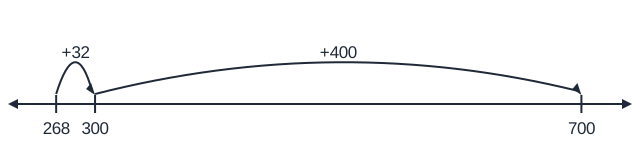
Ivy works out \(700 - 268\) by counting on. The picture shows her jumps.

She says the answer is 432.

Is Ivy right? How do you know?

Now work out \(600 - 345\)

An empty number line with marks at 268, 300 and 700. A jump marked +32 goes from 268 to 300. A jump marked +400 goes from 300 to 700.

Model answer

Yes. \(268 + 32 = 300\) and \(300 + 400 = 700\). Her jumps add up to \(32 + 400 = 432\).
\(345 + 55 = 400\)
\(400 + 200 = 600\)
\(55 + 200 = 255\)

Explanation

Counting on finds the gap between two numbers. The jumps from 268 to 700 add up to 432, so the gap is 432. With 700 and 600, counting on avoids two exchanges across zeros. A common mistake is to forget to add up the jumps.

Mark scheme
  1. 1 mark

    Yes, with a relevant but incomplete reason, for example "she counted on"

    Yes alone scores 0.

  2. 1 mark

    A complete correct reason: the jumps add up to 432 (\(32 + 400\)), and they go from 268 to 700; or checking with an addition, \(432 + 268 = 700\)

    A complete correct reason on its own scores both of these marks.

  3. 1 mark

    A correct method (column method, partitioning, counting on, or a number line) with no more than one arithmetic error for 600 - 345; or the correct answer 255 with no working

    Pupils type their working, so any clear record counts, for example counting on "345 + 55 = 400, 400 + 200 = 600, 55 + 200 = 255" or "Ones: 10 - 5 = 5, Tens: 9 - 4 = 5, Hundreds: 5 - 3 = 2". A column layout is not needed.

  4. 1 mark

    255

    A correct answer with no working scores both of the last two marks.

Ready to try the rest? Tap your answers and see straight away how you did.

Topic notes

Column subtraction

The big idea

Column subtraction is a way to take away bigger numbers on paper. Write the bigger number on top. Write the number you are taking away under it. Then work one column at a time.

Start with partitioning

To partition a number means to split it into hundreds, tens and ones. You can take away one part at a time. For \(586 - 243\), take away 200, then 40, then 3: 386, 346, 343. Columns are shorter to write.

Subtracting column by column

Each digit is one of the signs 0 to 9. It goes in a column: hundreds (H), tens (T) or ones (O).

  1. Line up the ones under the ones and the tens under the tens.
  2. Start with the ones. Take the bottom digit away from the top digit.
  3. Move left: the tens, then the hundreds.

A tree has 586 leaves. Then 243 leaves fall off. How many are left?

\[ \begin{array}{cccc} & \text{H} & \text{T} & \text{O} \\ & 5 & 8 & 6 \\ - & 2 & 4 & 3 \\ \hline & 3 & 4 & 3 \end{array} \]

Ones: \(6 - 3 = 3\). Tens: \(8 - 4 = 4\). Hundreds: \(5 - 2 = 3\).

There are 343 leaves left.

Exchanging

Sometimes the top digit is too small. You cannot take 8 from 2. Then you exchange: take 1 from the column on the left, and turn it into 10 in your column. 1 ten becomes 10 ones, and 1 hundred becomes 10 tens. Some people call this borrowing.

Cross out the digit you took from, and write the new digit above it. Write a small 1 in front of the digit that gets the extra 10.

A baker makes 472 buns. She sells 138. How many buns are left?

\[ \begin{array}{cccc} & & {\scriptsize 6} & \\ & 4 & \cancel{7} & {}^{1}2 \\ - & 1 & 3 & 8 \\ \hline & 3 & 3 & 4 \end{array} \]

Ones: you cannot take 8 from 2. Exchange 1 ten for 10 ones. The 7 tens become 6 tens, and the 2 ones become 12. Then \(12 - 8 = 4\).

Tens: \(6 - 3 = 3\). Hundreds: \(4 - 1 = 3\).

There are 334 buns left.

Sometimes you must exchange twice.

A school has 641 children. 286 go on a trip. How many stay at school?

\[ \begin{array}{cccc} & {\scriptsize 5} & {\scriptsize {}^{1}3} & \\ & \cancel{6} & \cancel{4} & {}^{1}1 \\ - & 2 & 8 & 6 \\ \hline & 3 & 5 & 5 \end{array} \]

Ones: exchange 1 ten for 10 ones. The 4 tens become 3 tens, and \(11 - 6 = 5\).

Tens: you cannot take 8 from 3. Exchange 1 hundred for 10 tens. The 6 hundreds become 5, and \(13 - 8 = 5\).

Hundreds: \(5 - 2 = 3\).

355 children stay at school.

Finding a difference

The difference is how far apart two numbers are. Take the smaller number from the larger one. When the numbers are close, counting on is quicker. For \(704 - 689\), count on 11 to reach 700, then 4 more. The difference is \(11 + 4 = 15\).

Checking and missing digits

Addition undoes subtraction. To check, add your answer to the number you took away. You should get the top number: \(355 + 286 = 641\).

For a missing digit, look at one column at a time. In \(685 - 2\square 3 = 452\), the tens column must give 5. \(8 - 3 = 5\), so the missing digit is 3.

Stretch: exchanging across a zero

A 0 has nothing to give. Go to the next column on the left instead. The 0 gets 10, then gives 1 away, so it is left as 9.

A farm has 503 sheep. 276 are in the top field. The rest are in the bottom field. How many is that?

\[ \begin{array}{cccc} & {\scriptsize 4} & {\scriptsize 9} & \\ & \cancel{5} & \cancel{0} & {}^{1}3 \\ - & 2 & 7 & 6 \\ \hline & 2 & 2 & 7 \end{array} \]

You cannot take 6 from 3, and the tens digit is 0. So go to the hundreds. The 5 hundreds become 4. The tens become 10, then 9, and the ones become 13.

Now subtract: \(13 - 6 = 7\), \(9 - 7 = 2\) and \(4 - 2 = 2\).

There are 227 sheep in the bottom field.

Common mistakes

  • Taking the smaller digit from the bigger one in every column. \(472 - 138\) is 334, not 346.
  • Forgetting that the column you took from now has 1 less. Using 7 tens instead of 6 gives 344.
  • Leaving a 0 as 10 after exchanging across it. Once it gives 1 away, it is 9.

Top tip

Cross out neatly and write each new digit small. Then you can see every exchange.

Study Helper Hints first, answers after you try

Stuck on this one? Ask for a hint and I’ll point you in the right direction, without giving the answer away. Once you’ve checked your answer, I’ll show you how the marks are awarded.