Level:
Correct: 0
Incorrect: 0
Marks: 0/0
Practice
Course:
Topics:
Year 3 Maths Smart practice A mixed round aimed at your weak spots
Unit 1
Place value
Unit 2
Addition and subtraction
Unit 3
Multiplication and division
Unit 4
Fractions
Unit 5
Measurement
Unit 6
Geometry
Unit 7
Statistics
Statistics
Pictograms
Quick practice5 skills
Bar charts
Quick practice6 skills
Tables
Quick practice5 skills
Avg
score:
–
Topics
done:
0/36

Money

Practise 24 questions on Money for Year 3 Maths. Tap your answer and find out straight away if you are right, with the Study Helper on hand if you get stuck.

  • 24 questions
  • 1–4 marks each
  • Instant marking
  • No sign-up needed
20 questions, marked as you go

Sample questions with model answers

Here are 4 of the questions in this topic, each with a model answer, an explanation of why it earns the marks and the mark scheme.

Question 1

1 mark

A pencil costs 45p. A rubber costs 35p.

What is the total cost?

Model answer

\(45 + 35 = 80\)
The total cost is 80p.

Explanation

Total means add the prices. Add the tens: \(40 + 30 = 70\). Add the ones: \(5 + 5 = 10\). Then \(70 + 10 = 80\), so the total is 80p. A common mistake is to find the difference instead of adding.

Mark scheme
  1. 1 mark

    80p

    Accept 80, 80 pence, £0.80 or 0.80. Do not accept 10p (the difference) or 70p (5 and 5 not carried).

Question 2

2 marks

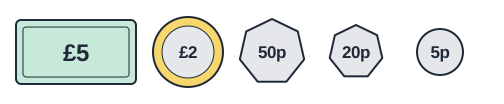
The picture shows some money.

How much money is there altogether?

A £5 note, a £2 coin, a 50p coin, a 20p coin and a 5p coin.

Model answer

Pounds: \(5 + 2 = 7\), so £7.
Pence: \(50 + 20 + 5 = 75\), so 75p.
£7 and 75p

Explanation

Add the pounds and the pence on their own. The note and the big coin make £7. The three small coins make 75p. A common mistake is to add 5, 2, 50, 20 and 5 as if they were all the same kind of money.

Mark scheme
  1. 1 mark

    The pounds added to make £7, or the pence added to make 75p; or the correct answer £7 and 75p with no working

  2. 1 mark

    £7 and 75p

    Accept £7 75p, 775p, £7.75, 7.75 or 7 pounds 75. Do not accept 5 (counting the items) or £82 (all the numbers added as pounds). A correct answer with no working scores full marks.

Question 3

2 marks

Luca wants to make 38p with the fewest coins he can.

How many coins does he need?

Model answer

Use the biggest coin that fits each time.
20p leaves 18p.
10p leaves 8p.
5p leaves 3p.
2p leaves 1p.
1p leaves 0p.
That is 5 coins.

Explanation

To use the fewest coins, always pick the biggest coin that still fits. That gives 20p, 10p, 5p, 2p and 1p, which is 5 coins. A common mistake is to use three 10p coins, which needs an extra coin.

Mark scheme
  1. 1 mark

    Any set of coins that makes exactly 38p, for example 20p, 10p, 5p, 2p and 1p; or the correct answer 5 coins with no working

    The set does not have to be the fewest for this mark.

  2. 1 mark

    5 coins (20p, 10p, 5p, 2p and 1p)

    Accept 5 with or without the list of coins. Do not accept 6 or more. A correct answer with no working scores full marks.

Question 4

4 marks

Zara has only 5p and 10p coins.
She can use one kind of coin or both kinds.

Find all the ways she can make exactly 30p.

Model answer

Start with as many 10p coins as you can.
10p, 10p, 10p
10p, 10p, 5p, 5p
10p, 5p, 5p, 5p, 5p
5p, 5p, 5p, 5p, 5p, 5p
There are 4 ways.

Explanation

Work in order so you do not miss a way. Start with three 10p coins. Then swap one 10p coin for two 5p coins each time, until you have only 5p coins. A common mistake is to write the same coins in a new order and count it as a new way.

Mark scheme
  1. 1 mark

    One correct way. There are 4 ways in all: three 10p coins; two 10p coins and two 5p coins; one 10p coin and four 5p coins; six 5p coins.

    Ways may be written in any order and in any clear form, for example 10 + 10 + 10. The same coins in a different order are the same way, and earn no extra mark.

  2. 1 mark

    A second correct way

  3. 1 mark

    A third correct way

  4. 1 mark

    The fourth correct way

    Take off 1 mark for each way listed that does not make 30p, down to a lowest score of 0. Max 4.

Ready to try the rest? Tap your answers and see straight away how you did.

Topic notes

Money

The big idea

We pay for things with coins and notes. We count money in pounds (£) and pence (p). There are 100 pence in every pound, so £1 = 100p.

Coins and notes

MoneyValues
Coins1p, 2p, 5p, 10p, 20p, 50p, £1, £2
Notes£5, £10, £20, £50

To count some money, add the values of the coins, not how many coins there are. Start with the coins worth the most. So a £2 coin, a 50p coin and a 5p coin make £2 and 55p.

Pounds and pence

We can write the same money in two ways. We can use pounds and pence, like £3 and 45p. Or we can use only pence, like 345p.

  • Pounds to pence: £3 is 300p. Then \(300 + 45 = 345\), so £3 and 45p is 345p.
  • Pence to pounds: split it into hundreds and the rest. 407p is 400p and 7p, so it is £4 and 7p.

Watch the zero. £4 and 7p is 407p, not 47p and not 470p.

Adding money

Write the amounts in pence and add them. Then swap each 100p for £1.

At the school fair, Lee spends 60p on a cake, 90p on a game and 75p on a badge. How much does he spend altogether?

Add the first two: \(60 + 90 = 150\)

Add the badge: \(150 + 75 = 225\)

He spends 225p. Split it into 200p and 25p.

That is £2 and 25p.

Giving change

Change is the money you get back when you pay with too much. To find it, count on from the price to the money you paid. Use easy jumps. Go to the next 10p or the next whole pound first.

A sweet costs 35p and you pay with a 50p coin. From 35p to 40p is 5p. From 40p to 50p is 10p. So the change is 15p.

Three boxes joined by arrows. £6 and 70p goes to £7 with a jump of 30p. Then £7 goes to £10 with a jump of £3.
Counting on from £6 and 70p to £10. The jumps are 30p and £3.

A comic costs £6 and 70p. Ana pays with a £10 note. The shopkeeper gives her £4 and 30p change. Is that right?

Count on from the price. From £6 and 70p to £7 is 30p.

From £7 to £10 is £3.

So the change should be £3 and 30p.

No, it is not right. The shopkeeper has given her £1 too much.

Check your answer: 670p and 330p make 1,000p, which is £10.

Comparing prices

To compare, write both prices in pence. The smaller number is cheaper. Do not just look at the numbers you can see: 99p is less than £1, because £1 is 100p.

A pen costs 45p. A pack of 3 pens costs £1 and 25p. Is it cheaper to buy the pack or 3 single pens? How much cheaper?

Find the cost of 3 single pens: \(45 + 45 + 45 = 135\), so they cost 135p.

Write the pack in pence: £1 and 25p is 125p.

125p is less than 135p, so the pack is cheaper.

Take away: \(135 - 125 = 10\). It is 10p cheaper.

Shopping problems

Some problems have more than one step. Work out one step at a time. Then check what the question is asking.

Sam has £5. He buys a sandwich for £2 and 60p and a juice for 95p. Does he have enough left for an ice cream that costs £1 and 50p?

Add the prices: \(260 + 95 = 355\). So he spends 355p, which is £3 and 55p.

Count on to £5. From £3 and 55p to £4 is 45p. From £4 to £5 is £1.

He has £1 and 45p left. That is 145p.

The ice cream is 150p, and 145p is less. No, he does not have enough. He needs 5p more.

Remember

  • £1 = 100p
  • £3 and 45p is the same as 345p.
  • Find change by counting on from the price.

Common mistakes

  • Counting the coins and not their values. Three 20p coins make 60p, not 3p.
  • Writing the pence in the wrong place. 506p is £5 and 6p, not £5 and 60p.
  • Writing too many pounds. 600p is £6, not £60.
  • Counting a pound too many. From £2 and 40p to £3 is only 60p. So a £2 and 40p book paid for with £3 gives 60p change, not £1 and 60p.
  • Stopping too soon. Find the total first, and then the change.

Top tip

Check your change by adding it to the price. You should get back to the money that was paid.

Study Helper Hints first, answers after you try

Stuck on this one? Ask for a hint and I’ll point you in the right direction, without giving the answer away. Once you’ve checked your answer, I’ll show you how the marks are awarded.