Practise 20 questions on Mass for Year 3 Maths. Tap your answer and find out straight away if you are right, with the Study Helper on hand if you get stuck.
20 questions
1–4 marks each
Instant marking
No sign-up needed
20 questions, marked as you go
Sample questions with model answers
Here are 4 of the questions in this topic, each with a model answer, an explanation of why it earns the marks and the mark scheme.
Question 1
1 mark
Which of these has a mass of about 5 grams?
Model answer
A grape.
Explanation
A gram is very light, so 5 grams must be something very small. A grape is the only one that small. A common mistake is to choose the bag of potatoes, because it is the smallest of the other things, but it is still several kilograms.
Mark scheme
1 mark
a grape
Do not accept any other choice: they are all far too heavy and would be weighed in kilograms.
Question 2
2 marks
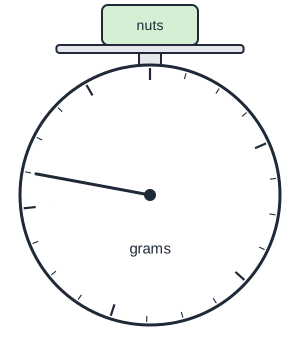
The picture shows a bag of nuts on a weighing scale.
How many grams does each small step on the dial show?
What is the mass of the nuts?
Model answer
There are 4 small steps from 80 to 100, and 20 g shared into 4 steps is 5 g. Each small step shows 5 g. The needle is 1 step past 80, so the mass is 85 g.
Explanation
The numbers go up in 20s, and there are 4 small steps between them. So each step is 5 g, because 4 lots of 5 make 20. The needle is 1 step past 80, which is 85 g. A common mistake is to think each small step is 1 g and say 81.
Mark scheme
1 mark
Each small step shows 5 g
Accept 5 with or without the unit.
1 mark
85 g
Accept 85 with or without the unit. Do not accept 81 (counting each step as 1 g). Mark the two answers separately: 85 g earns this mark even if the step size given is wrong.
Question 3
2 marks
Kai says, "500 g is heavier than 2 kg, because 500 is bigger than 2."
Is Kai right? How do you know?
Model answer
No. 2 kg is the same as 2,000 g. 2,000 g is heavier than 500 g.
Explanation
You can only compare the numbers when the units are the same. Write 2 kg in grams, and you get 2,000 g, which is much more than 500 g. A common mistake is to look at the numbers and forget the units.
Mark scheme
1 mark
Says No, with a reason that is relevant but not complete, e.g. "you have to look at the units" or "kilograms are heavier than grams"
No alone scores 0. "Because 2 kg is bigger" with nothing else scores 0.
1 mark
A complete reason: 2 kg is the same as 2,000 g, and 2,000 g is heavier than 500 g / 500 g is less than 1 kg, so it is lighter than 2 kg
A complete correct reason on its own scores both marks.
Question 4
4 marks
Rosa has one 100 g weight, one 200 g weight and one 500 g weight. She puts two or three of them on a scale.
Find all the total masses she can make.
Model answer
\(100 + 200 = 300\) \(100 + 500 = 600\) \(200 + 500 = 700\) \(100 + 200 + 500 = 800\) The totals are 300 g, 600 g, 700 g and 800 g.
Explanation
Work in order, so you do not miss one. First try each pair of weights, which gives 3 totals. Then use all three weights together. A common mistake is to forget the total that uses all three.
Mark scheme
1 mark
300 g
There are 4 totals in all, each worth 1 mark, in any order. 100 g + 200 g.
1 mark
600 g
100 g + 500 g.
1 mark
700 g
200 g + 500 g.
1 mark
800 g
100 g + 200 g + 500 g. Max 3 marks if the list also has a wrong total. Ignore 100 g, 200 g or 500 g on their own.
Ready to try the rest? Tap your answers and see straight away how you did.
Ctrl + Enter to check
Study HelperHints first, answers after you try
Stuck on this one? Ask for a hint and I’ll point you in the right direction, without giving the answer away. Once you’ve checked your answer, I’ll show you how the marks are awarded.