Level:
Correct: 0
Incorrect: 0
Marks: 0/0
Practice
Course:
Topics:
Year 3 Maths Smart practice A mixed round aimed at your weak spots
Unit 1
Place value
Unit 2
Addition and subtraction
Unit 3
Multiplication and division
Unit 4
Fractions
Unit 5
Measurement
Unit 6
Geometry
Unit 7
Statistics
Statistics
Pictograms
Quick practice5 skills
Bar charts
Quick practice6 skills
Tables
Quick practice5 skills
Avg
score:
–
Topics
done:
0/36

Capacity and volume

Practise 19 questions on Capacity and volume for Year 3 Maths. Tap your answer and find out straight away if you are right, with the Study Helper on hand if you get stuck.

  • 19 questions
  • 1–4 marks each
  • Instant marking
  • No sign-up needed
19 questions, marked as you go

Sample questions with model answers

Here are 4 of the questions in this topic, each with a model answer, an explanation of why it earns the marks and the mark scheme.

Question 1

1 mark

Which of these holds about 1 litre?

Model answer

A large bottle of juice.

Explanation

A litre is about as much as a large bottle of juice holds. A teaspoon holds about 5 ml, and a bath holds many litres. A common mistake is to choose the mug, which holds only about 300 ml.

Mark scheme
  1. 1 mark

    a large bottle of juice

    Do not accept a mug (it holds only about 300 ml), a teaspoon or a bath.

Question 2

2 marks

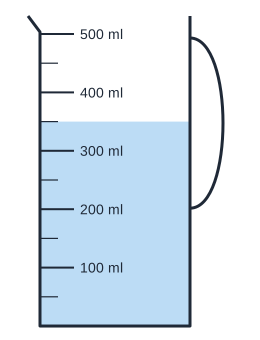
The picture shows a jug of water.

How much water is in the jug?

Jade pours in 100 ml more. How much water is in the jug now?

A measuring jug marked from 100 ml to 500 ml, with a numbered line every 100 ml and a small line halfway between each pair of numbers. The jug has some water in it, and the top of the water is level with one of the small lines.

Model answer

Each small step is 50 ml. The water is 1 step past 300, so there is 350 ml.
\(350 + 100 = 450\)
There is 450 ml in the jug now.

Explanation

There are 2 small steps between the numbers, so each step is 50 ml. The water is at 350 ml. Adding 100 ml makes 450 ml. A common mistake is to read the halfway line as 305 instead of 350.

Mark scheme
  1. 1 mark

    350 ml

    Accept 350 with or without the unit. Do not accept 305 or 35.

  2. 1 mark

    450 ml

    Accept 450 with or without the unit. Allow a wrong reading plus 100, worked out correctly.

Question 3

2 marks

Ravi says, "1 l 50 ml is the same as 1,500 ml."

Is Ravi right? How do you know?

Model answer

No. 1 l = 1,000 ml
\(1{,}000 + 50 = 1{,}050\)
So 1 l 50 ml is 1,050 ml, not 1,500 ml.

Explanation

Change the litre to 1,000 ml, then add the 50 ml. That makes 1,050 ml. The number 1,500 has 5 hundreds, but 50 ml has only 5 tens. A common mistake is to write the 50 straight after the 1 and add a zero.

Mark scheme
  1. 1 mark

    Says No, with a reason that is relevant but not complete, e.g. "1 l is 1,000 ml" or "the 50 ml is not 500 ml"

    No alone scores 0.

  2. 1 mark

    A complete reason: 1 l 50 ml is 1,050 ml, not 1,500 ml / 1,500 ml is 1 l 500 ml

    A complete correct reason on its own scores both marks.

Question 4

4 marks

Jo needs exactly 1 litre of water. She has only 250 ml cups and 500 ml bottles. She fills each one to the top.

Find all the ways to make 1 litre.

Model answer

1 litre = 1,000 ml
\(500 + 500 = 1{,}000\), so 2 bottles.
\(500 + 250 + 250 = 1{,}000\), so 1 bottle and 2 cups.
\(250 + 250 + 250 + 250 = 1{,}000\), so 4 cups.

Explanation

Work in order so that you do not miss a way. Start with as many bottles as you can, then swap a bottle for 2 cups, because 2 cups hold 500 ml. A common mistake is to forget the ways that use only cups or only bottles.

Mark scheme
  1. 1 mark

    2 bottles (and no cups)

    There are 3 ways in all. The ways can be in any order.

  2. 1 mark

    1 bottle and 2 cups

  3. 1 mark

    4 cups (and no bottles)

  4. 1 mark

    All three ways listed with no wrong way added

    If the list has a way that does not make exactly 1,000 ml, this mark is lost. Accept sums such as \(500 + 250 + 250\) as a way of writing 1 bottle and 2 cups.

Ready to try the rest? Tap your answers and see straight away how you did.

Topic notes

Capacity and volume

The big idea

Capacity is how much a container can hold when it is full. Volume is how much liquid is in it now.

Millilitres and litres

We use two units. A unit is the size we count in.

  • A millilitre (ml) is tiny. A teaspoon holds about 5 ml.
  • A litre (l) is much more. A big carton of milk holds about 1 l.

1 l = 1,000 ml

Mixed units means using two units together, like 2 l 300 ml. To write this in millilitres, change 2 l to 2,000 ml. Then add the 300 ml. So 2 l 300 ml = 2,300 ml.

To go back, take out 1,000 ml for each litre. So 1,600 ml = 1 l 600 ml.

A glass can hold 300 ml, and it is full of water. A bucket can hold 5 l, but it has only 200 ml of water in it. Which has the bigger capacity? Which has more water in it now?

Capacity is how much each one can hold. The bucket can hold 5 l, which is 5,000 ml. The glass can hold only 300 ml. So the bucket has the bigger capacity.

Volume is how much water is in each one now. The glass is full, so it has 300 ml. The bucket has only 200 ml.

So the glass has more water, even though it is much smaller.

Reading a measuring jug

A measuring jug or a tall measuring cylinder has lines on its side. Look at the top of the water. Then read the line it reaches.

First work out what each small step is worth.

The numbers go up inSmall steps between themEach small step is
100 ml1010 ml
50 ml510 ml
100 ml250 ml
500 ml5100 ml

Some jugs have only a line for each 250 ml. They go 250 ml, 500 ml, 750 ml, 1,000 ml.

The side of a measuring jug from 0 to 400 millilitres, numbered in 100s, with 10 small steps between the numbers. Arrow A points to 230 ml.
Arrow A shows the top of the water. Each small step is 10 ml. Arrow A is 3 steps past 200, so the jug holds 230 ml.

Comparing amounts

To compare, write the amounts in the same unit first.

Look at 2 l, 1,900 ml and 2 l 150 ml. In millilitres they are 2,000 ml, 1,900 ml and 2,150 ml. So in order, starting with the biggest, they are 2 l 150 ml, 2 l and 1,900 ml.

A red watering can holds 2 l 300 ml. A blue one holds 2,030 ml. Which one holds more? How much more?

Write the red can in millilitres: 2 l 300 ml is 2,300 ml.

2,300 ml is more than 2,030 ml, so the red can holds more.

Count on from 2,030: 70 to reach 2,100, then 200 more to reach 2,300.

\(70 + 200 = 270\), so it holds 270 ml more.

Adding and taking away

Write the amounts in millilitres. Add or take away. If you are asked for litres and millilitres, change the answer back.

A fruit punch uses 1 l of orange juice, 450 ml of apple juice and 750 ml of lemonade. How much punch does it make?

The orange juice is 1,000 ml.

Add the apple juice: \(1{,}000 + 450 = 1{,}450\).

Add the lemonade: \(1{,}450 + 750 = 2{,}200\).

Take out 2,000 ml to make 2 l. That leaves 200 ml.

It makes 2 l 200 ml of punch.

Kim needs 1 l 100 ml of water for some soup. Her measuring jug holds 400 ml. How can she measure the water with this jug?

Write the amount in millilitres: 1,100 ml.

Two full jugs make \(400 + 400 = 800\) ml.

She still needs \(1{,}100 - 800 = 300\) ml.

She should use 2 full jugs, then fill the jug to the 300 ml line.

Remember

  • Capacity is how much a container can hold. Volume is how much is in it now.
  • 1 l = 1,000 ml
  • Find what each small step is worth before you read a jug.

Common mistakes

  • Mixing up capacity and volume. A half-full 600 ml jug still has a capacity of 600 ml.
  • Using 100 in place of 1,000. 4 l is 4,000 ml, not 400 ml.
  • Losing the zero in mixed units. 2 l 40 ml is 2,040 ml, not 2,400 ml.
  • Counting each small step as 1 ml. Work out each step first.

Top tip

Crouch down so your eyes are level with the top of the water. Then you can read the line properly.

Study Helper Hints first, answers after you try

Stuck on this one? Ask for a hint and I’ll point you in the right direction, without giving the answer away. Once you’ve checked your answer, I’ll show you how the marks are awarded.