
Level:
Correct: 0
Incorrect: 0
Marks: 0/0
Exam Practice
Course:
Topics:
AQA Level 2 Further Maths (Calculator) Smart practice A mixed round aimed at your weak spots
Unit 1
Number
Unit 2
Algebra
Unit 3
Coordinate Geometry (2 dimensions only)
Unit 4
Calculus
Unit 5
Matrix Transformations
Unit 6
Geometry
Avg
score:
–
Topics
done:
0/43

Using ratio to find the coordinates of a point on a line

Practise 15 exam-style questions on Using ratio to find the coordinates of a point on a line for AQA Level 2 Further Maths (Calculator). Write your answer as you would in the exam and get it marked in seconds against the mark scheme, point by point, with the Study Helper on hand if you get stuck.

  • 15 questions
  • 1–6 marks each
  • Instant marking
  • No sign-up needed
15 questions, marked as you go

Sample questions with model answers

Here are 4 of the questions in this topic, each with a model answer, an explanation of why it earns the marks and the mark scheme an examiner would use.

Question 1

1 mark

A and B are two points.
P lies on the line segment AB such that AP : PB = 2 : 3

What fraction of the length AB is the length AP?

Choose your answer.

  • \(\dfrac{2}{3}\)
  • \(\dfrac{2}{5}\)
  • \(\dfrac{3}{5}\)
  • \(\dfrac{3}{2}\)

Model answer

AB is split into \(2 + 3 = 5\) equal parts.
AP is 2 of these parts.
AP \(= \dfrac{2}{5}\) of AB

Explanation

A ratio AP : PB = 2 : 3 splits AB into 2 + 3 = 5 equal parts, and AP is 2 of them, so AP is 2/5 of AB. This fraction is the multiplier used on the change in x and in y to find P. A common error is to write the ratio 2 : 3 as the fraction 2/3.

Mark scheme
  1. 1 mark

    B1 for \(\dfrac{2}{5}\)

    \(\dfrac{2}{3}\) writes the ratio as a fraction, \(\dfrac{3}{5}\) is PB as a fraction of AB and \(\dfrac{3}{2}\) is AP : PB inverted: all B0.
Question 2

3 marks

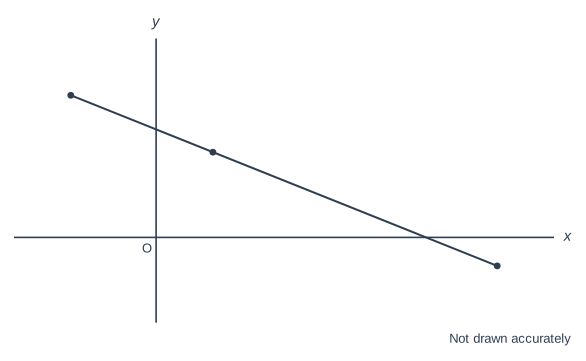
The diagram shows the points A \((2, 3)\) and B \((12, -1)\)
The line BA is extended beyond A to the point C.
The \(x\)-coordinate of C is \(-3\)

Work out the \(y\)-coordinate of C.
Work out the ratio CA : AB, giving your answer in its simplest form.

A sketch on a pair of axes (x across, y up) with no scale marked, the axes crossing at the origin O. It is marked "Not drawn accurately". Point A is marked with a dot at (2, 3). Point B is marked with a dot at (12, −1). Point C is marked with a dot; its coordinates cannot be read off, as the sketch has no scale. A straight line segment joins C to B (12, −1).

Model answer

Gradient of AB \(= \dfrac{-1 - 3}{12 - 2} = \dfrac{-4}{10} = -0.4\)
From A to C the change in \(x\) is \(-3 - 2 = -5\)
So the change in \(y\) is \(-0.4 \times (-5) = 2\), and the \(y\)-coordinate of C is \(3 + 2 = 5\)
C to A is 5 across and A to B is 10 across, so CA : AB \(= 5 : 10 = 1 : 2\)

Explanation

C is on the same straight line, so the step from A to C has the same gradient, −0.4, as AB; going 5 to the left from A means going up 2. Lengths along one straight line are in the same ratio as the steps in x, so CA : AB = 5 : 10 = 1 : 2. A common error is a sign slip with the step to the left, giving y = 1.

Mark scheme
  1. 1 mark

    M1 for gradient of AB \(= \dfrac{-1 - 3}{12 - 2}\) or \(-0.4\) oe

    oe eg \(-\dfrac{4}{10}\) or \(-\dfrac{2}{5}\), or the equation of the line, eg \(y - 3 = -0.4(x - 2)\) or \(y = -0.4x + 3.8\), or the steps from A to B, 10 across and 4 down, used in proportion

  2. 1 mark

    A1 for \(y = 5\)

    eg from \(3 + (-0.4) \times (-5)\) or \(3 + \dfrac{5}{10} \times 4\). Accept C \((-3, 5)\). \(y = 1\) (a sign error, \(3 - 2\)) is M1A0.

  3. 1 mark

    B1 for CA : AB = 1 : 2

    eg from the steps in \(x\): C to A is 5 and A to B is 10. Accept from lengths \(\sqrt{29} : \sqrt{116}\) simplified to 1 : 2. \(5 : 10\) (not simplified) or \(2 : 1\) (reversed) is B0. A fully correct answer with no working scores full marks.

Question 3

4 marks

A is the point \((1, 8)\) and B is the point \((9, -2)\)
P lies on AB such that AP : PB = 2 : 3
O is the origin.

Work out the length of OP.

Model answer

P is \(\dfrac{2}{5}\) of the way from A to B.
\(x = 1 + \dfrac{2}{5} \times (9 - 1) = 1 + 3.2 = 4.2\)
\(y = 8 + \dfrac{2}{5} \times (-2 - 8) = 8 - 4 = 4\)
P is \((4.2, 4)\)
\(OP = \sqrt{4.2^2 + 4^2} = \sqrt{17.64 + 16} = \sqrt{33.64}\)
\(OP = 5.8\)

Explanation

First find P, which is 2/5 of the way from A to B, then use Pythagoras for its distance from the origin: the changes in x and y from O are just the coordinates of P. A common error is to use 2/3 of the way, treating 2 : 3 as a fraction.

Mark scheme
  1. 1 mark

    M1 for \(\dfrac{2}{5} \times (9 - 1)\) or 3.2 or \(\dfrac{2}{5} \times (-2 - 8)\) or \(-4\)

    oe eg \(1 + \dfrac{2}{5} \times 8\). Using \(\dfrac{2}{3}\) of the change (giving \(\left(\dfrac{19}{3}, \dfrac{4}{3}\right)\)) is M0A0.

  2. 1 mark

    A1 for P \((4.2, 4)\)

    accept x = 4.2, y = 4

  3. 1 mark

    M1 for \(4.2^2 + 4^2\) oe or 33.64

    ft their P. oe eg \(\sqrt{(4.2 - 0)^2 + (4 - 0)^2}\)

  4. 1 mark

    A1 for 5.8

    accept \(\sqrt{33.64}\) only if evaluated to 5.8. ±5.8 on the answer line is A0. A fully correct answer with no working scores full marks.

Question 4

5 marks

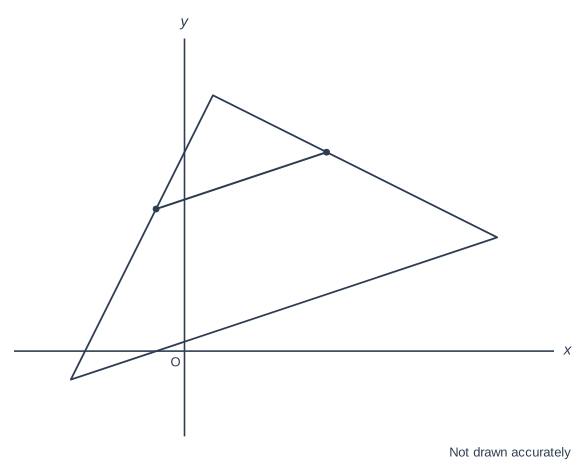
The diagram shows triangle ABC.
A is the point \((1, 9)\), B is the point \((-4, -1)\) and C is the point \((11, 4)\)
P lies on AB such that AP : PB = 2 : 3
Q lies on AC such that AQ : QC = 2 : 3

Show that PQ is parallel to BC.
Show that the length of PQ is 0.4 times the length of BC.

A sketch on a pair of axes (x across, y up) with no scale marked, the axes crossing at the origin O. It is marked "Not drawn accurately". Triangle ABC (unshaded) is drawn with vertices A(1, 9), B(−4, −1) and C(11, 4). Point P is marked with a dot; its coordinates cannot be read off, as the sketch has no scale. Point Q is marked with a dot; its coordinates cannot be read off, as the sketch has no scale. A straight line segment joins P to Q.

Model answer

P is \(\dfrac{2}{5}\) of the way from A to B: \(x = 1 + \dfrac{2}{5} \times (-5) = -1\) and \(y = 9 + \dfrac{2}{5} \times (-10) = 5\), so P is \((-1, 5)\)
Q is \(\dfrac{2}{5}\) of the way from A to C: \(x = 1 + \dfrac{2}{5} \times 10 = 5\) and \(y = 9 + \dfrac{2}{5} \times (-5) = 7\), so Q is \((5, 7)\)
Gradient of PQ \(= \dfrac{7 - 5}{5 - (-1)} = \dfrac{2}{6} = \dfrac{1}{3}\)
Gradient of BC \(= \dfrac{4 - (-1)}{11 - (-4)} = \dfrac{5}{15} = \dfrac{1}{3}\)
The gradients are equal, so PQ is parallel to BC.
\(PQ = \sqrt{6^2 + 2^2} = \sqrt{40} = 2\sqrt{10}\)
\(BC = \sqrt{15^2 + 5^2} = \sqrt{250} = 5\sqrt{10}\)
\(\dfrac{PQ}{BC} = \dfrac{2\sqrt{10}}{5\sqrt{10}} = \dfrac{2}{5} = 0.4\), so PQ is 0.4 times the length of BC.

Explanation

P and Q are each 2/5 of the way from A along their sides, so find them with the ratio, then compare the gradients for the parallel lines and the lengths for the scale factor. This is a coordinate proof of the similar triangles fact: triangle APQ is an enlargement of triangle ABC with scale factor 2/5. A common error is to use 2/3 of the way, treating the ratio as a fraction.

Mark scheme
  1. 1 mark

    M1 for P \((-1, 5)\) or Q \((5, 7)\)

    eg \(1 + \dfrac{2}{5} \times (-5)\) and \(9 + \dfrac{2}{5} \times (-10)\)

  2. 1 mark

    A1 for P \((-1, 5)\) and Q \((5, 7)\)

  3. 1 mark

    B1 for gradient of PQ \(= \dfrac{1}{3}\) and gradient of BC \(= \dfrac{1}{3}\) and a statement that they are parallel

    oe eg \(\dfrac{2}{6}\) and \(\dfrac{5}{15}\). Alternative: the step from P to Q is 6 across and 2 up, and the step from B to C is 15 across and 5 up \(= 2.5 \times\) (6 across and 2 up), so PQ is parallel to BC and PQ \(= \dfrac{1}{2.5}\) BC \(= 0.4\) BC: B1, M1, A1.

  4. 1 mark

    M1 for \(PQ = \sqrt{6^2 + 2^2} = \sqrt{40}\) and \(BC = \sqrt{15^2 + 5^2} = \sqrt{250}\)

    oe eg \(2\sqrt{10}\) and \(5\sqrt{10}\), or \(PQ^2 = 40\) and \(BC^2 = 250\)

  5. 1 mark

    A1 for \(\dfrac{PQ}{BC} = \dfrac{2\sqrt{10}}{5\sqrt{10}} = 0.4\) oe, with a conclusion

    oe eg \(\sqrt{\dfrac{40}{250}} = \sqrt{0.16} = 0.4\) or \(0.4 \times 5\sqrt{10} = 2\sqrt{10}\). Decimal lengths (6.32... and 15.8...) must be shown to give exactly 0.4, eg \(\dfrac{6.3245...}{15.811...} = 0.4\). An answer that only restates the results scores 0; every step must be shown.

Ready to try the rest? Every answer you write is marked against the mark scheme, so you can see exactly where the marks are.

Study Helper Hints first, answers after you try

Stuck on this one? Ask for a hint and I’ll point you in the right direction, without giving the answer away. Once you’ve checked your answer, I’ll show you how the marks are awarded.