
Level:
Correct: 0
Incorrect: 0
Marks: 0/0
Exam Practice
Course:
Topics:
AQA Level 2 Further Maths (Calculator) Smart practice A mixed round aimed at your weak spots
Unit 1
Number
Unit 2
Algebra
Unit 3
Coordinate Geometry (2 dimensions only)
Unit 4
Calculus
Unit 5
Matrix Transformations
Unit 6
Geometry
Avg
score:
–
Topics
done:
0/43

Use and manipulation of formulae and expressions

Practise 15 exam-style questions on Use and manipulation of formulae and expressions for AQA Level 2 Further Maths (Calculator). Write your answer as you would in the exam and get it marked in seconds against the mark scheme, point by point, with the Study Helper on hand if you get stuck.

  • 15 questions
  • 1–6 marks each
  • Instant marking
  • No sign-up needed
15 questions, marked as you go

Sample questions with model answers

Here are 4 of the questions in this topic, each with a model answer, an explanation of why it earns the marks and the mark scheme an examiner would use.

Question 1

1 mark

\(k = \dfrac{m}{n^2}\), where \(n > 0\)

Which of these gives \(n\) in terms of \(k\) and \(m\)?

Choose your answer.

  • \(n = \sqrt{\dfrac{k}{m}}\)
  • \(n = \dfrac{\sqrt{m}}{k}\)
  • \(n = \sqrt{\dfrac{m}{k}}\)
  • \(n = \left(\dfrac{m}{k}\right)^2\)

Model answer

\(k = \dfrac{m}{n^2}\)
\(kn^2 = m\)
\(n^2 = \dfrac{m}{k}\)
\(n = \sqrt{\dfrac{m}{k}}\) (positive root, since \(n > 0\))

Explanation

Multiply both sides by \(n^2\) to bring it out of the denominator, divide by \(k\), then take the square root of the whole of \(\dfrac{m}{k}\). A common error is to divide the wrong way, giving \(n^2 = \dfrac{k}{m}\).

Mark scheme
  1. 1 mark

    B1 for \(n = \sqrt{\dfrac{m}{k}}\)

    or the third option clearly identified. From \(kn^2 = m\), \(n^2 = \dfrac{m}{k}\). \(\sqrt{\dfrac{k}{m}}\) inverts the fraction, \(\dfrac{\sqrt{m}}{k}\) roots only \(m\), and \(\left(\dfrac{m}{k}\right)^2\) squares instead of rooting. Do not accept a choice of answers.
Question 2

3 marks

Make \(y\) the subject of \(x = \dfrac{2y + 5}{4 - 3y}\)

Type fractions with /, for example (x + 1)/(x - 2).

Model answer

\(x(4 - 3y) = 2y + 5\)
\(4x - 3xy = 2y + 5\)
\(4x - 5 = 2y + 3xy\)
\(4x - 5 = y(2 + 3x)\)
\(y = \dfrac{4x - 5}{3x + 2}\)

Explanation

The subject appears twice, so multiply out to clear the fraction, collect both \(y\) terms on one side, then factorise out \(y\) and divide. A common error is to move a term without changing its sign, for example writing \(4x + 5 = 2y + 3xy\).

Mark scheme
  1. 1 mark

    M1 for \(x(4 - 3y) = 2y + 5\)

    oe eg \(4x - 3xy = 2y + 5\)

  2. 1 mark

    M1dep for \(4x - 5 = 2y + 3xy\)

    oe with all the \(y\) terms on one side and the other terms on the other, eg \(-3xy - 2y = 5 - 4x\)

  3. 1 mark

    A1 for \(y = \dfrac{4x - 5}{3x + 2}\)

    oe eg \(y = \dfrac{5 - 4x}{-3x - 2}\); accept typed y = (4x - 5)/(3x + 2). An answer not in the form \(y = \dots\) is A0. A fully correct answer with no working scores full marks.

Question 3

3 marks

\(p = 3x + 1\)

Express \(9x^2 + 12x\) in terms of \(p\).
Give your answer in its simplest form.

Type powers with \(\text{\textasciicircum}\), for example \(\text{x\textasciicircum 2}\).

Model answer

\(x = \dfrac{p - 1}{3}\)
\(9x^2 = 9 \times \dfrac{(p - 1)^2}{9} = (p - 1)^2\)
\(12x = 12 \times \dfrac{p - 1}{3} = 4(p - 1)\)
\(9x^2 + 12x = (p - 1)^2 + 4(p - 1)\)
\(= p^2 - 2p + 1 + 4p - 4\)
\(= p^2 + 2p - 3\)

Explanation

Make \(x\) the subject of \(p = 3x + 1\) and substitute, or notice that \(9x^2 + 12x\) is close to \((3x + 1)^2 = 9x^2 + 6x + 1\) and adjust: \(9x^2 + 12x = p^2 + 2p - 3\). Check with a value: \(x = 1\) gives \(p = 4\) and \(9 + 12 = 21 = 16 + 8 - 3\). A common error is \(9\left(\dfrac{p - 1}{3}\right)^2 = 3(p - 1)^2\), squaring only the top.

Mark scheme
  1. 1 mark

    M1 for \(x = \dfrac{p - 1}{3}\)

    oe. Alternative method: \((3x + 1)^2 = 9x^2 + 6x + 1\) seen

  2. 1 mark

    M1dep for \(9\left(\dfrac{p - 1}{3}\right)^2 + 12\left(\dfrac{p - 1}{3}\right)\) or \((p - 1)^2 + 4(p - 1)\)

    oe. Alternative method: \(9x^2 + 12x = (3x + 1)^2 + 2(3x + 1) - 3\) oe

  3. 1 mark

    A1 for \(p^2 + 2p - 3\)

    accept typed \(\text{p\textasciicircum 2 + 2p - 3}\); terms in any order; accept \((p + 3)(p - 1)\). An answer containing \(x\) is A0. A fully correct answer with no working scores full marks.

Question 4

5 marks

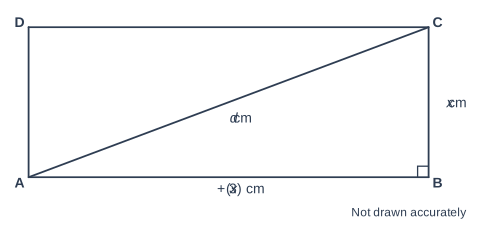
The diagram shows a rectangle.
The length of the rectangle is \((x + 3)\) cm and the width is \(x\) cm.
The length of a diagonal of the rectangle is \(d\) cm.

The solutions of \(ax^2 + bx + c = 0\), where \(a ≠ 0\), are \(x = \dfrac{-b \pm \sqrt{b^2 - 4ac}}{2a}\)

Show that \(x = \dfrac{-3 + \sqrt{2d^2 - 9}}{2}\)

The diagonal is 10 cm long.
Work out the value of \(x\).
Give your answer to 3 significant figures.

Geometry diagram, marked "Not drawn accurately". Rectangle ABCD. Line segment AC is drawn. Angle ABC is marked as a right angle (90°). Side AB is labelled (x + 3) cm. Side BC is labelled x cm. AC is labelled d cm.

Model answer

By Pythagoras' theorem, \(x^2 + (x + 3)^2 = d^2\)
\(x^2 + x^2 + 6x + 9 = d^2\)
\(2x^2 + 6x + 9 - d^2 = 0\)
\(x = \dfrac{-6 \pm \sqrt{36 - 4 \times 2 \times (9 - d^2)}}{2 \times 2} = \dfrac{-6 \pm \sqrt{8d^2 - 36}}{4}\)
\(\sqrt{8d^2 - 36} = \sqrt{4(2d^2 - 9)} = 2\sqrt{2d^2 - 9}\)
\(x = \dfrac{-6 \pm 2\sqrt{2d^2 - 9}}{4} = \dfrac{-3 \pm \sqrt{2d^2 - 9}}{2}\)
\(x\) is a length, so it is positive; \(\dfrac{-3 - \sqrt{2d^2 - 9}}{2}\) is negative, so
\(x = \dfrac{-3 + \sqrt{2d^2 - 9}}{2}\)
When \(d = 10\): \(x = \dfrac{-3 + \sqrt{191}}{2} = 5.4101...\)
\(x = 5.41\) (3 sf)

Explanation

Pythagoras' theorem gives a quadratic equation in \(x\) whose constant term contains \(d\); solving it with the formula makes \(x\) the subject. Take the factor 4 out of the square root to simplify, and reject the negative root because a length must be positive. A common error is \(c = 9 + d^2\) instead of \(9 - d^2\).

Mark scheme
  1. 1 mark

    M1 for \(x^2 + (x + 3)^2 = d^2\)

    oe Pythagoras' theorem

  2. 1 mark

    M1dep for \(2x^2 + 6x + 9 - d^2 = 0\)

    oe three-term quadratic in \(x\) with brackets expanded, eg \(2x^2 + 6x + (9 - d^2) = 0\)

  3. 1 mark

    M1dep for \(x = \dfrac{-6 \pm \sqrt{36 - 8(9 - d^2)}}{4}\)

    oe correct substitution into the quadratic formula with \(a = 2\), \(b = 6\), \(c = 9 - d^2\); or completing the square, \(\left(x + \dfrac{3}{2}\right)^2 = \dfrac{d^2}{2} - \dfrac{9}{4}\)

  4. 1 mark

    A1 for \(\sqrt{8d^2 - 36} = 2\sqrt{2d^2 - 9}\) and \(x = \dfrac{-3 + \sqrt{2d^2 - 9}}{2}\), with the negative root rejected

    the reason for rejecting \(\dfrac{-3 - \sqrt{2d^2 - 9}}{2}\) must be given, eg it is negative and \(x\) is a length. An answer that only restates the result scores 0; every step must be shown.

  5. 1 mark

    B1 for \(5.41\) [5.405, 5.415]

    accept a more accurate value in the range, eg 5.4101; premature rounding giving a value outside the range is B0. May be found from the given formula or from \(x^2 + (x + 3)^2 = 100\). \(-8.41\) given as well is B0. 5.41 with no working scores this mark only.

Ready to try the rest? Every answer you write is marked against the mark scheme, so you can see exactly where the marks are.

Study Helper Hints first, answers after you try

Stuck on this one? Ask for a hint and I’ll point you in the right direction, without giving the answer away. Once you’ve checked your answer, I’ll show you how the marks are awarded.