
Level:
Correct: 0
Incorrect: 0
Marks: 0/0
Exam Practice
Course:
Topics:
AQA Level 2 Further Maths (Calculator) Smart practice A mixed round aimed at your weak spots
Unit 1
Number
Unit 2
Algebra
Unit 3
Coordinate Geometry (2 dimensions only)
Unit 4
Calculus
Unit 5
Matrix Transformations
Unit 6
Geometry
Avg
score:
–
Topics
done:
0/43

Transformations of the unit square

Practise 16 exam-style questions on Transformations of the unit square for AQA Level 2 Further Maths (Calculator). Write your answer as you would in the exam and get it marked in seconds against the mark scheme, point by point, with the Study Helper on hand if you get stuck.

  • 16 questions
  • 1–5 marks each
  • Instant marking
  • No sign-up needed
16 questions, marked as you go

Sample questions with model answers

Here are 4 of the questions in this topic, each with a model answer, an explanation of why it earns the marks and the mark scheme an examiner would use.

Question 1

2 marks

Describe geometrically the single transformation represented by the matrix \(\begin{pmatrix} 0 & -1 \\ 1 & 0 \end{pmatrix}\)

Model answer

\(\begin{pmatrix} 0 & -1 \\ 1 & 0 \end{pmatrix}\begin{pmatrix} 1 \\ 0 \end{pmatrix} = \begin{pmatrix} 0 \\ 1 \end{pmatrix}\) and \(\begin{pmatrix} 0 & -1 \\ 1 & 0 \end{pmatrix}\begin{pmatrix} 0 \\ 1 \end{pmatrix} = \begin{pmatrix} -1 \\ 0 \end{pmatrix}\)
\((1, 0)\) on the positive x-axis goes to \((0, 1)\) on the positive y-axis: a quarter turn anticlockwise.
Rotation of 90° anticlockwise about the origin

Explanation

Look at where the matrix sends (1, 0) and (0, 1): these are its two columns. Each moves a quarter turn anticlockwise around O. A full description of a rotation needs the angle, the direction and the centre. A common error is to say clockwise, confusing this matrix with \(\begin{pmatrix} 0 & 1 \\ -1 & 0 \end{pmatrix}\).

Mark scheme
  1. 1 mark

    B1 for rotation of 90° anticlockwise

    accept rotation of +90°, or of 270° clockwise or −270°. 'Rotation of 90°' with no direction, or clockwise, is B0.

  2. 1 mark

    B1 for about the origin

    accept centre (0, 0) or O. A combination of two transformations scores B0B0. A fully correct answer with no working scores full marks.
Question 2

3 marks

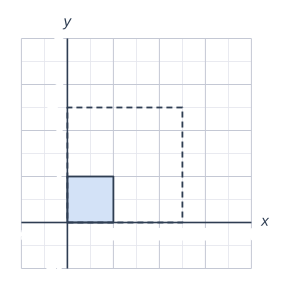
The diagram shows the unit square OABC.
The transformation represented by the matrix M maps OABC onto OA′B′C′, shown dashed.

Work out M.
Use M to work out the coordinates of the image of the point \((-2, 4)\).

Give your answer as a matrix, typed as [[a, b], [c, d]].
Give the coordinates, typed as (x, y).

A coordinate grid with x from −1 to 4 and y from −1 to 4; each grid square is 1 unit across (with 2 small squares along each side of a large square), and the axes cross at the origin O. A shaded quadrilateral with vertices (0, 0), A(1, 0), B(1, 1) and C(0, 1). An unshaded, dashed quadrilateral with vertices (0, 0), A′(2.5, 0), B′(2.5, 2.5) and C′(0, 2.5).

Model answer

M maps A\((1, 0)\) to A′\((2.5, 0)\) and C\((0, 1)\) to C′\((0, 2.5)\)
These are the columns of M: \(\mathbf{M} = \begin{pmatrix} 2.5 & 0 \\ 0 & 2.5 \end{pmatrix}\)
\(\begin{pmatrix} 2.5 & 0 \\ 0 & 2.5 \end{pmatrix}\begin{pmatrix} -2 \\ 4 \end{pmatrix} = \begin{pmatrix} -5 \\ 10 \end{pmatrix}\)
The image of \((-2, 4)\) is \((-5, 10)\)

Explanation

The first column of a transformation matrix is the image of (1, 0), here A′, and the second column is the image of (0, 1), here C′. M is an enlargement, scale factor 2.5, centre O, so it multiplies both coordinates of any point by 2.5. A common error is to use B′ as a column of the matrix.

Mark scheme
  1. 1 mark

    B1 for \(\mathbf{M} = \begin{pmatrix} 2.5 & 0 \\ 0 & 2.5 \end{pmatrix}\)

    the columns are the images of A(1, 0) and C(0, 1): (2.5, 0) and (0, 2.5). Accept \(2.5\begin{pmatrix} 1 & 0 \\ 0 & 1 \end{pmatrix}\); condone missing brackets.

  2. 1 mark

    M1 for \(\begin{pmatrix} 2.5 & 0 \\ 0 & 2.5 \end{pmatrix}\begin{pmatrix} -2 \\ 4 \end{pmatrix}\)

    ft their M; at least one entry of the product correct for their M

  3. 1 mark

    A1 for \((-5, 10)\)

    accept x = −5, y = 10. A fully correct answer with no working scores full marks.

Question 3

3 marks

The matrix \(\begin{pmatrix} 0 & -1 \\ 1 & 0 \end{pmatrix}\) maps the point \(P(a, b)\) to the point P′, where \(a\) and \(b\) are not zero.
O is the origin.

Show that OP′ is perpendicular to OP.

Model answer

\(\begin{pmatrix} 0 & -1 \\ 1 & 0 \end{pmatrix}\begin{pmatrix} a \\ b \end{pmatrix} = \begin{pmatrix} -b \\ a \end{pmatrix}\), so P′ is \((-b, a)\)
Gradient of OP \(= \dfrac{b}{a}\)
Gradient of OP′ \(= \dfrac{a}{-b} = -\dfrac{a}{b}\)
\(\dfrac{b}{a} \times \left(-\dfrac{a}{b}\right) = -1\)
The product of the gradients is −1, so OP′ is perpendicular to OP.

Explanation

Find P′ by multiplying the matrix by the column (a, b), then compare gradients from the origin: two lines are perpendicular when the product of their gradients is −1. This matrix is a rotation of 90° about O, which explains the result. A common error is to show it for one particular point only, which does not prove it for every a and b.

Mark scheme
  1. 1 mark

    M1 for P′ \((-b, a)\) from \(\begin{pmatrix} 0 & -1 \\ 1 & 0 \end{pmatrix}\begin{pmatrix} a \\ b \end{pmatrix}\)

    the product must be seen or clearly used

  2. 1 mark

    M1 for the gradients of OP and OP′: \(\dfrac{b}{a}\) and \(\dfrac{a}{-b}\) oe

    ft their P′. Alternative: M1 for identifying the matrix as a rotation of 90° anticlockwise about O, so the angle POP′ is 90°; or Pythagoras: PP′² \(= (a + b)^2 + (b - a)^2 = 2a^2 + 2b^2\) = OP² + OP′²

  3. 1 mark

    A1 for \(\dfrac{b}{a} \times \left(-\dfrac{a}{b}\right) = -1\), so OP′ is perpendicular to OP

    or a complete alternative argument with a conclusion. Checking one numerical point only (eg (2, 3)) does not show the result for all a and b: M0M1A0 at most. This is a 'show that' question: an answer that only restates the result scores 0; every step must be shown.

Question 4

5 marks

The circle C has equation \(x^2 + y^2 - 6x + 4y - 3 = 0\)
C is reflected in the line \(y = x\), using the matrix \(\begin{pmatrix} 0 & 1 \\ 1 & 0 \end{pmatrix}\)

Work out the equation of the image of C.
Give your answer in the form \(x^2 + y^2 + px + qy + s = 0\), where \(p\), \(q\) and \(s\) are integers.

The equation of a circle with centre \((a, b)\) and radius \(r\) is \((x - a)^2 + (y - b)^2 = r^2\)

Type powers with \(\text{\textasciicircum}\), for example \(\text{x\textasciicircum 2}\).

Model answer

\(x^2 - 6x + y^2 + 4y - 3 = 0\)
\((x - 3)^2 - 9 + (y + 2)^2 - 4 - 3 = 0\)
\((x - 3)^2 + (y + 2)^2 = 16\)
Centre \((3, -2)\), radius 4
Image of the centre: \(\begin{pmatrix} 0 & 1 \\ 1 & 0 \end{pmatrix}\begin{pmatrix} 3 \\ -2 \end{pmatrix} = \begin{pmatrix} -2 \\ 3 \end{pmatrix}\)
A reflection does not change the radius, so the image has centre \((-2, 3)\) and radius 4.
\((x + 2)^2 + (y - 3)^2 = 16\)
\(x^2 + 4x + 4 + y^2 - 6y + 9 = 16\)
\(x^2 + y^2 + 4x - 6y - 3 = 0\)

Explanation

A reflection moves the circle but keeps its size, so find the centre and radius by completing the square, transform the centre with the matrix, and write the equation of the new circle. Swapping x and y in the original equation gives the same answer, because the reflection swaps the coordinates of every point. Common errors are sign errors when completing the square and changing the radius.

Mark scheme
  1. 1 mark

    M1 for \((x - 3)^2 + (y + 2)^2 = 16\) oe

    completing the square for both x and y; oe eg \((x - 3)^2 - 9 + (y + 2)^2 - 4 - 3 = 0\)

  2. 1 mark

    A1 for centre \((3, -2)\) and radius 4

    both needed; radius² = 16 is enough

  3. 1 mark

    M1 for the image of their centre using the matrix: \(\begin{pmatrix} 0 & 1 \\ 1 & 0 \end{pmatrix}\begin{pmatrix} 3 \\ -2 \end{pmatrix} = \begin{pmatrix} -2 \\ 3 \end{pmatrix}\)

    ft their centre

  4. 1 mark

    M1dep for \((x + 2)^2 + (y - 3)^2 = 16\)

    ft their image centre and radius; the radius does not change

  5. 1 mark

    A1 for \(x^2 + y^2 + 4x - 6y - 3 = 0\)

    accept terms in any order equal to 0, and typed powers, eg \(\text{x\textasciicircum 2 + y\textasciicircum 2 + 4x - 6y - 3 = 0}\). Alternative method: the matrix maps (x, y) to (y, x), so the image is found by swapping x and y in the equation of C: \(y^2 + x^2 - 6y + 4x - 3 = 0\); a correct swap leading to the correct answer scores full marks. Changing the signs as well as swapping is M0 for the method. A fully correct answer with no working scores full marks.

Ready to try the rest? Every answer you write is marked against the mark scheme, so you can see exactly where the marks are.

Study Helper Hints first, answers after you try

Stuck on this one? Ask for a hint and I’ll point you in the right direction, without giving the answer away. Once you’ve checked your answer, I’ll show you how the marks are awarded.