
Level:
Correct: 0
Incorrect: 0
Marks: 0/0
Exam Practice
Course:
Topics:
AQA Level 2 Further Maths (Calculator) Smart practice A mixed round aimed at your weak spots
Unit 1
Number
Unit 2
Algebra
Unit 3
Coordinate Geometry (2 dimensions only)
Unit 4
Calculus
Unit 5
Matrix Transformations
Unit 6
Geometry
Avg
score:
–
Topics
done:
0/43

Drawing and sketching of functions; interpretation of graphs

Practise 18 exam-style questions on Drawing and sketching of functions; interpretation of graphs for AQA Level 2 Further Maths (Calculator). Write your answer as you would in the exam and get it marked in seconds against the mark scheme, point by point, with the Study Helper on hand if you get stuck.

  • 18 questions
  • 1–6 marks each
  • Instant marking
  • No sign-up needed
18 questions, marked as you go

Sample questions with model answers

Here are 4 of the questions in this topic, each with a model answer, an explanation of why it earns the marks and the mark scheme an examiner would use.

Question 1

1 mark

Sam says,
"The curve \(y = 3 \times 0.8^x\) crosses the x-axis when \(x\) is large enough."

Explain why Sam is wrong.

Model answer

A positive number raised to any power is positive, so \(0.8^x > 0\) for every \(x\).
So \(y = 3 \times 0.8^x > 0\) for every \(x\): y gets closer to 0 as x increases but never equals 0.
The curve never meets the x-axis, so Sam is wrong.

Explanation

On the x-axis y = 0, but \(3 \times 0.8^x\) is a positive number times a positive power, so it can never be 0. Each step of 1 in x multiplies y by 0.8, so y keeps getting smaller without reaching 0. A common misconception is that a decreasing curve must eventually cross the axis, as a straight line would.

Mark scheme
  1. 1 mark

    B1 for a correct explanation, eg \(0.8^x\) is positive for every value of \(x\), so \(y = 3 \times 0.8^x\) is always positive and is never 0

    oe eg y gets closer and closer to 0 but never reaches 0; the x-axis is an asymptote. Do not accept 'because it is an exponential graph' or 'because it is decreasing' with no further reason. Working out y for some large values of x alone is B0.
Question 2

3 marks

The value, £\(V\), of a car \(t\) years after it was bought is modelled by
\(V = 18\,500 \times 0.85^t\)

Write down the percentage by which the value of the car decreases each year.
Work out the value of the car 4 years after it was bought.
Give your answer to the nearest pound.

Model answer

The multiplier is 0.85 = 1 − 0.15, so the value decreases by 15% each year.
\(V = 18\,500 \times 0.85^4\)
\(= 18\,500 \times 0.52200625\)
\(= 9657.115...\)
Value after 4 years: £9657 (to the nearest pound)

Explanation

In \(V = ab^t\), a is the starting value and b is the multiplier for each year: b = 0.85 means 85% of the value is kept, a 15% decrease. After 4 years the value has been multiplied by 0.85 four times. Common errors are giving 85% as the decrease and multiplying by \(0.85 \times 4\) instead of \(0.85^4\).

Mark scheme
  1. 1 mark

    B1 for 15%

    Do not accept 85% or 0.15 without %.

  2. 1 mark

    M1 for \(18\,500 \times 0.85^4\) oe

    oe eg 18 500 × 0.85 × 0.85 × 0.85 × 0.85. \(18\,500 \times 0.85 \times 4\) or 18 500 - 4 × 2775 (a simple decrease) is M0.

  3. 1 mark

    A1 for £9657 [9656.5, 9657.5]

    Accept 9657.12 or 9657.115... (more accurate). Ignore the £ sign. A fully correct answer with no working scores full marks; a partly correct answer with no working scores 0 for that part.

Question 3

4 marks

The curve \(y = ab^{-x}\), where \(a\) and \(b\) are positive constants, passes through the points \((-1, 22.5)\) and \((2, 11.52)\).
The curve crosses the y-axis at the point C.

Work out the coordinates of C.

Give the coordinates, typed as (x, y).

Model answer

At \((-1, 22.5)\): \(ab^{1} = 22.5\)
At \((2, 11.52)\): \(ab^{-2} = 11.52\)
Dividing: \(\dfrac{ab}{ab^{-2}} = b^3 = \dfrac{22.5}{11.52} = 1.953125\)
\(b = \sqrt[3]{1.953125} = 1.25\)
\(a = \dfrac{22.5}{1.25} = 18\)
\(y = 18 \times 1.25^{-x}\)
At C, \(x = 0\): \(y = 18 \times 1.25^{0} = 18\)
C is \((0, 18)\)

Explanation

Substitute each point into \(y = ab^{-x}\), taking care that x = −1 gives \(b^{-(-1)} = b\). Dividing the two equations removes a and leaves \(b^3\); a calculator gives the cube root, 1.25, and then \(a = 22.5 \div 1.25 = 18\). At x = 0, \(b^0 = 1\), so the curve crosses the y-axis at \((0, a)\). Common errors are writing \(b^{-(-1)}\) as \(b^{-1}\), subtracting the equations instead of dividing, and giving C as \((18, 0)\).

Mark scheme
  1. 1 mark

    M1 for \(ab = 22.5\) and \(ab^{-2} = 11.52\) oe

    both equations, from the two points. oe eg \(ab^{1} = 22.5\) and \(\dfrac{a}{b^2} = 11.52\). \(ab^{-1} = 22.5\) (from \(b^{-(-1)}\) wrongly) is M0.

  2. 1 mark

    M1dep for \(b^3 = \dfrac{22.5}{11.52}\) or \(b^3 = 1.953125\)

    eliminating a by dividing one equation by the other, oe

  3. 1 mark

    A1 for \(b = 1.25\)

    oe \(b = \dfrac{5}{4}\)

  4. 1 mark

    A1 for \((0, 18)\)

    oe x = 0, y = 18. a = 18 found but C not given (or given as (18, 0)) is A0. A fully correct answer with no working scores full marks.

Question 4

5 marks

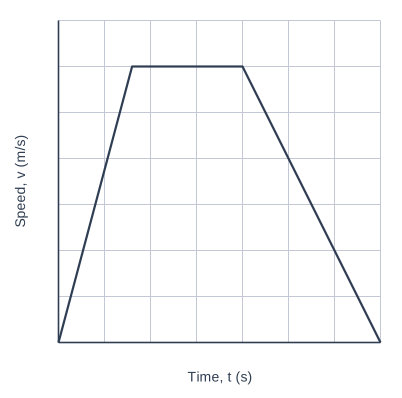
A cyclist's speed, \(v\) m/s, \(t\) seconds after she starts is given by
\(v = \begin{cases} 1.5t & 0 \le t < 8 \\ 12 & 8 \le t < 20 \\ 28 - 0.8t & 20 \le t \le 35 \end{cases}\)

The graph of \(v\) against \(t\) is shown.

Work out the total distance the cyclist travels in the 35 seconds.
Work out the time at which the cyclist has travelled 100 m.
Give this time to 3 significant figures.

A graph of Speed, v (m/s) (vertical axis, 0 to 14, marked every 2) against Time, t (s) (horizontal axis, 0 to 35, marked every 5), on a grid. The graph is made of straight-line sections joining (0, 0), (8, 12), (20, 12) and (35, 0).

Model answer

Distance = area under the speed-time graph
\(0 \le t < 8\): triangle \(\dfrac{1}{2} \times 8 \times 12 = 48\)
\(8 \le t < 20\): rectangle \(12 \times 12 = 144\)
\(20 \le t \le 35\): triangle \(\dfrac{1}{2} \times 15 \times 12 = 90\)
Total distance \(= 48 + 144 + 90 = 282\) m
After 8 seconds the cyclist has travelled 48 m, and after 20 seconds \(48 + 144 = 192\) m, so 100 m is reached in the middle part.
From \(t = 8\) the speed is 12 m/s, so the distance travelled is \(48 + 12(t - 8)\)
\(48 + 12(t - 8) = 100\)
\(12(t - 8) = 52\)
\(t = 8 + 4.333... = 12.333...\)
\(t = 12.3\) seconds (3 sf)

Explanation

The distance travelled is the area under a speed-time graph, here two triangles and a rectangle (or one trapezium). To find when the cyclist has gone 100 m, work out the distance covered by the end of each part: 48 m by t = 8 and 192 m by t = 20, so 100 m is passed in the constant-speed part, where each second adds 12 m. Common errors are adding the speeds instead of finding areas, and dividing 100 by 12 as if the speed were 12 m/s from the start.

Mark scheme
  1. 1 mark

    M1 for one correct area: \(\dfrac{1}{2} \times 8 \times 12\) (48) or \(12 \times 12\) (144) or \(\dfrac{1}{2} \times 15 \times 12\) (90)

    oe; the distance travelled is the area under the speed-time graph

  2. 1 mark

    M1dep for \(48 + 144 + 90\) oe

    oe eg the trapezium \(\dfrac{1}{2} \times (35 + 12) \times 12\)

  3. 1 mark

    A1 for 282 (m)

    ignore units

  4. 1 mark

    M1 for \(48 + 12(t - 8) = 100\) oe

    oe eg \(12(t - 8) = 52\), or \(8 + \dfrac{52}{12}\); the cyclist has travelled 48 m after 8 seconds and then travels 12 m each second. \(\dfrac{1}{2} \times t \times 1.5t = 100\) (t = 11.5..., which is not in the first part) or \(100 \div 12\) (as if the speed were 12 m/s from the start) is M0.

  5. 1 mark

    A1 for 12.3 [12.25, 12.35] (seconds)

    oe exact \(\dfrac{37}{3}\) or \(12\dfrac{1}{3}\). Accept a more accurate value in the range. Ignore units. A correct answer to either part with no working scores the marks for that part (282 scores the first three marks; 12.3 scores the last two).

Ready to try the rest? Every answer you write is marked against the mark scheme, so you can see exactly where the marks are.

Study Helper Hints first, answers after you try

Stuck on this one? Ask for a hint and I’ll point you in the right direction, without giving the answer away. Once you’ve checked your answer, I’ll show you how the marks are awarded.