
Level:
Correct: 0
Incorrect: 0
Marks: 0/0
Exam Practice
Course:
Topics:
AQA Level 2 Further Maths (Calculator) Smart practice A mixed round aimed at your weak spots
Unit 1
Number
Unit 2
Algebra
Unit 3
Coordinate Geometry (2 dimensions only)
Unit 4
Calculus
Unit 5
Matrix Transformations
Unit 6
Geometry
Avg
score:
–
Topics
done:
0/43

Solution of simultaneous equations in two unknowns

Practise 19 exam-style questions on Solution of simultaneous equations in two unknowns for AQA Level 2 Further Maths (Calculator). Write your answer as you would in the exam and get it marked in seconds against the mark scheme, point by point, with the Study Helper on hand if you get stuck.

  • 19 questions
  • 1–6 marks each
  • Instant marking
  • No sign-up needed
19 questions, marked as you go

Sample questions with model answers

Here are 4 of the questions in this topic, each with a model answer, an explanation of why it earns the marks and the mark scheme an examiner would use.

Question 1

2 marks

The lines \(y = 0.7x + 0.75\) and \(5x - 2y = 3.9\) intersect at the point P.

Work out the coordinates of P.
You must show your working.

Give the coordinates, typed as (x, y).

Model answer

Substitute \(y = 0.7x + 0.75\) into \(5x - 2y = 3.9\)
\(5x - 2(0.7x + 0.75) = 3.9\)
\(5x - 1.4x - 1.5 = 3.9\)
\(3.6x = 5.4\)
\(x = 1.5\)
\(y = 0.7 \times 1.5 + 0.75 = 1.8\)
P is \((1.5, 1.8)\)

Explanation

The point of intersection lies on both lines, so its coordinates satisfy both equations: substitute the expression for \(y\) from the first equation into the second. Put a bracket round \(0.7x + 0.75\) before multiplying by 2; a common error is to multiply only the \(0.7x\) by 2, or to get the sign of the 1.5 wrong.

Mark scheme
  1. 1 mark

    M1 for \(5x - 2(0.7x + 0.75) = 3.9\) oe

    oe eg \(3.6x - 1.5 = 3.9\) or \(3.6x = 5.4\); or a correct equation in y, eg \(y = 0.7 \times \dfrac{3.9 + 2y}{5} + 0.75\); implied by x = 1.5 or y = 1.8

  2. 1 mark

    A1 for \((1.5, 1.8)\)

    accept x = 1.5, y = 1.8, or \(\left(\dfrac{3}{2}, \dfrac{9}{5}\right)\). The question says 'You must show your working': a correct answer with no working scores 0 (a calculator equation solver is not working).
Question 2

3 marks

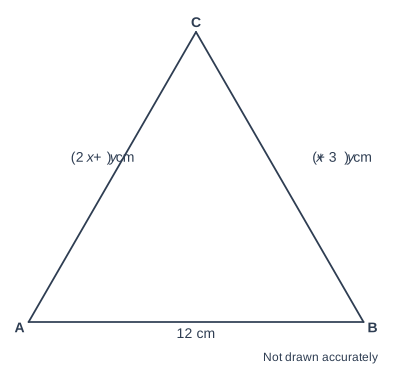
The diagram shows an equilateral triangle.

Work out the value of \(x\) and the value of \(y\).
You must show your working.

Geometry diagram, marked "Not drawn accurately". Equilateral triangle ABC. Side AB is labelled 12 cm. Side AC is labelled (2x + y) cm. Side BC is labelled (x + 3y) cm.

Model answer

All three sides of an equilateral triangle are equal.
(1) \(2x + y = 12\)
(2) \(x + 3y = 12\)
\(2 \times\) (2): \(2x + 6y = 24\)
Subtract (1): \(5y = 12\), so \(y = 2.4\)
From (2): \(x = 12 - 3 \times 2.4 = 4.8\)
\(x = 4.8,\ y = 2.4\)

Explanation

Equilateral means all three sides are equal, so each algebraic side equals 12 cm, which gives two linear equations to solve simultaneously. Check: \(2(4.8) + 2.4 = 12\) and \(4.8 + 3(2.4) = 12\). A common error is to set only the two algebraic sides equal to each other, which gives one equation in two unknowns.

Mark scheme
  1. 1 mark

    M1 for \(2x + y = 12\) and \(x + 3y = 12\)

    both equations; oe eg \(2x + y = x + 3y\) with one of them equal to 12

  2. 1 mark

    M1dep for a correct method to eliminate one variable

    eg \(2 \times\) second \(-\) first giving \(5y = 12\), or substituting \(y = 12 - 2x\) into the second equation giving \(x + 36 - 6x = 12\)

  3. 1 mark

    A1 for \(x = 4.8\) and \(y = 2.4\)

    oe eg \(x = \dfrac{24}{5}\), \(y = \dfrac{12}{5}\). The question says 'You must show your working': correct answers with no working score 0 (a calculator equation solver is not working).

Question 3

4 marks

Solve the simultaneous equations

\(x = 3y^2 + 2y\)
\(x + 3y = 2\)

Use an algebraic method.
Give your answers as exact values.

Model answer

From the second equation, \(x = 2 - 3y\)
\(3y^2 + 2y = 2 - 3y\)
\(3y^2 + 5y - 2 = 0\)
\((3y - 1)(y + 2) = 0\)
\(y = \dfrac{1}{3}\) or \(y = -2\)
\(y = \dfrac{1}{3}\): \(x = 2 - 1 = 1\)
\(y = -2\): \(x = 2 + 6 = 8\)
\(x = 1,\ y = \dfrac{1}{3}\) and \(x = 8,\ y = -2\)

Explanation

Here the second-order equation gives \(x\) in terms of \(y\), so the easiest route is to eliminate \(x\): equate the two expressions for \(x\) to get a quadratic in \(y\), factorise it, then find each x-value from the linear equation. Keep \(\dfrac{1}{3}\) as a fraction so that the answers are exact. Common errors are treating the y-values as x-values, stopping after finding \(y\), and pairing the values wrongly.

Mark scheme
  1. 1 mark

    M1 for \(3y^2 + 2y + 3y = 2\) oe

    oe eg \(3y^2 + 5y - 2 = 0\) or \(3y^2 + 2y = 2 - 3y\); or eliminating y: \(x = 3\left(\dfrac{2 - x}{3}\right)^2 + \dfrac{2(2 - x)}{3}\) oe leading to \(x^2 - 9x + 8 = 0\)

  2. 1 mark

    M1dep for \((3y - 1)(y + 2) (= 0)\) oe

    or \((x - 1)(x - 8) (= 0)\), or a correct substitution into the quadratic formula, eg \(\dfrac{-5 \pm \sqrt{25 + 24}}{6}\), or correct completing the square

  3. 1 mark

    A1 for \(y = \dfrac{1}{3}\) and \(y = -2\)

    or x = 1 and x = 8, or one correct pair of values

  4. 1 mark

    A1 for \(x = 1,\ y = \dfrac{1}{3}\) and \(x = 8,\ y = -2\)

    values correctly paired; accept \(\left(1, \dfrac{1}{3}\right)\) and (8, −2). 0.33 or 0.333 for \(\dfrac{1}{3}\) is A0 (not exact). The question says 'Use an algebraic method': correct answers with no working score 0, and answers from trial and improvement or a graph score 0.

Question 4

5 marks

Solve the simultaneous equations

\(x^2 + y^2 = 30\)
\(y = 2x + 10\)

The solutions of \(ax^2 + bx + c = 0\), where \(a ≠ 0\), are \(x = \dfrac{-b \pm \sqrt{b^2 - 4ac}}{2a}\)

Give your answers in surd form.
You must show your working.

Type square roots as sqrt( ), for example 2sqrt(3).

Model answer

\(x^2 + (2x + 10)^2 = 30\)
\(x^2 + 4x^2 + 40x + 100 = 30\)
\(5x^2 + 40x + 70 = 0\)
\(x^2 + 8x + 14 = 0\)
\(x = \dfrac{-8 \pm \sqrt{64 - 56}}{2} = \dfrac{-8 \pm 2\sqrt{2}}{2} = -4 \pm \sqrt{2}\)
\(y = 2x + 10 = 2(-4 \pm \sqrt{2}) + 10 = 2 \pm 2\sqrt{2}\)
\(x = -4 + \sqrt{2},\ y = 2 + 2\sqrt{2}\) and \(x = -4 - \sqrt{2},\ y = 2 - 2\sqrt{2}\)

Explanation

Substitute \(y = 2x + 10\) into the equation of the circle, divide by 5 to get \(x^2 + 8x + 14 = 0\) and use the formula (or complete the square: \((x + 4)^2 = 2\)). Since \(\sqrt{8} = 2\sqrt{2}\), the 2s cancel. Match each x-value with its own y-value using \(y = 2x + 10\). Common errors are writing \((2x + 10)^2\) as \(4x^2 + 100\), giving decimals when surd form is asked for, and pairing \(-4 + \sqrt{2}\) with \(2 - 2\sqrt{2}\).

Mark scheme
  1. 1 mark

    M1 for \(x^2 + (2x + 10)^2 = 30\) oe

    or eliminating x: \(\left(\dfrac{y - 10}{2}\right)^2 + y^2 = 30\) oe

  2. 1 mark

    M1dep for \(5x^2 + 40x + 70 = 0\) or \(x^2 + 8x + 14 = 0\) oe

    oe eg \(5y^2 - 20y - 20 = 0\) or \(y^2 - 4y - 4 = 0\); \((2x + 10)^2\) must be expanded correctly

  3. 1 mark

    M1dep for \(\dfrac{-8 \pm \sqrt{8^2 - 4 \times 1 \times 14}}{2 \times 1}\) oe

    a correct substitution into the formula for their correct quadratic (eg with a = 5, b = 40, c = 70), or \(\dfrac{-8 \pm \sqrt{8}}{2}\), or \((x + 4)^2 = 2\); condone + for ±

  4. 1 mark

    A1 for \(x = -4 + \sqrt{2}\) and \(x = -4 - \sqrt{2}\)

    oe exact, eg \(-4 \pm \sqrt{2}\) or \(\dfrac{-8 \pm \sqrt{8}}{2}\); or \(y = 2 \pm 2\sqrt{2}\); or one correct pair of values

  5. 1 mark

    A1 for \(x = -4 + \sqrt{2},\ y = 2 + 2\sqrt{2}\) and \(x = -4 - \sqrt{2},\ y = 2 - 2\sqrt{2}\)

    values correctly paired, in surd form; accept equivalent exact forms such as \(\sqrt{2} - 4\), \(2 + \sqrt{8}\) or \(\dfrac{4 + \sqrt{32}}{2}\). Decimal answers only (−2.59, 4.83 and −5.41, −0.828) score M3A0A0 because the question asks for surd form. The question says 'You must show your working': correct answers with no working score 0.

Ready to try the rest? Every answer you write is marked against the mark scheme, so you can see exactly where the marks are.

Study Helper Hints first, answers after you try

Stuck on this one? Ask for a hint and I’ll point you in the right direction, without giving the answer away. Once you’ve checked your answer, I’ll show you how the marks are awarded.