Level:
Correct: 0
Incorrect: 0
Marks: 0/0
Exam Practice
Course:
Topics:
AQA Level 2 Further Maths (Calculator) Smart practice A mixed round aimed at your weak spots
Unit 1
Number
Unit 2
Algebra
Unit 3
Coordinate Geometry (2 dimensions only)
Unit 4
Calculus
Unit 5
Matrix Transformations
Unit 6
Geometry
Avg
score:
–
Topics
done:
0/43

Area, volume, angle properties and circle theorems

Practise 21 exam-style questions on Area, volume, angle properties and circle theorems for AQA Level 2 Further Maths (Calculator). Write your answer as you would in the exam and get it marked in seconds against the mark scheme, point by point, with the Study Helper on hand if you get stuck.

  • 21 questions
  • 1–6 marks each
  • Instant marking
  • No sign-up needed
20 questions, marked as you go

Sample questions with model answers

Here are 4 of the questions in this topic, each with a model answer, an explanation of why it earns the marks and the mark scheme an examiner would use.

Question 1

2 marks

Each interior angle of a regular polygon is 168°

Work out the number of sides of the polygon.

Model answer

Exterior angle \(= 180 - 168 = 12^\circ\)
The exterior angles add up to 360°
Number of sides \(= 360 \div 12 = 30\)

Explanation

Each interior angle and its exterior angle add up to 180°, so each exterior angle is 12°. The exterior angles of any polygon add up to 360°, so there are \(360 \div 12 = 30\) sides. A common error is to divide 360 by the interior angle.

Mark scheme
  1. 1 mark

    M1 for \(180 - 168\) (\(= 12\)) or \((n - 2) \times 180 = 168n\) oe

    Exterior angle 12° seen implies M1. oe eg \(\dfrac{(n - 2) \times 180}{n} = 168\)

  2. 1 mark

    A1 for \(30\)

    From \(360 \div 12\). A fully correct answer with no working scores full marks. \(360 \div 168\) is M0A0; \(180 - 168 = 12\) followed by \(168 \div 12 = 14\) is M1A0.
Question 2

3 marks

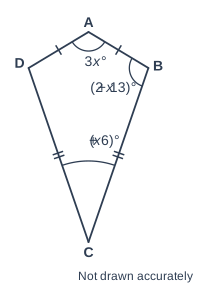
The diagram shows a kite ABCD.
\(AB = AD\) and \(CB = CD\)
Angle DAB \(= 3x^\circ\)
Angle ABC \(= (2x + 13)^\circ\)
Angle BCD \(= (x + 6)^\circ\)

Work out the size of the largest angle of the kite.

Geometry diagram, marked "Not drawn accurately". Kite ABCD. Angle DAB is marked 3x°. Angle ABC is marked (2x + 13)°. Angle BCD is marked (x + 6)°. AB and AD are each marked with one short dash (equal lengths). CB and CD are each marked with two short dashes (equal lengths).

Model answer

In a kite, the angles between the unequal sides are equal, so angle ADC = angle ABC \(= (2x + 13)^\circ\)
Angles in a quadrilateral add up to 360°:
\(3x + 2(2x + 13) + (x + 6) = 360\)
\(8x + 32 = 360\)
\(x = 41\)
Angles: DAB \(= 123^\circ\), ABC = ADC \(= 95^\circ\), BCD \(= 47^\circ\)
The largest angle is 123°

Explanation

A kite is symmetrical about the diagonal AC, so angle ADC equals angle ABC. With all four angles in terms of \(x\), the angle sum of 360° gives \(x = 41\), and then each angle can be worked out. Common errors are to use only three angles in the sum, or to stop at \(x = 41\) without finding the angle asked for.

Mark scheme
  1. 1 mark

    M1 for \(3x + 2(2x + 13) + x + 6 = 360\) oe

    Uses angle ADC = angle ABC (a kite has one pair of equal opposite angles, between the unequal sides) and the angle sum of a quadrilateral. oe eg \(8x + 32 = 360\). \(3x + 2x + 13 + x + 6 = 360\) (only three angles) is M0.

  2. 1 mark

    A1 for \(x = 41\)

    May be implied by one correct angle: 123, 95 or 47

  3. 1 mark

    A1 for \(123\)

    Condone a missing degree sign. A fully correct answer with no working scores full marks. 41 on the answer line is M1A1A0; 95 (angle ABC) is M1A1A0.

Question 3

4 marks

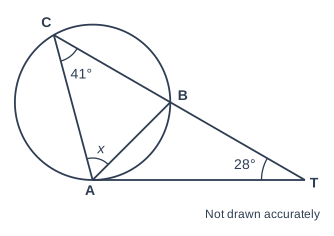
The diagram shows a circle.
A, B and C are points on the circle.
The tangent to the circle at A meets CB extended at T.
Angle ATB = 28°
Angle ACB = 41°

Work out the value of \(x\).

Geometry diagram, marked "Not drawn accurately". A circle; A, B and C lie on it, in that order going anticlockwise. Line segments AT, CT, AB and AC are drawn. B lies on CT. AT touches the circle at A (it is a tangent). Angle ATB is marked 28°. Angle ACB is marked 41°. Angle BAC is marked x.

Model answer

Angle TAB = angle ACB = 41° (alternate segment theorem)
In triangle TAC: angle TAC \(= 180 - 28 - 41 = 111^\circ\) (angles in a triangle)
\(x\) = angle TAC − angle TAB
\(x = 111 - 41 = 70\)

Explanation

The tangent-chord angle TAB equals the angle ACB in the alternate segment, so it is 41°. Triangle TAC contains the angles 28° at T and 41° at C, so angle TAC is 111°, and \(x\) is the part of it left after angle TAB. Another route: angle ABC is the exterior angle of triangle TAB, \(28 + 41 = 69^\circ\), and then the angles of triangle ABC give \(x\). A common error is to assume angle TAB equals angle ATB.

Mark scheme
  1. 1 mark

    B1 for angle TAB \(= 41^\circ\)

    Alternate segment theorem. May be seen on the diagram.

  2. 1 mark

    M1 for angle TAC \(= 180 - 28 - 41\) (\(= 111\)) or angle ABT \(= 180 - 28 -\) their 41 (\(= 111\))

    Angle sum of triangle TAC or of triangle TAB. May be seen on the diagram. Alternative: angle ABC \(= 28 +\) their 41 (\(= 69\)), the exterior angle of triangle TAB, scores this M1 and the next.

  3. 1 mark

    M1dep for \(x = 111 -\) their 41 or angle ABC \(= 180 -\) their 111 (\(= 69\)) oe

    oe eg \(x + 41 = 111\)

  4. 1 mark

    A1 for \(x = 70\)

    From \(111 - 41\) or \(180 - 41 - 69\). Condone a missing degree sign. A fully correct answer with no working scores full marks. 111 or 69 on the answer line is A0; 41 (taking \(x\) = angle ACB) scores 0.

Question 4

5 marks

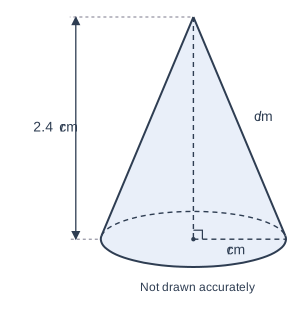
The diagram shows a solid cone.
The radius of the base is \(r\) cm.
The perpendicular height is \(2.4r\) cm.
The slant height is \(l\) cm.
Altogether, the curved surface and the base have an area of 500 cm²

Curved surface area of a cone \(= \pi r l\)
Volume of a cone \(= \dfrac{1}{3}\pi r^2 h\)

Work out the volume of the cone.
Give your answer to 3 significant figures.

A cone drawn in 3D (hidden edges dashed). The radius is labelled r cm (on a dashed line from the centre of the base to its edge). The perpendicular height is labelled 2.4r cm (a dashed vertical line from the top down to the centre of the base, with a right angle marked there; the label itself is beside a double-headed arrow to the left of the solid, spanning the same height). The slant height is labelled l cm (along the sloping side). The diagram is labelled "Not drawn accurately".

Model answer

\(l^2 = r^2 + (2.4r)^2 = 6.76r^2\), so \(l = 2.6r\)
Total surface area \(= \pi r^2 + \pi r l = \pi r^2 + 2.6\pi r^2 = 3.6\pi r^2\)
\(3.6\pi r^2 = 500\)
\(r^2 = 44.209...\), so \(r = 6.6490...\) cm
Volume \(= \dfrac{1}{3}\pi r^2 \times 2.4r = 0.8\pi r^3\)
\(= 0.8\pi \times 6.6490...^3 = 738.78...\)
\(= 739\) cm³ (3 sf)

Explanation

Write every length in terms of \(r\): Pythagoras gives the slant height \(l = 2.6r\) (a multiple of the 5, 12, 13 triangle, since \(1 : 2.4 : 2.6 = 5 : 12 : 13\)). The total surface area of a solid cone is the curved surface plus the circular base, which gives an equation for \(r\). Then substitute into the volume. Leaving out the base, or rounding \(r\) to 6.64, gives a wrong answer.

Mark scheme
  1. 1 mark

    M1 for \(l^2 = r^2 + (2.4r)^2\) or \(l = 2.6r\)

    oe eg \(l = \sqrt{6.76r^2}\) (2.6 is exact)

  2. 1 mark

    M1 for \(\pi r^2 + \pi r \times\) their \(2.6r = 500\) oe

    Their l must be of the form kr. oe eg \(3.6\pi r^2 = 500\) (exact)

  3. 1 mark

    A1 for \(r = [6.64, 6.65]\) or \(r^2 = [44.2, 44.21]\)

    Needs both M marks

  4. 1 mark

    M1 for \(\dfrac{1}{3}\pi \times\) their \(r^2 \times 2.4 \times\) their \(r\) oe

    oe eg \(0.8\pi r^3\) (exact) with their r

  5. 1 mark

    A1 for \(739\) [738.5, 739.5]

    Accept a more accurate value in the range, eg 738.8; π = 3.142 gives 738.7 (A1). A fully correct answer with no working scores full marks. Premature rounding giving a value outside the range is A0: r = 6.649 gives 738.8 (A1), r = 6.65 gives 739.1 (A1), but r = 6.64 gives 735.8 (A0). Leaving out the base (\(2.6\pi r^2 = 500\), r = 7.82, volume 1200) is M1M0A0M1A0.

Ready to try the rest? Every answer you write is marked against the mark scheme, so you can see exactly where the marks are.

Study Helper Hints first, answers after you try

Stuck on this one? Ask for a hint and I’ll point you in the right direction, without giving the answer away. Once you’ve checked your answer, I’ll show you how the marks are awarded.