
Level:
Correct: 0
Incorrect: 0
Marks: 0/0
Exam Practice
Course:
Topics:
AQA Level 2 Further Maths (Calculator) Smart practice A mixed round aimed at your weak spots
Unit 1
Number
Unit 2
Algebra
Unit 3
Coordinate Geometry (2 dimensions only)
Unit 4
Calculus
Unit 5
Matrix Transformations
Unit 6
Geometry
Avg
score:
–
Topics
done:
0/43

Gradients, parallel and perpendicular lines, and distance

Practise 17 exam-style questions on Gradients, parallel and perpendicular lines, and distance for AQA Level 2 Further Maths (Calculator). Write your answer as you would in the exam and get it marked in seconds against the mark scheme, point by point, with the Study Helper on hand if you get stuck.

  • 17 questions
  • 1–6 marks each
  • Instant marking
  • No sign-up needed
17 questions, marked as you go

Sample questions with model answers

Here are 4 of the questions in this topic, each with a model answer, an explanation of why it earns the marks and the mark scheme an examiner would use.

Question 1

2 marks

A is the point \((-2.4, 1.3)\) and B is the point \((3.6, -2.9)\)

Work out the acute angle between the line AB and the \(x\)-axis.
Give your answer to 1 decimal place.

Model answer

Gradient of AB \(= \dfrac{-2.9 - 1.3}{3.6 - (-2.4)} = \dfrac{-4.2}{6} = -0.7\)
The line falls 4.2 for every 6 across, so the acute angle \(\theta\) with the \(x\)-axis has \(\tan\theta = 0.7\)
\(\theta = \tan^{-1} 0.7 = 34.99...\)
Acute angle \(= 35.0^\circ\) (1 dp)

Explanation

The size of the gradient (change in y ÷ change in x) is the tangent of the acute angle the line makes with the x-axis: it is opposite over adjacent in the right-angled triangle under the line. The negative sign only says that the line slopes downwards, so use tan⁻¹ 0.7. AQA's examiners report (8365/1 June 2023) noted students who put the change in x on top of a gradient; here that gives 55.0°, the angle with the y-axis.

Mark scheme
  1. 1 mark

    M1 for gradient of AB \(= \dfrac{-2.9 - 1.3}{3.6 - (-2.4)}\) or \(-0.7\) or \(\tan\theta = \dfrac{4.2}{6}\) oe

    oe eg \(\dfrac{4.2}{-6}\) or \(\tan^{-1} 0.7\) or \(\tan^{-1}(-0.7)\). Change in \(x\) over change in \(y\), eg \(\tan\theta = \dfrac{6}{4.2}\) (giving 55.0, the angle with the \(y\)-axis), is M0A0.

  2. 1 mark

    A1 for 35.0 [34.95, 35.05]

    accept 35 or a more accurate value in the range, eg 34.99; premature rounding giving a value outside the range is A0. \(-35.0\) from \(\tan^{-1}(-0.7)\) given as the final answer, or 145.0 (the obtuse angle), is M1A0. Condone a missing degree sign. A fully correct answer with no working scores full marks.
Question 2

3 marks

On a map, positions are given as coordinates \((x, y)\), where \(x\) and \(y\) are distances in kilometres east and north of a harbour.
A ferry sails in a straight line from the point \((-3.2, 4.1)\) to the point \((2.6, -1.5)\)
It sails at a constant speed of 12 km/h.

Work out the time the journey takes, in minutes.
Give your answer to 3 significant figures.

Model answer

Change in \(x = 2.6 - (-3.2) = 5.8\) and change in \(y = -1.5 - 4.1 = -5.6\)
Distance \(= \sqrt{5.8^2 + 5.6^2} = \sqrt{65} = 8.062...\) km
Time \(= \dfrac{8.062...}{12} = 0.6718...\) hours
\(0.6718... \times 60 = 40.31...\) minutes
Time \(= 40.3\) minutes (3 sf)

Explanation

The distance between the two points is the hypotenuse of a right-angled triangle whose other sides are the changes in x and in y, so use Pythagoras' theorem; then time = distance ÷ speed. Keep the unrounded distance on the calculator and multiply the time in hours by 60. Common errors are a sign slip in the change in x (5.8 is 2.6 − (−3.2), not 2.6 − 3.2) and giving the time in hours.

Mark scheme
  1. 1 mark

    M1 for \((2.6 - (-3.2))^2 + (-1.5 - 4.1)^2\) oe or \(5.8^2 + 5.6^2\) or 65

    oe eg \(33.64 + 31.36\). Implied by \(\sqrt{65}\) or a distance in [8.06, 8.063]

  2. 1 mark

    M1dep for their distance \(\div 12 \times 60\) oe, eg \(\dfrac{\sqrt{65}}{12} \times 60\)

    oe eg \(\sqrt{65} \div 0.2\) (0.2 km each minute), or a time of [0.671, 0.672] hours seen

  3. 1 mark

    A1 for 40.3 [40.25, 40.35]

    accept a more accurate value in the range, eg 40.31; premature rounding giving a value outside the range is A0 (eg a distance of 8.1 gives 40.5, A0). 0.672 (the time in hours) is M2A0. A fully correct answer with no working scores full marks.

Question 3

3 marks

E is the point \((-4, 1)\), F is the point \((2, 3)\) and G is the point \((1, -2)\)

Kai says,
"Triangle EFG is a right-angled triangle."

Is Kai correct?
You must show your working.

Model answer

\(EF^2 = (2 - (-4))^2 + (3 - 1)^2 = 36 + 4 = 40\)
\(FG^2 = (1 - 2)^2 + (-2 - 3)^2 = 1 + 25 = 26\)
\(EG^2 = (1 - (-4))^2 + (-2 - 1)^2 = 25 + 9 = 34\)
The longest side is EF.
\(FG^2 + EG^2 = 26 + 34 = 60\), which is not equal to \(EF^2 = 40\)
So the triangle is not right-angled: Kai is not correct.

Explanation

A triangle is right-angled exactly when the square of its longest side equals the sum of the squares of the other two (the converse of Pythagoras), or when two of its sides have gradients that multiply to −1. Here 40 < 60, so every angle is acute. A common error is to check only one pair of gradients and conclude from that alone.

Mark scheme
  1. 1 mark

    M1 for all three gradients \(\dfrac{1}{3}\) (EF), 5 (FG) and \(-\dfrac{3}{5}\) (EG) or all three squared lengths \(EF^2 = 40\), \(FG^2 = 26\), \(EG^2 = 34\)

    oe eg lengths \(\sqrt{40}\), \(\sqrt{26}\), \(\sqrt{34}\) or 6.32..., 5.09..., 5.83...

  2. 1 mark

    M1dep for a correct test, eg the products of the three pairs of gradients (\(\dfrac{5}{3}\), \(-\dfrac{1}{5}\), \(-3\)) or comparing \(EF^2 = 40\) with \(FG^2 + EG^2 = 60\)

    With gradients, all three pairs must be checked. With lengths, the longest side must be compared with the other two (checking other pairs as well is not needed but is not penalised).

  3. 1 mark

    A1 for No (Kai is not correct) with a correct reason

    eg 'no pair of gradients multiplies to −1' or '40 ≠ 26 + 34, so Pythagoras' theorem does not hold'. 'No' with no working scores 0 (the question says 'You must show your working'). 'Yes' scores at most M2.

Question 4

4 marks

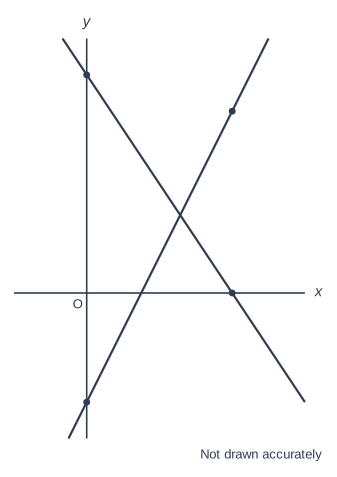
Here is a sketch of the lines \(L_1\) and \(L_2\)
\(L_1\) passes through the points \((0, -3)\) and \((4, 5)\)
\(L_2\) passes through the points \((0, 6)\) and \((4, 0)\)

Work out the acute angle between \(L_1\) and \(L_2\)
Give your answer to 1 decimal place.

A sketch on a pair of axes (x across, y up) with no scale marked, the axes crossing at the origin O. It is marked "Not drawn accurately". Line L₁ is a straight line sloping upwards from left to right passing through (2, 1) and (4, 5). Line L₂ is a straight line sloping downwards from left to right passing through (2, 3) and (6, −3). Line L₁ and line L₂ cross at one point, which cannot be read off, as the sketch has no scale. A dot at (0, −3) is labelled "(0, −3)". A dot at (4, 5) is labelled "(4, 5)". A dot at (0, 6) is labelled "(0, 6)". A dot at (4, 0) is labelled "(4, 0)".

Model answer

Gradient of \(L_1 = \dfrac{5 - (-3)}{4 - 0} = 2\)
Gradient of \(L_2 = \dfrac{0 - 6}{4 - 0} = -1.5\)
\(L_1\) makes an angle of \(\tan^{-1} 2 = 63.43...^\circ\) with the \(x\)-axis.
\(L_2\) makes an angle of \(\tan^{-1} 1.5 = 56.30...^\circ\) with the \(x\)-axis (sloping the other way).
The two lines and the \(x\)-axis form a triangle, so the angle between the lines is
\(180 - 63.43... - 56.30... = 60.25...\)
Acute angle \(= 60.3^\circ\) (1 dp)

Explanation

The gradient of a line is the tangent of the angle it makes with the x-axis, so tan⁻¹ of each gradient (ignoring the sign) gives the angle each line makes with the x-axis. With the x-axis the lines form a triangle, and the third angle is the angle between them. The product of the gradients is −3, not −1, so they are not perpendicular. Common errors are subtracting the two acute angles (63.4° − 56.3°) and giving the obtuse angle, 119.7°.

Mark scheme
  1. 1 mark

    M1 for both gradients, 2 for \(L_1\) and \(-1.5\) for \(L_2\)

    oe eg \(\dfrac{8}{4}\) and \(-\dfrac{6}{4}\); accept \(-\dfrac{3}{2}\). May be implied by the angles below.

  2. 1 mark

    M1 for the angle one line makes with the \(x\)-axis, eg \(\tan^{-1} 2\) or [63.4, 63.44] or \(\tan^{-1} 1.5\) or [56.3, 56.31]

    oe eg the angle with the \(y\)-axis, \(\tan^{-1} 0.5\) or [26.5, 26.57], or \(\tan^{-1} \dfrac{2}{3}\) or [33.6, 33.7]. Accept [123.69, 123.7], the angle \(L_2\) makes with the positive \(x\)-axis measured anticlockwise.

  3. 1 mark

    M1dep for a complete method for the angle between the lines, eg \(180 - [63.4, 63.44] - [56.3, 56.31]\)

    oe eg \([26.5, 26.57] + [33.6, 33.7]\) or \([123.69, 123.7] - [63.4, 63.44]\) or \(180 - ([63.4, 63.44] + [56.3, 56.31])\) seen as part of a correct method. The angles of the triangle formed by the two lines and the \(x\)-axis (or the \(y\)-axis) may be used. Other complete correct methods score all three method marks, eg the cosine rule in the triangle formed by the two lines and the \(x\)-axis, whose vertices are \((1.5, 0)\), \((4, 0)\) and the point where the lines meet, \(\left(\dfrac{18}{7}, \dfrac{15}{7}\right)\). \([63.4, 63.44] - [56.3, 56.31]\) (7.1) is M0.

  4. 1 mark

    A1 for 60.3 [60.25, 60.35]

    accept a more accurate value in the range, eg 60.26; premature rounding giving a value outside the range is A0 (eg 63 and 56 give 61, A0). The obtuse angle, 119.7, as the final answer is M3A0. A fully correct answer with no working scores full marks.

Ready to try the rest? Every answer you write is marked against the mark scheme, so you can see exactly where the marks are.

Study Helper Hints first, answers after you try

Stuck on this one? Ask for a hint and I’ll point you in the right direction, without giving the answer away. Once you’ve checked your answer, I’ll show you how the marks are awarded.