
Level:
Correct: 0
Incorrect: 0
Marks: 0/0
Exam Practice
Course:
Topics:
AQA Level 2 Further Maths (Calculator) Smart practice A mixed round aimed at your weak spots
Unit 1
Number
Unit 2
Algebra
Unit 3
Coordinate Geometry (2 dimensions only)
Unit 4
Calculus
Unit 5
Matrix Transformations
Unit 6
Geometry
Avg
score:
–
Topics
done:
0/43

Linear equations in three unknowns

Practise 15 exam-style questions on Linear equations in three unknowns for AQA Level 2 Further Maths (Calculator). Write your answer as you would in the exam and get it marked in seconds against the mark scheme, point by point, with the Study Helper on hand if you get stuck.

  • 15 questions
  • 1–6 marks each
  • Instant marking
  • No sign-up needed
15 questions, marked as you go

Sample questions with model answers

Here are 4 of the questions in this topic, each with a model answer, an explanation of why it earns the marks and the mark scheme an examiner would use.

Question 1

2 marks

Here are two equations.

\(3x + y + 2z = 14.6\)
\(3x - y + 2z = 9.4\)

Work out the value of \(y\).

Model answer

Subtract the second equation from the first: the \(3x\) and \(2z\) terms cancel.
\(y - (-y) = 14.6 - 9.4\)
\(2y = 5.2\)
\(y = 2.6\)

Explanation

There are three unknowns but only two equations, so in general \(x\), \(y\) and \(z\) cannot all be found. Here \(3x\) and \(2z\) appear identically in both equations, so subtracting eliminates both at once and leaves \(y\). A common error is to work out \(y - (-y)\) as 0 instead of \(2y\), which loses the \(y\) terms.

Mark scheme
  1. 1 mark

    M1 for subtracting the equations, eg \(2y = 5.2\)

    oe eg \(-2y = -5.2\), or \(y = 14.6 - 3x - 2z\) substituted into the second equation correctly

  2. 1 mark

    A1 for \(y = 2.6\)

    A fully correct answer with no working scores full marks.
Question 2

3 marks

A jar contains only 5p, 10p and 20p coins.

There are 42 coins in the jar.
The total value of the coins is £4.20
There are 6 more 10p coins than 20p coins.

Work out the number of each type of coin in the jar.
You must show your working.

Model answer

Let there be \(f\) 5p coins, \(t\) 10p coins and \(w\) 20p coins.
\(f + t + w = 42\)
\(5f + 10t + 20w = 420\)
\(t = w + 6\)
Substitute for \(t\): \(f + 2w = 36\) and \(5f + 30w = 360\), so \(f + 6w = 72\)
Subtract: \(4w = 36\), so \(w = 9\)
\(t = 15\) and \(f = 36 - 18 = 18\)
18 five-pence coins, 15 ten-pence coins and 9 twenty-pence coins

Explanation

Write one equation for the number of coins, one for their value (in pence, to avoid decimals) and one for the extra condition, then substitute \(t = w + 6\) to reduce to two equations in two unknowns. A common error is to mix pounds and pence in the value equation, writing \(5f + 10t + 20w = 4.20\). Check: \(90 + 150 + 180 = 420\).

Mark scheme
  1. 1 mark

    M1 for \(f + t + w = 42\) and \(5f + 10t + 20w = 420\) oe

    any letters; both equations; oe in pounds, eg \(0.05f + 0.1t + 0.2w = 4.2\)

  2. 1 mark

    M1dep for using \(t = w + 6\) to form two correct equations in two unknowns and eliminating one of them

    eg \(f + 2w = 36\) and \(5f + 30w = 360\), leading to \(4w = 36\) oe

  3. 1 mark

    A1 for 18 five-pence coins, 15 ten-pence coins and 9 twenty-pence coins

    all three numbers, clearly matched to the coins. The question says 'You must show your working': correct answers with no working score 0 (a calculator equation solver is not working).

Question 3

4 marks

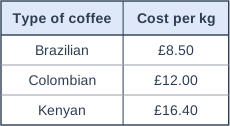
A café makes 25 kg of a coffee blend from three types of coffee.

The table shows the cost per kilogram of each type.

The 25 kg of blend costs £302.80 altogether.
The blend contains 1 kg more Brazilian coffee than Kenyan coffee.

Work out the mass of each type of coffee in the blend.
You must show your working.

Table with columns "Type of coffee", "Cost per kg". Type of coffee: Brazilian; Cost per kg: £8.50 | Type of coffee: Colombian; Cost per kg: £12.00 | Type of coffee: Kenyan; Cost per kg: £16.40.

Model answer

Let the masses be \(b\) kg Brazilian, \(c\) kg Colombian and \(k\) kg Kenyan.
\(b + c + k = 25\)
\(8.5b + 12c + 16.4k = 302.8\)
\(b = k + 1\)
Substitute: \(c + 2k = 24\), so \(c = 24 - 2k\)
\(8.5(k + 1) + 12(24 - 2k) + 16.4k = 302.8\)
\(8.5k + 8.5 + 288 - 24k + 16.4k = 302.8\)
\(0.9k + 296.5 = 302.8\)
\(0.9k = 6.3\), so \(k = 7\)
\(b = 8\) and \(c = 24 - 14 = 10\)
Brazilian 8 kg, Colombian 10 kg, Kenyan 7 kg

Explanation

There are three unknown masses, so three equations are needed: total mass, total cost and the extra condition. Substituting \(b = k + 1\) reduces the problem to two equations in two unknowns. Check: \(8.5 \times 8 + 12 \times 10 + 16.4 \times 7 = 68 + 120 + 114.8 = 302.8\). A common error is to write the condition the wrong way round, \(k = b + 1\).

Mark scheme
  1. 1 mark

    M1 for \(b + c + k = 25\) and \(8.5b + 12c + 16.4k = 302.8\) oe

    any letters; both equations; oe in pence, eg \(850b + 1200c + 1640k = 30280\)

  2. 1 mark

    M1 for using \(b = k + 1\) to form two correct equations in two unknowns

    eg \(c + 2k = 24\) and \(12c + 24.9k = 294.3\); oe for other choices of variables, eg \(2b + c = 26\) and \(24.9b + 12c = 319.2\)

  3. 1 mark

    M1dep for a correct equation in one variable, eg \(0.9k = 6.3\)

    oe eg \(0.9b = 7.2\) or \(-0.45c = -4.5\); implied by a correct mass

  4. 1 mark

    A1 for Brazilian 8 kg, Colombian 10 kg and Kenyan 7 kg

    all three, clearly matched. The question says 'You must show your working': correct answers with no working score 0.

Question 4

5 marks

Here are three equations.

\(x + y + z = 6\)
\(3x - y + 2z = k\)
\(2x + y - z = 3\)

where \(k\) is a constant.

The solution of the equations has \(x = y\).

Work out the value of \(k\).
You must show your working.

Model answer

Substitute \(y = x\) into the first and third equations:
\(2x + z = 6\)
\(3x - z = 3\)
Add: \(5x = 9\), so \(x = 1.8\) and \(y = 1.8\)
\(z = 6 - 2 \times 1.8 = 2.4\)
\(k = 3x - y + 2z = 3(1.8) - 1.8 + 2(2.4) = 5.4 - 1.8 + 4.8\)
\(k = 8.4\)

Explanation

The condition \(x = y\) acts as a fourth equation, so there are four equations for the four unknowns \(x\), \(y\), \(z\) and \(k\). Use it in the two equations that do not contain \(k\) to find \(x\), \(y\) and \(z\), then substitute into the second equation to find \(k\). A common error is to try to solve the three equations first, which leaves everything in terms of \(k\).

Mark scheme
  1. 1 mark

    M1 for substituting \(y = x\) into the first and third equations, eg \(2x + z = 6\) and \(3x - z = 3\)

    both correct equations. Alternative: M1 for eliminating z from the first and third equations, \(3x + 2y = 9\), then substituting y = x

  2. 1 mark

    M1dep for a correct equation in one variable, eg \(5x = 9\)

    oe

  3. 1 mark

    A1 for \(x = 1.8\)

    oe eg \(\dfrac{9}{5}\); implies y = 1.8

  4. 1 mark

    A1 for \(z = 2.4\)

    dep on M2; oe eg \(\dfrac{12}{5}\)

  5. 1 mark

    A1ft for \(k = 8.4\)

    dep on M2; ft \(k = 2 \times\) their \(x + 2 \times\) their \(z\) (from \(3x - x + 2z\)). oe eg \(\dfrac{42}{5}\). The question says 'You must show your working': a correct answer with no working scores 0 (a calculator equation solver is not working).

Ready to try the rest? Every answer you write is marked against the mark scheme, so you can see exactly where the marks are.

Study Helper Hints first, answers after you try

Stuck on this one? Ask for a hint and I’ll point you in the right direction, without giving the answer away. Once you’ve checked your answer, I’ll show you how the marks are awarded.