
Level:
Correct: 0
Incorrect: 0
Marks: 0/0
Exam Practice
Course:
Topics:
AQA Level 2 Further Maths (Calculator) Smart practice A mixed round aimed at your weak spots
Unit 1
Number
Unit 2
Algebra
Unit 3
Coordinate Geometry (2 dimensions only)
Unit 4
Calculus
Unit 5
Matrix Transformations
Unit 6
Geometry
Avg
score:
–
Topics
done:
0/43

Combination of transformations

Practise 16 exam-style questions on Combination of transformations for AQA Level 2 Further Maths (Calculator). Write your answer as you would in the exam and get it marked in seconds against the mark scheme, point by point, with the Study Helper on hand if you get stuck.

  • 16 questions
  • 1–6 marks each
  • Instant marking
  • No sign-up needed
16 questions, marked as you go

Sample questions with model answers

Here are 4 of the questions in this topic, each with a model answer, an explanation of why it earns the marks and the mark scheme an examiner would use.

Question 1

2 marks

Work out the single matrix that represents a rotation of 90° anticlockwise about the origin followed by an enlargement, scale factor 2.5, centre the origin.

Give your answer as a matrix, typed as [[a, b], [c, d]].

Model answer

Rotation of 90° anticlockwise: \(\begin{pmatrix} 0 & -1 \\ 1 & 0 \end{pmatrix}\); enlargement, scale factor 2.5: \(\begin{pmatrix} 2.5 & 0 \\ 0 & 2.5 \end{pmatrix}\)
Rotation followed by enlargement: \(\begin{pmatrix} 2.5 & 0 \\ 0 & 2.5 \end{pmatrix}\begin{pmatrix} 0 & -1 \\ 1 & 0 \end{pmatrix} = \begin{pmatrix} 0 & -2.5 \\ 2.5 & 0 \end{pmatrix}\)

Explanation

The matrix of the second transformation goes on the left. Multiplying by an enlargement matrix kI simply multiplies every entry by k, so here the order does not change the answer. A common error is to use the matrix for a clockwise rotation.

Mark scheme
  1. 1 mark

    M1 for \(\begin{pmatrix} 2.5 & 0 \\ 0 & 2.5 \end{pmatrix}\begin{pmatrix} 0 & -1 \\ 1 & 0 \end{pmatrix}\)

    both matrices correct and multiplied; either order gives the same product here, because an enlargement centre O commutes with every 2 × 2 matrix

  2. 1 mark

    A1 for \(\begin{pmatrix} 0 & -2.5 \\ 2.5 & 0 \end{pmatrix}\)

    accept 5/2 for 2.5. \(\begin{pmatrix} 0 & 2.5 \\ -2.5 & 0 \end{pmatrix}\) (rotating clockwise) is M0A0. Condone missing brackets. A fully correct answer with no working scores full marks.
Question 2

3 marks

\(\mathbf{M} = \begin{pmatrix} 0 & -1.5 \\ 1.5 & 0 \end{pmatrix}\)

Work out \(\mathbf{M}^4\)
Describe geometrically the single transformation represented by \(\mathbf{M}^4\).

Give your answer as a matrix, typed as [[a, b], [c, d]].

Model answer

\(\mathbf{M}^2 = \begin{pmatrix} 0 & -1.5 \\ 1.5 & 0 \end{pmatrix}\begin{pmatrix} 0 & -1.5 \\ 1.5 & 0 \end{pmatrix} = \begin{pmatrix} -2.25 & 0 \\ 0 & -2.25 \end{pmatrix}\)
\(\mathbf{M}^4 = \mathbf{M}^2\mathbf{M}^2 = \begin{pmatrix} -2.25 & 0 \\ 0 & -2.25 \end{pmatrix}\begin{pmatrix} -2.25 & 0 \\ 0 & -2.25 \end{pmatrix} = \begin{pmatrix} 5.0625 & 0 \\ 0 & 5.0625 \end{pmatrix}\)
\(\mathbf{M}^4\) is an enlargement, scale factor 5.0625, centre the origin.

Explanation

M is a rotation of 90° anticlockwise combined with an enlargement, scale factor 1.5. Four quarter turns make a full turn, so only the enlargement is left, with scale factor 1.5⁴ = 5.0625. Working out M² first and squaring it is quickest. A common error is to raise each entry of M to the power 4.

Mark scheme
  1. 1 mark

    M1 for \(\mathbf{M}^2 = \begin{pmatrix} -2.25 & 0 \\ 0 & -2.25 \end{pmatrix}\)

    or \(\mathbf{M}^3 = \begin{pmatrix} 0 & 3.375 \\ -3.375 & 0 \end{pmatrix}\) correct

  2. 1 mark

    A1 for \(\mathbf{M}^4 = \begin{pmatrix} 5.0625 & 0 \\ 0 & 5.0625 \end{pmatrix}\)

    exact value; accept \(\dfrac{81}{16}\). Condone missing brackets.

  3. 1 mark

    B1ft for enlargement, scale factor 5.0625, centre the origin

    ft their \(\mathbf{M}^4\) of the form kI; all of enlargement, the scale factor and the centre (0, 0) or O needed. A fully correct answer with no working scores full marks.

Question 3

4 marks

Transformation T is a rotation of 90° clockwise about the origin followed by an enlargement, scale factor \(k\), centre the origin, where \(k > 0\)
When T is applied twice, the point \((2, -3)\) is mapped to \((-12.5, 18.75)\).

Use matrices to work out the value of \(k\).

Model answer

Matrix for T: \(\begin{pmatrix} k & 0 \\ 0 & k \end{pmatrix}\begin{pmatrix} 0 & 1 \\ -1 & 0 \end{pmatrix} = \begin{pmatrix} 0 & k \\ -k & 0 \end{pmatrix}\)
T applied twice: \(\begin{pmatrix} 0 & k \\ -k & 0 \end{pmatrix}\begin{pmatrix} 0 & k \\ -k & 0 \end{pmatrix} = \begin{pmatrix} -k^2 & 0 \\ 0 & -k^2 \end{pmatrix}\)
\(\begin{pmatrix} -k^2 & 0 \\ 0 & -k^2 \end{pmatrix}\begin{pmatrix} 2 \\ -3 \end{pmatrix} = \begin{pmatrix} -2k^2 \\ 3k^2 \end{pmatrix} = \begin{pmatrix} -12.5 \\ 18.75 \end{pmatrix}\)
\(k^2 = 6.25\), and \(k > 0\), so \(k = 2.5\)

Explanation

Two rotations of 90° clockwise make a half turn, so applying T twice gives a half turn and two enlargements: the matrix −k²I. Then compare entries with the final image; both coordinates give k² = 6.25, and k > 0 gives k = 2.5. A common error is to forget that the half turn changes both signs, which leads to k² = −6.25 and no solution.

Mark scheme
  1. 1 mark

    M1 for the matrix for T: \(\begin{pmatrix} k & 0 \\ 0 & k \end{pmatrix}\begin{pmatrix} 0 & 1 \\ -1 & 0 \end{pmatrix} = \begin{pmatrix} 0 & k \\ -k & 0 \end{pmatrix}\)

    oe; the enlargement matrix kI gives the same product in either order

  2. 1 mark

    M1dep for T applied twice: \(\begin{pmatrix} 0 & k \\ -k & 0 \end{pmatrix}^2 = \begin{pmatrix} -k^2 & 0 \\ 0 & -k^2 \end{pmatrix}\)

    or T applied to (2, −3) to give \((-3k, -2k)\) and then again to give \((-2k^2, 3k^2)\)

  3. 1 mark

    M1dep for \(-2k^2 = -12.5\) or \(3k^2 = 18.75\) oe

    oe eg \(k^2 = 6.25\)

  4. 1 mark

    A1 for \(k = 2.5\)

    k = ±2.5 or −2.5 as the final answer is A0 (k > 0). Taking T² as \(k^2\mathbf{I}\) (forgetting that two quarter turns make a half turn) gives \(k^2 = -6.25\), which has no solution: M1M0M0A0. The question says 'Use matrices': a correct answer with no working, or found without matrices, scores SC1 only.

  5. 1 mark

    SC1 for \(k = 2.5\) found without matrices

    Special case: award only when no other marks are scored; the response then scores 1 in total. max 4

Question 4

5 marks

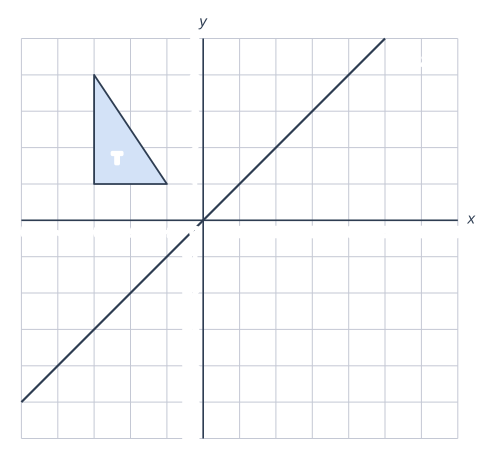
The diagram shows triangle T with vertices \((-3, 1)\), \((-1, 1)\) and \((-3, 4)\), and the line \(y = x\)
T is reflected in the line \(y = x\)
The image is then enlarged by scale factor 1.5, centre the origin, to give triangle T′.

Use matrices to work out the coordinates of the vertices of T′.
Work out the area of T′.

Give the coordinates of each point, typed as (x, y).

A coordinate grid with x from −5 to 7 and y from −6 to 5; each grid square is 1 unit across, and the axes cross at the origin O. Shape T is a shaded triangle with vertices (−3, 1), (−1, 1) and (−3, 4). The line labelled "y = x" is a straight line sloping upwards from left to right passing through the origin and (−3, −3).

Model answer

Reflection in \(y = x\): \(\begin{pmatrix} 0 & 1 \\ 1 & 0 \end{pmatrix}\); enlargement, scale factor 1.5: \(\begin{pmatrix} 1.5 & 0 \\ 0 & 1.5 \end{pmatrix}\)
Single matrix: \(\begin{pmatrix} 1.5 & 0 \\ 0 & 1.5 \end{pmatrix}\begin{pmatrix} 0 & 1 \\ 1 & 0 \end{pmatrix} = \begin{pmatrix} 0 & 1.5 \\ 1.5 & 0 \end{pmatrix}\)
\(\begin{pmatrix} 0 & 1.5 \\ 1.5 & 0 \end{pmatrix}\begin{pmatrix} -3 & -1 & -3 \\ 1 & 1 & 4 \end{pmatrix} = \begin{pmatrix} 1.5 & 1.5 & 6 \\ -4.5 & -1.5 & -4.5 \end{pmatrix}\)
T′ has vertices \((1.5, -4.5)\), \((1.5, -1.5)\) and \((6, -4.5)\)
T′ is right-angled at \((1.5, -4.5)\), with shorter sides 3 and 4.5
Area of T′ \(= \dfrac{1}{2} \times 3 \times 4.5 = 6.75\)

Explanation

Combine the two matrices (the enlargement on the left), then multiply by the vertices written as columns. A reflection keeps the area the same and an enlargement with scale factor 1.5 multiplies areas by 1.5², so the area changes from 3 to 6.75. A common error is to multiply the area by 1.5.

Mark scheme
  1. 1 mark

    B1 for \(\begin{pmatrix} 0 & 1 \\ 1 & 0 \end{pmatrix}\) and \(\begin{pmatrix} 1.5 & 0 \\ 0 & 1.5 \end{pmatrix}\)

    both matrices correct

  2. 1 mark

    M1 for the single matrix \(\begin{pmatrix} 0 & 1.5 \\ 1.5 & 0 \end{pmatrix}\), or the image of T after the reflection, \((1, -3)\), \((1, -1)\), \((4, -3)\)

    ft their matrices; at least one vertex correctly transformed

  3. 1 mark

    A1 for \((1.5, -4.5)\), \((1.5, -1.5)\) and \((6, -4.5)\)

    exact values, all three, in any order. Using the matrix for a reflection in y = −x gives (−1.5, 4.5), (−1.5, 1.5) and (−6, 4.5): B0M1A0. Vertices found without matrices: B0M0A0, but the area marks can still be awarded (max 2).

  4. 1 mark

    M1 for a correct method for the area of T′, eg \(\dfrac{1}{2} \times 3 \times 4.5\) or \(3 \times 1.5^2\)

    area of T = \(\dfrac{1}{2} \times 2 \times 3 = 3\); a reflection does not change area and the enlargement multiplies it by \(1.5^2\). ft their vertices of T′

  5. 1 mark

    A1 for 6.75

    exact value; accept 27/4. 4.5 (area multiplied by 1.5 instead of 1.5²) is A0. A fully correct answer with no working scores full marks for the area.

Ready to try the rest? Every answer you write is marked against the mark scheme, so you can see exactly where the marks are.

Study Helper Hints first, answers after you try

Stuck on this one? Ask for a hint and I’ll point you in the right direction, without giving the answer away. Once you’ve checked your answer, I’ll show you how the marks are awarded.