
Level:
Correct: 0
Incorrect: 0
Marks: 0/0
Exam Practice
Course:
Topics:
AQA Level 2 Further Maths (Calculator) Smart practice A mixed round aimed at your weak spots
Unit 1
Number
Unit 2
Algebra
Unit 3
Coordinate Geometry (2 dimensions only)
Unit 4
Calculus
Unit 5
Matrix Transformations
Unit 6
Geometry
Avg
score:
–
Topics
done:
0/43

Expanding brackets and collecting like terms

Practise 15 exam-style questions on Expanding brackets and collecting like terms for AQA Level 2 Further Maths (Calculator). Write your answer as you would in the exam and get it marked in seconds against the mark scheme, point by point, with the Study Helper on hand if you get stuck.

  • 15 questions
  • 1–6 marks each
  • Instant marking
  • No sign-up needed
15 questions, marked as you go

Sample questions with model answers

Here are 4 of the questions in this topic, each with a model answer, an explanation of why it earns the marks and the mark scheme an examiner would use.

Question 1

1 mark

Expand and simplify \(\dfrac{1}{2}x^{-2}(4x^5 - 6x^2)\)

Type powers with \(\text{\textasciicircum}\), for example \(\text{x\textasciicircum 2}\).

Model answer

\(\dfrac{1}{2}x^{-2} \times 4x^5 = 2x^3\)
\(\dfrac{1}{2}x^{-2} \times (-6x^2) = -3x^0 = -3\)
\(\dfrac{1}{2}x^{-2}(4x^5 - 6x^2) = 2x^3 - 3\)

Explanation

Multiply each term inside the bracket by \(\dfrac{1}{2}x^{-2}\): multiply the numbers and add the indices, so \(x^{-2} \times x^5 = x^3\) and \(x^{-2} \times x^2 = x^0 = 1\). Common errors are leaving the second term as \(-3x\) and treating \(x^{-2}\) as \(x^2\).

Mark scheme
  1. 1 mark

    B1 for \(2x^3 - 3\)

    terms in either order; accept typed powers such as \(\text{2x\textasciicircum 3 - 3}\). Do not accept \(2x^3 - 3x\), \(2x^7 - 3x^4\) (\(x^{-2}\) treated as \(x^2\)) or an unsimplified answer such as \(2x^3 - 3x^0\). Penalise incorrect further working on the answer line.
Question 2

2 marks

Expand and simplify \((p + q - r)(p - q + r)\)

Type powers with \(\text{\textasciicircum}\), for example \(\text{x\textasciicircum 2}\).

Model answer

\((p + q - r)(p - q + r) = (p + (q - r))(p - (q - r))\)
\(= p^2 - (q - r)^2\)
\(= p^2 - (q^2 - 2qr + r^2)\)
\(= p^2 - q^2 + 2qr - r^2\)

Explanation

Writing the brackets as \(p + (q - r)\) and \(p - (q - r)\) turns the product into a difference of two squares, \(p^2 - (q - r)^2\). Expanding all nine terms also works, but then the \(pq\) and \(pr\) terms must be seen to cancel. A common error is to change the sign of only the first term of \((q - r)^2\), giving \(p^2 - q^2 - 2qr + r^2\).

Mark scheme
  1. 1 mark

    M1 for a full expansion with at least 7 of the 9 terms correct: \(p^2 - pq + pr + pq - q^2 + qr - pr + qr - r^2\)

    may be seen in a grid. Also award for \(p^2 - (q - r)^2\) (difference of two squares) or \(p^2 - (q^2 - 2qr + r^2)\).

  2. 1 mark

    A1 for \(p^2 - q^2 + 2qr - r^2\)

    terms in any order and letters in any order within a term, eg \(2rq\); accept typed powers such as \(\text{p\textasciicircum 2 - q\textasciicircum 2 + 2qr - r\textasciicircum 2}\). \(p^2 - (q - r)^2\) left as the answer is M1A0. Do not accept \(p^2 - q^2 - 2qr + r^2\). A fully correct answer with no working scores full marks.

Question 3

3 marks

Expand and simplify \(2x(x - 1)(x + 3) - (x - 2)(x^2 + 4)\)

Type powers with \(\text{\textasciicircum}\), for example \(\text{x\textasciicircum 2}\).

Model answer

\((x - 1)(x + 3) = x^2 + 2x - 3\)
\(2x(x^2 + 2x - 3) = 2x^3 + 4x^2 - 6x\)
\((x - 2)(x^2 + 4) = x^3 + 4x - 2x^2 - 8 = x^3 - 2x^2 + 4x - 8\)
\(2x^3 + 4x^2 - 6x - (x^3 - 2x^2 + 4x - 8) = 2x^3 + 4x^2 - 6x - x^3 + 2x^2 - 4x + 8\)
\(= x^3 + 6x^2 - 10x + 8\)

Explanation

Expand each product separately, then put the second result in a bracket before subtracting, so that every one of its terms changes sign. Forgetting the bracket and changing only the sign of \(x^3\) gives \(x^3 + 2x^2 - 2x - 8\), a common wrong answer.

Mark scheme
  1. 1 mark

    M1 for \(2x^3 + 4x^2 - 6x\)

    oe eg \(2x^3 + 6x^2 - 2x^2 - 6x\), or \(2x(x^2 + 2x - 3)\) with \(x^2 + 2x - 3\) correct

  2. 1 mark

    M1 for \(x^3 - 2x^2 + 4x - 8\)

    oe eg \(x^3 + 4x - 2x^2 - 8\); may be seen in a grid

  3. 1 mark

    A1 for \(x^3 + 6x^2 - 10x + 8\)

    dep on both M marks. Terms in any order; accept typed powers such as \(\text{x\textasciicircum 3 + 6x\textasciicircum 2 - 10x + 8}\). \(x^3 + 2x^2 - 2x - 8\) (only the first term of the second product subtracted) scores M1M1A0. A fully correct answer with no working scores full marks.

Question 4

5 marks

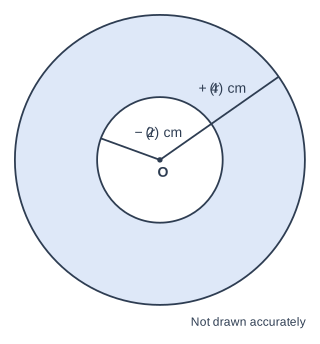
The diagram shows two circles with the same centre O.
The radius of the larger circle is \((r + 4)\) cm.
The radius of the smaller circle is \((r - 2)\) cm.
The region between the two circles is shaded.

Show that the shaded area is \(12\pi(r + 1)\) cm².

The shaded area is 210 cm².
Work out the value of \(r\).
Give your answer to 3 significant figures.

Geometry diagram, marked "Not drawn accurately". A circle with centre O (shaded). Another circle with centre O (filled white, so the inside of the circle is not shaded). A line is drawn from O going up and to the right. A line is drawn from O going to the left. The line going up and to the right from O is labelled (r + 4) cm. The line going to the left from O is labelled (r − 2) cm.

Model answer

Shaded area \(= \pi(r + 4)^2 - \pi(r - 2)^2\)
\(= \pi(r^2 + 8r + 16) - \pi(r^2 - 4r + 4)\)
\(= \pi(r^2 + 8r + 16 - r^2 + 4r - 4)\)
\(= \pi(12r + 12)\)
\(= 12\pi(r + 1)\)
\(12\pi(r + 1) = 210\)
\(r + 1 = \dfrac{210}{12\pi} = 5.5704...\)
\(r = 4.5704...\)
\(r = 4.57\) (3 sf)

Explanation

The shaded ring is the area of the large circle minus the area of the small circle; expanding both squares makes the \(r^2\) terms cancel, leaving an expression that is linear in \(r\). Then solve \(12\pi(r + 1) = 210\) with a calculator. Common errors are \((r - 2)^2 = r^2 - 4\) and forgetting to subtract 1 at the end, which gives 5.57.

Mark scheme
  1. 1 mark

    M1 for \(\pi(r + 4)^2 - \pi(r - 2)^2\)

    oe eg \(\pi((r + 4)^2 - (r - 2)^2)\)

  2. 1 mark

    M1 for \((r + 4)^2 = r^2 + 8r + 16\) and \((r - 2)^2 = r^2 - 4r + 4\)

    oe unsimplified, eg \(r^2 + 4r + 4r + 16\); both needed. \((r - 2)^2 = r^2 - 4\) is M0.

  3. 1 mark

    A1 for \(\pi(r^2 + 8r + 16 - r^2 + 4r - 4) = \pi(12r + 12) = 12\pi(r + 1)\) with no errors

    dep on both M marks; the bracket must be dealt with correctly when subtracting. An answer that only restates \(12\pi(r + 1)\) scores 0 for these three marks; every step must be shown.

  4. 1 mark

    M1 for \(12\pi(r + 1) = 210\)

    oe eg \(r + 1 = \dfrac{210}{12\pi}\) or \(r + 1 = [5.569, 5.574]\). This mark and the final A1 may be scored even if the first three marks are not.

  5. 1 mark

    A1 for \(4.57\) [4.565, 4.575]

    accept a more accurate value in the range, eg 4.5704; accept [3.14, 3.142] for \(\pi\) throughout; premature rounding giving a value outside the range is A0. 5.57 (forgetting to subtract 1) is M1A0; 16.5 (\(\pi\) left out) is M0A0. A correct value of \(r\) with no working scores the last two marks only.

Ready to try the rest? Every answer you write is marked against the mark scheme, so you can see exactly where the marks are.

Study Helper Hints first, answers after you try

Stuck on this one? Ask for a hint and I’ll point you in the right direction, without giving the answer away. Once you’ve checked your answer, I’ll show you how the marks are awarded.