
Level:
Correct: 0
Incorrect: 0
Marks: 0/0
Exam Practice
Course:
Topics:
AQA Level 2 Further Maths (Calculator) Smart practice A mixed round aimed at your weak spots
Unit 1
Number
Unit 2
Algebra
Unit 3
Coordinate Geometry (2 dimensions only)
Unit 4
Calculus
Unit 5
Matrix Transformations
Unit 6
Geometry
Avg
score:
–
Topics
done:
0/43

Solution of linear and quadratic inequalities

Practise 16 exam-style questions on Solution of linear and quadratic inequalities for AQA Level 2 Further Maths (Calculator). Write your answer as you would in the exam and get it marked in seconds against the mark scheme, point by point, with the Study Helper on hand if you get stuck.

  • 16 questions
  • 1–6 marks each
  • Instant marking
  • No sign-up needed
16 questions, marked as you go

Sample questions with model answers

Here are 4 of the questions in this topic, each with a model answer, an explanation of why it earns the marks and the mark scheme an examiner would use.

Question 1

2 marks

Solve \(4.5 - 1.2x \ge 0.6x - 2.7\)

Give your answer as an inequality. Type ≤ as <= and ≥ as >=.

Model answer

\(4.5 - 1.2x \ge 0.6x - 2.7\)
\(4.5 + 2.7 \ge 0.6x + 1.2x\)
\(7.2 \ge 1.8x\)
\(4 \ge x\)
\(x \le 4\)

Explanation

Solve it like an equation, but collect the x terms on the side where they stay positive (here the right), so you never divide by a negative number. If you do divide by a negative, the inequality sign must be reversed. A common error is to get \(-1.8x \ge -7.2\) and then write \(x \ge 4\).

Mark scheme
  1. 1 mark

    M1 for \(7.2 \ge 1.8x\) oe

    oe eg \(-1.8x \ge -7.2\), or \(1.8x = 7.2\) or \(x = 4\) seen

  2. 1 mark

    A1 for \(x \le 4\)

    oe eg \(4 \ge x\). \(x \ge 4\) or \(x = 4\) or \(x < 4\) is A0. A fully correct answer with no working scores full marks.
Question 2

3 marks

Solve \((2x - 1)^2 < 9\)

Give your answer as an inequality. Type ≤ as <= and ≥ as >=.

Model answer

\((2x - 1)^2 < 9\) means \(-3 < 2x - 1 < 3\)
Add 1: \(-2 < 2x < 4\)
Divide by 2: \(-1 < x < 2\)

Explanation

A square is less than 9 when the number being squared is between −3 and 3, so \(2x - 1\) is between −3 and 3. Alternatively expand to \(4x^2 - 4x - 8 < 0\), find the critical values −1 and 2, and take the region between them. A common error is to square root both sides and get only \(2x - 1 < 3\), giving \(x < 2\).

Mark scheme
  1. 1 mark

    M1 for \(-3 < 2x - 1 < 3\) oe or \(4x^2 - 4x - 8 < 0\) oe

    oe eg \(x^2 - x - 2 < 0\) or \(4x^2 - 4x - 8 = 0\), or \(2x - 1 = \pm 3\)

  2. 1 mark

    A1 for critical values \(-1\) and \(2\)

    may be seen in an inequality or equation

  3. 1 mark

    A1 for \(-1 < x < 2\)

    oe eg \(x > -1\) and \(x < 2\). \(x < 2\) only is A0; \(x < -1\) or \(x > 2\) is A0. A fully correct answer with no working scores full marks.

Question 3

4 marks

Solve \(3x^2 + 2 > 9x\)

The solutions of \(ax^2 + bx + c = 0\), where \(a ≠ 0\), are \(x = \dfrac{-b \pm \sqrt{b^2 - 4ac}}{2a}\)

Give the numbers in your answer to 2 decimal places.

Give your answer as inequalities. Type ≤ as <= and ≥ as >=.

Model answer

\(3x^2 - 9x + 2 > 0\)
Critical values from \(3x^2 - 9x + 2 = 0\):
\(x = \dfrac{9 \pm \sqrt{81 - 24}}{6} = \dfrac{9 \pm \sqrt{57}}{6}\)
\(x = 0.2416...\) or \(x = 2.7583...\)
The graph of \(y = 3x^2 - 9x + 2\) is U-shaped, so \(y > 0\) outside the critical values.
\(x < 0.24\) or \(x > 2.76\)

Explanation

Rearrange so that one side is zero, \(3x^2 - 9x + 2 > 0\); the quadratic does not factorise, so find the critical values with the formula and round them only at the end. A U-shaped parabola is above the x-axis outside its roots, so the answer has two separate parts (check: \(x = 0\) gives \(2 > 0\), true, and \(x = 1\) gives \(5 > 9\), false). Common errors are sign slips with \(b = -9\) and giving the region between the roots.

Mark scheme
  1. 1 mark

    M1 for \(\dfrac{-(-9) \pm \sqrt{(-9)^2 - 4 \times 3 \times 2}}{2 \times 3}\) oe

    a correct substitution into the formula for \(3x^2 - 9x + 2 = 0\) oe, or \(\dfrac{9 \pm \sqrt{57}}{6}\), or completing the square \(\left(x - \dfrac{3}{2}\right)^2 = \dfrac{19}{12}\); condone + for ±

  2. 1 mark

    A1 for 0.24 [0.235, 0.245]

    one critical value; may be seen in an inequality or equation

  3. 1 mark

    A1 for 2.76 [2.755, 2.765]

    dep on M1; the other critical value; may be seen in an inequality or equation

  4. 1 mark

    A1 for \(x < 0.24\) or \(x > 2.76\)

    two separate inequalities with values 0.24 [0.235, 0.245] and 2.76 [2.755, 2.765] ('or' or 'and' between them condoned); condone ≤ / ≥ for < / >. \(0.24 < x < 2.76\) (the wrong region) is A0; a single combined statement such as \(2.76 < x < 0.24\) is A0. Accept more accurate values in the ranges; premature rounding giving a value outside a range is A0. A fully correct answer with no working scores full marks.

Question 4

5 marks

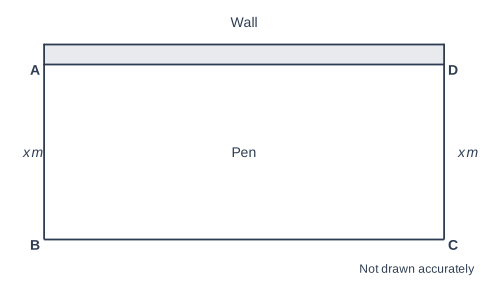
Max is making a rectangular pen against a long wall.

He uses 50 m of fencing for the other three sides, AB, BC and CD, as shown in the diagram.
The width of the pen is \(x\) m.

The area of the pen must be at least 280 m².

The solutions of \(ax^2 + bx + c = 0\), where \(a ≠ 0\), are \(x = \dfrac{-b \pm \sqrt{b^2 - 4ac}}{2a}\)

Work out the range of possible values of \(x\).
Give the numbers in your answer to 3 significant figures.

Give your answer as an inequality. Type ≤ as <= and ≥ as >=.

Geometry diagram, marked "Not drawn accurately". A wall with vertices A, D and 2 unlabelled points in order (shaded). A path A to B to C to D is drawn (not closed). AB is labelled x m. CD is labelled x m. The text "Wall" is written near A. The text "Pen" is written near A.

Model answer

Length of the pen \(= 50 - 2x\)
Area \(= x(50 - 2x) = 50x - 2x^2\)
\(50x - 2x^2 \ge 280\)
\(2x^2 - 50x + 280 \le 0\)
\(x^2 - 25x + 140 \le 0\)
Critical values: \(x = \dfrac{25 \pm \sqrt{625 - 560}}{2} = \dfrac{25 \pm \sqrt{65}}{2}\)
\(x = 8.468...\) or \(x = 16.531...\)
\(y = x^2 - 25x + 140\) is U-shaped, so it is \(\le 0\) between the critical values.
\(8.47 \le x \le 16.5\)

Explanation

The fence covers two widths and one length, so the length is \(50 - 2x\) and the area is \(x(50 - 2x)\). The area condition is a quadratic inequality: find the critical values with the formula and take the region between them, where the area is largest. Common errors are using \(50 - x\) for the length (forgetting the second width) and reversing the inequality when rearranging.

Mark scheme
  1. 1 mark

    M1 for length \(50 - 2x\) and area \(x(50 - 2x)\) oe

    oe eg \(50x - 2x^2\)

  2. 1 mark

    M1dep for \(x(50 - 2x) \ge 280\) leading to \(2x^2 - 50x + 280 \le 0\) oe

    oe eg \(x^2 - 25x + 140 \le 0\); = may be used for this mark

  3. 1 mark

    M1dep for \(\dfrac{25 \pm \sqrt{(-25)^2 - 4 \times 1 \times 140}}{2}\) oe

    a correct substitution into the formula, or \(\dfrac{25 \pm \sqrt{65}}{2}\), or completing the square; condone + for ±

  4. 1 mark

    A1 for critical values 8.47 [8.465, 8.475] and 16.5 [16.45, 16.55]

    may be seen in an inequality or equation

  5. 1 mark

    A1 for \(8.47 \le x \le 16.5\)

    values in the ranges above; condone < for ≤. \(x \le 8.47\) or \(x \ge 16.5\) is A0. Accept more accurate values in the ranges; premature rounding giving a value outside a range is A0. A fully correct answer with no working scores full marks.

Ready to try the rest? Every answer you write is marked against the mark scheme, so you can see exactly where the marks are.

Study Helper Hints first, answers after you try

Stuck on this one? Ask for a hint and I’ll point you in the right direction, without giving the answer away. Once you’ve checked your answer, I’ll show you how the marks are awarded.