Practise 17 exam-style questions on The equation of a tangent and normal to a curve for AQA Level 2 Further Maths (Calculator). Write your answer as you would in the exam and get it marked in seconds against the mark scheme, point by point, with the Study Helper on hand if you get stuck.
17 questions
1–6 marks each
Instant marking
No sign-up needed
17 questions, marked as you go
Sample questions with model answers
Here are 4 of the questions in this topic, each with a model answer, an explanation of why it earns the marks and the mark scheme an examiner would use.
Question 1
2 marks
A curve has equation \(y = 3x^{2} - 0.8x^{3}\)
Work out the gradient of the normal to the curve at the point where \(x = 1.5\) Give your answer to 3 significant figures.
Model answer
\(\dfrac{dy}{dx} = 6x - 2.4x^{2}\) At \(x = 1.5\): \(\dfrac{dy}{dx} = 9 - 5.4 = 3.6\) Gradient of the normal \(= -\dfrac{1}{3.6} = -0.2777...\) \(= -0.278\) (3 sf)
Explanation
Differentiate to find the gradient of the tangent at \(x = 1.5\), then use the fact that the normal is perpendicular to the tangent, so the product of their gradients is \(-1\). Common errors are giving the gradient of the tangent, and taking the reciprocal without changing the sign.
Mark scheme
1 mark
M1 for \(\dfrac{dy}{dx} = 6x - 2.4x^{2}\) and 3.6
the gradient of the tangent at \(x = 1.5\), exact; implied by \(-\dfrac{1}{3.6}\)
1 mark
A1 for \(-0.278\) [-0.2785, -0.2775]
accept \(-\dfrac{5}{18}\) or a more accurate value in the range, eg -0.2777...; premature rounding giving a value outside the range is A0. 3.6 (the gradient of the tangent), 0.278 (sign error) or -3.6 is M1A0. A fully correct answer with no working scores full marks.
Question 2
3 marks
A curve has equation \(y = 3x - 0.5x^{3}\) The tangent to the curve at the point where \(x = 2\) makes an acute angle \(\theta\) with the x-axis.
Work out the value of \(\theta\). Give your answer to 1 decimal place.
Model answer
\(\dfrac{dy}{dx} = 3 - 1.5x^{2}\) At \(x = 2\): \(\dfrac{dy}{dx} = 3 - 6 = -3\) The tangent has gradient \(-3\), so it slopes down and makes an acute angle \(\theta\) with the x-axis where \(\tan\theta = 3\) \(\theta = \tan^{-1} 3 = 71.565...\) \(\theta = 71.6^\circ\) (1 dp)
Explanation
The gradient of a line is the tangent of the angle it makes with the positive x-direction, so a line with gradient m makes an acute angle \(\tan^{-1}|m|\) with the x-axis. Here the gradient is \(-3\): the line slopes downwards, and the acute angle is \(\tan^{-1} 3\). A common error is to use the y-coordinate of the point instead of the gradient.
Mark scheme
1 mark
M1 for \(\dfrac{dy}{dx} = 3 - 1.5x^{2}\)
1 mark
M1dep for gradient \(-3\) at \(x = 2\)
implied by \(\tan\theta = 3\), \(\tan^{-1} 3\) or \(\theta\) in [71.5, 71.6]
1 mark
A1 for 71.6 [71.55, 71.65]
accept a more accurate value in the range, eg 71.565...; condone a missing degree sign. 108.4 (the obtuse angle) is M1M1A0; 18.4 (from \(\tan^{-1} \dfrac{1}{3}\)) is M1M1A0. Using the y-coordinate 2 (\(\tan^{-1} 2 = 63.4\)) scores M0. A fully correct answer with no working scores full marks.
Question 3
4 marks
A curve has equation \(y = x^{2} + bx + 2.75\), where \(b\) is a constant. The line \(y = 5x - 3.5\) is a tangent to the curve.
Work out the two possible values of \(b\).
Model answer
Let the line touch the curve at the point where \(x = p\) \(\dfrac{dy}{dx} = 2x + b\), so the gradients are equal: \(2p + b = 5\), so \(b = 5 - 2p\) The point is on both the curve and the line: \(p^{2} + bp + 2.75 = 5p - 3.5\) \(p^{2} + (5 - 2p)p + 2.75 = 5p - 3.5\) \(-p^{2} + 6.25 = 0\), so \(p = 2.5\) or \(p = -2.5\) \(p = 2.5\): \(b = 5 - 5 = 0\) \(p = -2.5\): \(b = 5 + 5 = 10\) \(b = 0\) or \(b = 10\)
Explanation
At the point of contact the curve and the tangent have the same gradient and the same y-value, which gives two equations in p and b. Alternatively, the line meets the curve where \(x^{2} + (b - 5)x + 6.25 = 0\), and a tangent gives equal roots, so the discriminant is 0. With \(b = 0\) the line touches the curve at \(x = 2.5\), and with \(b = 10\) at \(x = -2.5\); a common error is to find only one value.
Mark scheme
1 mark
M1 for \(2p + b = 5\) oe, where p is the x-coordinate of the point of contact
\(\dfrac{dy}{dx} = 2x + b\) equated to the gradient of the line; any letter for p
1 mark
M1 for \(p^{2} + bp + 2.75 = 5p - 3.5\) oe
the point of contact is on both the curve and the line
1 mark
M1dep for eliminating b to get \(p^{2} = 6.25\) oe
dep on both previous M1s; eg \(p^{2} + (5 - 2p)p + 6.25 = 5p\); implied by \(p = \pm 2.5\)
1 mark
A1 for \(b = 0\) and \(b = 10\)
both values. Alternative method (equal roots): M1 for \(x^{2} + bx + 2.75 = 5x - 3.5\); M1 for \(x^{2} + (b - 5)x + 6.25 = 0\); M1dep for \((b - 5)^{2} - 4 \times 6.25 = 0\); A1 for \(b = 0\) and \(b = 10\). A fully correct answer with no working scores full marks; one correct value only with no working scores 0.
Question 4
5 marks
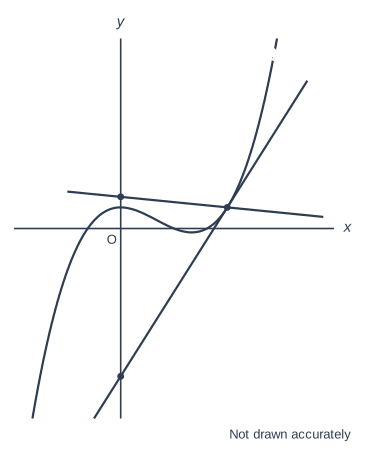
Here is a sketch of the curve \(y = x^{3} - 2x^{2} + 1\) The point P \((2, 1)\) lies on the curve. The tangent to the curve at P meets the y-axis at A. The normal to the curve at P meets the y-axis at B.
Work out the area of triangle PAB. You must show your working.
Model answer
\(\dfrac{dy}{dx} = 3x^{2} - 4x\) At \(x = 2\): gradient of the tangent \(= 12 - 8 = 4\) Tangent: \(y - 1 = 4(x - 2)\), so \(y = 4x - 7\) and A is \((0, -7)\) Gradient of the normal \(= -\dfrac{1}{4}\) Normal: \(y - 1 = -\dfrac{1}{4}(x - 2)\), so \(y = -0.25x + 1.5\) and B is \((0, 1.5)\) AB \(= 1.5 - (-7) = 8.5\), along the y-axis The height of the triangle from P to the y-axis is 2 Area \(= \dfrac{1}{2} \times 8.5 \times 2 = 8.5\)
Explanation
Find the tangent and the normal at P and put \(x = 0\) in each to get A and B. Since A and B are both on the y-axis, take AB as the base; the perpendicular height is the distance from P to the y-axis, which is its x-coordinate, 2. The angle at P is a right angle, so \(\dfrac{1}{2} \times PA \times PB\) also works. A common error is to use the gradient 4 for the normal as well as the tangent.
Mark scheme
1 mark
M1 for \(\dfrac{dy}{dx} = 3x^{2} - 4x\) and gradient 4 at \(x = 2\)
1 mark
M1dep for \(y - 1 = 4(x - 2)\) oe or A \((0, -7)\)
eg \(y = 4x - 7\)
1 mark
M1 for \(y - 1 = -\dfrac{1}{4}(x - 2)\) oe or B \((0, 1.5)\)
dep on the first M1; normal gradient \(-1 \div\) their 4; eg \(y = -0.25x + 1.5\)
1 mark
M1 for \(\dfrac{1}{2} \times (1.5 - (-7)) \times 2\) oe
their AB along the y-axis as the base, with height 2 (the x-coordinate of P); needs their A and B on the y-axis. Alternative: the angle at P is 90°, so \(\dfrac{1}{2} \times PA \times PB\) with their A and B, eg \(\dfrac{1}{2} \times \sqrt{68} \times \sqrt{4.25}\)
1 mark
A1 for 8.5
oe eg \(\dfrac{17}{2}\). An area estimated from the sketch scores 0 (it is not drawn accurately). The question says 'You must show your working': correct answer with no working scores 0.
Ready to try the rest? Every answer you write is marked against the mark scheme, so you can see exactly where the marks are.
Ctrl + Enter to check
Study HelperHints first, answers after you try
Stuck on this one? Ask for a hint and I’ll point you in the right direction, without giving the answer away. Once you’ve checked your answer, I’ll show you how the marks are awarded.