
Level:
Correct: 0
Incorrect: 0
Marks: 0/0
Exam Practice
Course:
Topics:
AQA Level 2 Further Maths (Calculator) Smart practice A mixed round aimed at your weak spots
Unit 1
Number
Unit 2
Algebra
Unit 3
Coordinate Geometry (2 dimensions only)
Unit 4
Calculus
Unit 5
Matrix Transformations
Unit 6
Geometry
Avg
score:
–
Topics
done:
0/43

Trigonometry and Pythagoras' theorem in 2D and 3D problems

Practise 20 exam-style questions on Trigonometry and Pythagoras' theorem in 2D and 3D problems for AQA Level 2 Further Maths (Calculator). Write your answer as you would in the exam and get it marked in seconds against the mark scheme, point by point, with the Study Helper on hand if you get stuck.

  • 20 questions
  • 1–6 marks each
  • Instant marking
  • No sign-up needed
20 questions, marked as you go

Sample questions with model answers

Here are 4 of the questions in this topic, each with a model answer, an explanation of why it earns the marks and the mark scheme an examiner would use.

Question 1

2 marks

The diagram shows a vertical lighthouse LF.
F is on horizontal ground at sea level and \(LF = 34\) m.
A boat B is on the sea, \(d\) m from F.
The angle of depression of B from L is 14.5°

Work out the value of \(d\).
Give your answer to 3 significant figures.
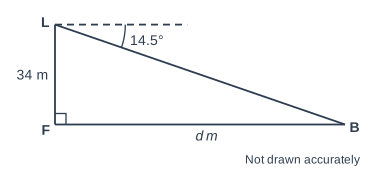
Geometry diagram, marked "Not drawn accurately". Line segments LF, FB and LB are drawn. A dashed line is drawn from L going to the right. Angle LFB is marked as a right angle (90°). The angle at L between the line going to the right from L and LB is marked 14.5°. LF is labelled 34 m. FB is labelled d m.

Model answer

The angle of depression equals angle LBF (alternate angles, the horizontal at L is parallel to the ground).
\(\tan 14.5^\circ = \dfrac{34}{d}\)
\(d = \dfrac{34}{\tan 14.5^\circ} = 131.46...\)
\(d = 131\) (3 sf)

Explanation

The angle of depression is measured down from the horizontal at L. Because the horizontal at L is parallel to the ground, the angle at B in triangle LFB is also 14.5°, with LF opposite it and BF adjacent. A common error is to put the 14.5° at L inside the triangle (between LB and LF), giving \(34\tan 14.5^\circ\).

Mark scheme
  1. 1 mark

    M1 for \(\tan 14.5 = \dfrac{34}{d}\) or \(d = \dfrac{34}{\tan 14.5}\) oe

    Angle LBF = 14.5° (alternate angles with the horizontal at L). oe eg \(d = 34 \tan 75.5\); accept [0.258, 0.259] for tan 14.5

  2. 1 mark

    A1 for \(131\) [130.5, 131.5]

    Accept a more accurate value in the range, eg 131.5. A fully correct answer with no working scores full marks. 8.79 (\(34 \tan 14.5\)) is M0A0.
Question 2

3 marks

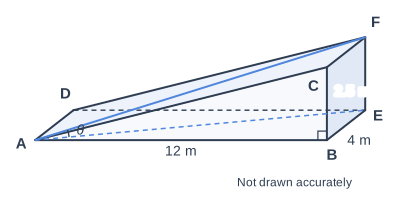
The diagram shows a ramp in the shape of a triangular prism ABCDEF.
The base ABED is a horizontal rectangle with \(AB = 12\) m and \(BE = 4\) m.
The face BCFE is vertical and is a rectangle.
\(BC = 2.5\) m

Work out the angle between the line AF and the base ABED.
Give your answer to 1 decimal place.

A triangular prism drawn in 3D with hidden edges shown as dashed lines. Its end is a right-angled triangle. The base of the triangle is labelled 12 m (along the bottom edge of the front triangle). The height of the triangle is labelled 2.5 m (along the vertical right side of the front triangle). The length of the prism is labelled 4 m (along the bottom edge going back from the front triangle). The front triangle is ABC (A bottom left, B bottom right, C the top) and the back triangle is DEF, with D behind A, E behind B and F behind C. A straight line is drawn from A to F. A straight line is drawn from A to E. The angle EAF at A is marked θ. The diagram is labelled "Not drawn accurately".

Model answer

F is vertically above E, so the projection of AF on the base is AE.
\(AE = \sqrt{12^2 + 4^2} = \sqrt{160} = 12.649...\) m
Triangle AEF has a right angle at E, with \(EF = BC = 2.5\) m:
\(\tan\theta = \dfrac{2.5}{12.649...}\)
\(\theta = 11.179...\)
\(\theta = 11.2^\circ\) (1 dp)

Explanation

AF runs diagonally up the sloping face, so its angle with the ground is found in the vertical triangle AEF, where E is directly below F. The horizontal side AE is the diagonal of the base rectangle. Using AB alone gives the angle of the front edge AC, which is steeper.

Mark scheme
  1. 1 mark

    M1 for \(AE^2 = 12^2 + 4^2\) or \(AE = \sqrt{160}\) or \([12.6, 12.65]\)

    E is vertically below F, so AE is the projection of AF on the base. Or \(AF = \sqrt{12^2 + 4^2 + 2.5^2} = [12.89, 12.9]\).

  2. 1 mark

    M1dep for \(\tan\theta = \dfrac{2.5}{\text{their } AE}\) or \(\sin\theta = \dfrac{2.5}{\text{their } AF}\) oe

    Triangle AEF with the right angle at E; accept their AE in [12.6, 12.65]

  3. 1 mark

    A1 for \(11.2\) [11.15, 11.25]

    Accept a more accurate value in the range, eg 11.18. A fully correct answer with no working scores full marks. 11.8 (from \(\tan\theta = \dfrac{2.5}{12}\), the slope of the ramp's front edge AC) is M0M0A0.

Question 3

4 marks

A cone has base radius 5.5 cm and perpendicular height 13 cm.
V is the apex of the cone and O is the centre of the base.
A and B are points on the circumference of the base with angle AOB = 90°

Sine rule: \(\dfrac{a}{\sin A} = \dfrac{b}{\sin B} = \dfrac{c}{\sin C}\)   Cosine rule: \(a^2 = b^2 + c^2 - 2bc\cos A\)   Area of triangle \(= \dfrac{1}{2}ab\sin C\)

Work out the size of angle AVB.
Give your answer to 1 decimal place.

Model answer

\(VA = VB = \sqrt{5.5^2 + 13^2} = \sqrt{199.25}\) cm (right-angled triangle VOA)
\(AB = \sqrt{5.5^2 + 5.5^2} = \sqrt{60.5}\) cm (right-angled triangle AOB)
Cosine rule in triangle VAB:
\(\cos AVB = \dfrac{199.25 + 199.25 - 60.5}{2 \times 199.25} = \dfrac{338}{398.5} = 0.84818...\)
Angle AVB \(= 31.985...\)
\(= 32.0^\circ\) (1 dp)

Explanation

Triangle VAB is not vertical and has no right angle, so find its sides first: VA and VB are slant heights (Pythagoras in a vertical cross-section) and AB is a chord of the base found from the right angle at O. Then the cosine rule gives the angle at the apex. A common error is to treat A and B as the ends of a diameter.

Mark scheme
  1. 1 mark

    M1 for \(VA^2 = 5.5^2 + 13^2\) (\(= 199.25\)) or \(VA = [14.1, 14.12]\)

    VA = VB, the slant height. Triangle VOA has a right angle at O.

  2. 1 mark

    M1 for \(AB^2 = 5.5^2 + 5.5^2\) (\(= 60.5\)) or \(AB = [7.77, 7.78]\)

    Triangle AOB has a right angle at O. oe eg \(5.5\sqrt{2}\)

  3. 1 mark

    M1dep for \(\cos AVB = \dfrac{199.25 + 199.25 - 60.5}{2 \times 199.25}\) or \(\cos AVB = [0.848, 0.8482]\), or \(\sin\left(\dfrac{1}{2}AVB\right) = \dfrac{\frac{1}{2}AB}{VA}\) oe

    dep on both M marks. Cosine rule in triangle VAB, or the isosceles triangle split at the midpoint of AB.

  4. 1 mark

    A1 for \(32.0\) [31.95, 32.05]

    Accept a more accurate value in the range, eg 31.99; condone 32. A fully correct answer with no working scores full marks. 45.9 (taking A and B at opposite ends of a diameter, or AB = 11) is M1M0M0A0. Premature rounding giving a value outside the range is A0.

Question 4

5 marks

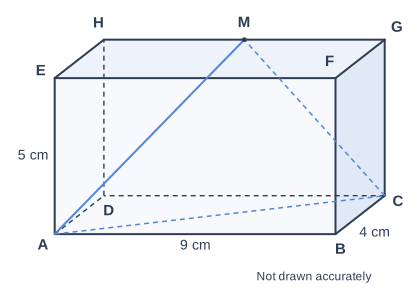
The diagram shows a cuboid ABCDEFGH.
\(AB = 9\) cm, \(BC = 4\) cm and \(CG = 5\) cm.
M is the midpoint of GH.

Sine rule: \(\dfrac{a}{\sin A} = \dfrac{b}{\sin B} = \dfrac{c}{\sin C}\)   Cosine rule: \(a^2 = b^2 + c^2 - 2bc\cos A\)   Area of triangle \(= \dfrac{1}{2}ab\sin C\)

Work out the area of triangle AMC.
Give your answer to 3 significant figures.

A cuboid drawn in 3D with hidden edges shown as dashed lines. The length is labelled 9 cm (along the front bottom edge). The width (the edge going back) is labelled 4 cm (along the bottom edge going back on the right). The height is labelled 5 cm (along the front left vertical edge). The vertices are labelled: base ABCD (A front left, B front right, C back right, D back left) and top EFGH, with E above A, F above B, G above C and H above D. M is the midpoint of GH. A straight line is drawn from A to C. A straight line is drawn from A to M. A straight line is drawn from C to M. The diagram is labelled "Not drawn accurately".

Model answer

AC is a diagonal of the base: \(AC^2 = 9^2 + 4^2 = 97\)
M is the midpoint of GH, so \(MG = 4.5\) cm and, in the face DCGH, \(MC^2 = 4.5^2 + 5^2 = 45.25\)
Let N be the midpoint of DC, directly below M: \(AN^2 = AD^2 + DN^2 = 4^2 + 4.5^2 = 36.25\) and \(AM^2 = 36.25 + 5^2 = 61.25\)
Cosine rule in triangle AMC:
\(\cos MAC = \dfrac{61.25 + 97 - 45.25}{2\sqrt{61.25}\sqrt{97}} = 0.73300...\)
Angle MAC \(= 42.860...^\circ\)
Area \(= \dfrac{1}{2} \times \sqrt{61.25} \times \sqrt{97} \times \sin 42.860...^\circ = 26.215...\)
\(= 26.2\) cm² (3 sf)

Explanation

Triangle AMC cuts through the cuboid and has no right angle (angle AMC is close to 90° but is 84.8°), so find its three sides first: AC across the base, MC in the back face DCGH, and AM through the inside, using the point directly below M. Then the cosine rule gives an angle, and \(\dfrac{1}{2}ab\sin C\) gives the area using the two sides that make that angle. Keep the square roots (or full calculator values) until the end.

Mark scheme
  1. 1 mark

    M1 for all three sides of triangle AMC: \(AC = \sqrt{97}\), \(MC = \sqrt{45.25}\) and \(AM = \sqrt{61.25}\) oe

    \(AC^2 = 9^2 + 4^2\) (diagonal of the base); \(MC^2 = 4.5^2 + 5^2\) (in the back face DCGH, with MG = 4.5); \(AM^2 = 4^2 + 4.5^2 + 5^2\), eg using the point N, the midpoint of DC, directly below M: \(AN^2 = 4^2 + 4.5^2\), then \(AM^2 = AN^2 + 5^2\). AC = [9.84, 9.85], MC = [6.72, 6.73], AM = [7.82, 7.83].

  2. 1 mark

    M1dep for the cosine rule for one angle of triangle AMC, eg \(\cos MAC = \dfrac{61.25 + 97 - 45.25}{2\sqrt{61.25}\sqrt{97}}\)

    oe for angle AMC or angle ACM

  3. 1 mark

    A1 for angle MAC \(= [42.8, 42.9]\) or \(\cos MAC = [0.733, 0.734]\)

    Or angle AMC = [84.8, 84.9] or angle ACM = [52.3, 52.4], or their cosines (cos AMC = [0.09, 0.091], cos ACM = [0.611, 0.612])

  4. 1 mark

    M1 for \(\dfrac{1}{2} \times \sqrt{61.25} \times \sqrt{97} \times \sin\) their angle MAC oe

    The angle used must be the one between the two sides used, eg \(\dfrac{1}{2} \times \sqrt{61.25} \times \sqrt{45.25} \times \sin AMC\) or \(\dfrac{1}{2} \times \sqrt{97} \times \sqrt{45.25} \times \sin ACM\); accept [0.68, 0.681] for sin MAC

  5. 1 mark

    A1 for \(26.2\) [26.15, 26.25]

    Needs the first M1. Accept a more accurate value in the range, eg 26.22. A fully correct answer with no working scores full marks. Any other valid method (eg Heron's formula with the three sides) can score full marks. Treating AMC as right-angled at M (\(\dfrac{1}{2} \times \sqrt{61.25} \times \sqrt{45.25} = 26.3\)) scores M1 only. Premature rounding giving a value outside the range is A0 (the sides rounded to 7.83, 6.73 and 9.85 give 26.24, which is in the range).

Ready to try the rest? Every answer you write is marked against the mark scheme, so you can see exactly where the marks are.

Study Helper Hints first, answers after you try

Stuck on this one? Ask for a hint and I’ll point you in the right direction, without giving the answer away. Once you’ve checked your answer, I’ll show you how the marks are awarded.