Question 1
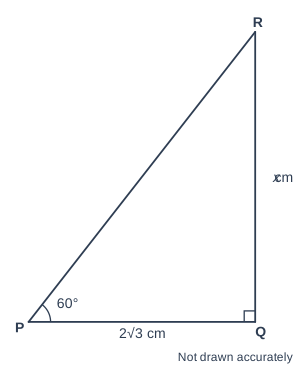
2 marksThe diagram shows a right-angled triangle PQR.
Angle PQR = 90°, angle QPR = 60° and PQ = \(2\sqrt{3}\) cm.
Work out the value of \(x\).
Model answer
\(\tan 60^\circ = \dfrac{QR}{PQ}\)
\(x = 2\sqrt{3} \times \tan 60^\circ = 2\sqrt{3} \times \sqrt{3} = 2 \times 3\)
\(x = 6\)
Explanation
QR is opposite the 60° angle and PQ is next to it, so QR = PQ × tan 60° = 2√3 × √3. Since √3 × √3 = 3, the answer is a whole number. In the ratio 1 : √3 : 2 the shortest side is next to the 60° angle, so here one part is 2√3 cm. A common error is to use tan 30°, or to treat PQ as the √3 side, giving 2.
Mark scheme
-
1 mark
M1 for \(x = 2\sqrt{3}\tan 60^\circ\) or \(2\sqrt{3} \times \sqrt{3}\) oe
oe eg \(\tan 60^\circ = \dfrac{x}{2\sqrt{3}}\), or the ratio \(1 : \sqrt{3} : 2\) used with PQ (next to 60°) as the shortest side, or PR = \(4\sqrt{3}\) and \(x = \sqrt{48 - 12}\)
-
1 mark
A1 for 6
accept 6.00 from a calculator. 2 (from tan 30°, or from treating PQ as the √3 side) is M0A0. A fully correct answer with no working scores full marks.