
Level:
Correct: 0
Incorrect: 0
Marks: 0/0
Exam Practice
Course:
Topics:
AQA Level 2 Further Maths (Calculator) Smart practice A mixed round aimed at your weak spots
Unit 1
Number
Unit 2
Algebra
Unit 3
Coordinate Geometry (2 dimensions only)
Unit 4
Calculus
Unit 5
Matrix Transformations
Unit 6
Geometry
Avg
score:
–
Topics
done:
0/43

Graphs of sin x, cos x and tan x for any angle

Practise 17 exam-style questions on Graphs of sin x, cos x and tan x for any angle for AQA Level 2 Further Maths (Calculator). Write your answer as you would in the exam and get it marked in seconds against the mark scheme, point by point, with the Study Helper on hand if you get stuck.

  • 17 questions
  • 1–6 marks each
  • Instant marking
  • No sign-up needed
17 questions, marked as you go

Sample questions with model answers

Here are 4 of the questions in this topic, each with a model answer, an explanation of why it earns the marks and the mark scheme an examiner would use.

Question 1

2 marks

Work out the two values of \(x\), where \(0^\circ \le x \le 360^\circ\), for which \(\cos x = \cos 1000^\circ\)

Model answer

\(1000^\circ - 2 \times 360^\circ = 280^\circ\), so \(\cos 1000^\circ = \cos 280^\circ\)
The graph of \(y = \cos x\) is symmetrical about \(x = 180^\circ\), so \(\cos(360^\circ - 280^\circ) = \cos 280^\circ\)
\(x = 80^\circ\) and \(x = 280^\circ\)

Explanation

The cosine graph repeats every 360°, so subtract 720° to bring 1000° into the range: cos 1000° = cos 280°. The graph is symmetrical about x = 180°, so the other angle is 360° − 280° = 80°. Working out cos 1000° = 0.1736... on a calculator and using cos⁻¹ gives 80° directly, and then 360° − 80° = 280°. A common error is to give 100° or 260°, using the symmetry of the sine graph instead.

Mark scheme
  1. 1 mark

    M1 for 280° or 80° seen

    oe eg \(1000^\circ - 720^\circ = 280^\circ\), or \(\cos^{-1}(\cos 1000^\circ) = 80^\circ\). One correct angle with no working scores M1.

  2. 1 mark

    A1 for 80° and 280°

    with no other values in the range 0° to 360°; ignore values outside the range. 100° or 260° (from 180° − x or 180° + x) as an extra value is A0. Condone missing degree signs. A fully correct answer with no working scores full marks.
Question 2

3 marks

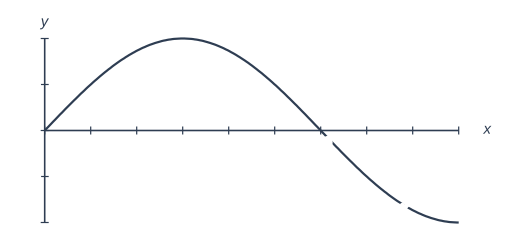
Here is a sketch of \(y = \sin x\) for \(0^\circ \le x \le 270^\circ\)

The equation \(\sin x = k\), where \(k\) is a constant, has exactly two solutions for \(0^\circ \le x \le 270^\circ\)

Work out the range of possible values of \(k\).

Give your answer as an inequality. Type ≤ as <= and ≥ as >=.

A pair of axes with x from 0 to 270 and y from −1 to 1; the x-axis is marked every 30 and the y-axis every 0.5, and the axes cross at the origin O. The curve labelled "y = sin x" is a sine curve (a smooth repeating wave): it crosses the x-axis at (0, 0) and (180, 0); it has a maximum point at (90, 1).

Model answer

The solutions of \(\sin x = k\) are where the line \(y = k\) meets the graph
For \(0 < k < 1\) the line meets the graph twice, once on each side of the maximum at \(x = 90^\circ\)
\(k = 1\) gives only one solution, \(x = 90^\circ\)
\(k = 0\) gives two solutions, \(x = 0^\circ\) and \(x = 180^\circ\)
For \(-1 \le k < 0\) there is only one solution, between 180° and 270°
So \(0 \le k < 1\)

Explanation

The number of solutions of sin x = k is the number of times the horizontal line y = k meets the graph. On this interval the curve rises to 1 at 90° and then falls to −1 at 270°, so a line below the x-axis meets it once, the x-axis meets it at 0° and 180°, and a line between 0 and 1 meets it twice. Common errors are 0 < k < 1 (missing that k = 0 gives two solutions) and −1 < k < 1 (forgetting that the interval stops at 270°).

Mark scheme
  1. 3 marks

    B3 for \(0 \le k < 1\)

    oe eg \(1 > k \ge 0\) or [0, 1). B2 for \(0 < k < 1\) or \(0 \le k \le 1\) (one end wrong). B1 for \(0 < k \le 1\), or for both boundary cases worked out correctly, eg k = 0 gives two solutions (0° and 180°) and k = 1 gives one solution (90°). \(-1 < k < 1\) is B0. A fully correct answer with no working scores full marks.
Question 3

3 marks

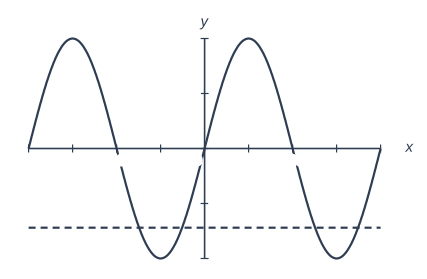
Here is a sketch of \(y = \sin x\) for \(-360^\circ \le x \le 360^\circ\) and the line \(y = -0.72\)

Work out all the solutions of \(\sin x = -0.72\) for \(-360^\circ \le x \le 360^\circ\)
Give your answers to 1 decimal place.

A pair of axes with x from −360 to 360 and y from −1 to 1; the x-axis is marked every 90 and the y-axis every 0.5, and the axes cross at the origin O. The curve labelled "y = sin x" is a sine curve (a smooth repeating wave): it crosses the x-axis at (−360, 0), (−180, 0), (0, 0), (180, 0) and (360, 0); it has a maximum point at (−270, 1) and a minimum point at (−90, −1) and a maximum point at (90, 1) and a minimum point at (270, −1). The line labelled "y = −0.72" is a horizontal straight line crossing the y-axis at (0, −0.72). The curve labelled "y = sin x" and the line labelled "y = −0.72" cross at 4 points, which can be read from the scales on the axes.

Model answer

\(\sin^{-1}(-0.72) = -46.054...^\circ\)
The graph is symmetrical about \(x = -90^\circ\), so \(-180^\circ + 46.054...^\circ = -133.945...^\circ\) is also a solution
The graph repeats every 360°, so add 360° to each: \(313.945...^\circ\) and \(226.054...^\circ\)
\(x = -133.9^\circ, -46.1^\circ, 226.1^\circ, 313.9^\circ\)

Explanation

The calculator gives one solution, −46.1°. The sine graph is symmetrical about the minimum at x = −90°, which gives −133.9°, and the graph repeats every 360°, which gives the two solutions between 180° and 360°. The line y = −0.72 crosses the curve four times in this interval, so look for four answers. A common error is to give only the solutions between 0° and 360°, or to use 180° − (−46.1°) = 226.1° and stop.

Mark scheme
  1. 1 mark

    M1 for \(\sin^{-1}(-0.72) = [-46.1, -46.0]\) or one correct solution

    the solutions are −133.9 [−133.95, −133.85], −46.1 [−46.15, −46.05], 226.1 [226.05, 226.15] and 313.9 [313.85, 313.95]. One correct solution with no working scores M1.

  2. 1 mark

    M1dep for a second correct solution

    two correct solutions with no working scores M2

  3. 1 mark

    A1 for −133.9, −46.1, 226.1 and 313.9 with no other values in the range

    accept more accurate values in the ranges; premature rounding giving a value outside a range is A0. Ignore values outside the range −360° to 360°. Condone missing degree signs. A fully correct answer with no working scores full marks.

Question 4

5 marks

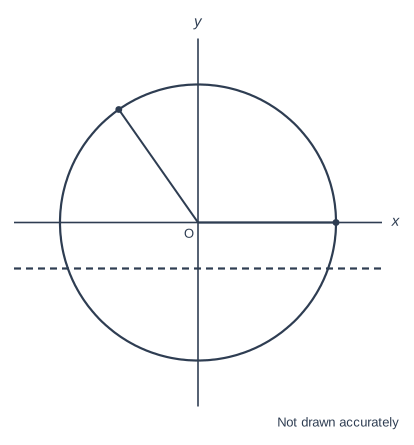
The diagram shows a circle with centre O and radius 6 cm, and the line \(y = -2\)
A point P starts at A(6, 0) and moves once round the circle anticlockwise.
When OP has turned through an angle \(\theta\) from OA, P is the point \((6\cos\theta, 6\sin\theta)\)

Work out the range of values of \(\theta\), for \(0^\circ \le \theta \le 360^\circ\), for which P is below the line \(y = -2\)
Give the values in your answer to 1 decimal place.

Work out the fraction of the complete turn for which P is below the line \(y = -2\)
Give your answer to 3 significant figures.

Give the range of values as an inequality. Type ≤ as <= and ≥ as >=.
Type θ as theta.

A sketch on a pair of axes (x across, y up) with no scale marked, the axes crossing at the origin O. It is marked "Not drawn accurately". The circle is a circle with centre (0, 0) (the origin) and radius 6. The line labelled "y = −2" is a horizontal straight line; its position cannot be read off, as the sketch has no scale. The circle and the line labelled "y = −2" cross at 2 points, which cannot be read off, as the sketch has no scale. Point A is marked with a dot at (6, 0). Point P is marked with a dot; its coordinates cannot be read off, as the sketch has no scale. A straight line segment joins (0, 0) to P. A straight line segment joins (0, 0) to A (6, 0).

Model answer

P is below the line when \(6\sin\theta < -2\), so \(\sin\theta < -\dfrac{1}{3}\)
\(\sin^{-1}\left(-\dfrac{1}{3}\right) = -19.471...^\circ\)
For \(0^\circ \le \theta \le 360^\circ\), \(\sin\theta = -\dfrac{1}{3}\) at \(180^\circ + 19.471...^\circ = 199.471...^\circ\) and \(360^\circ - 19.471...^\circ = 340.528...^\circ\)
Between these angles \(\sin\theta < -\dfrac{1}{3}\) (P is lowest at \(\theta = 270^\circ\))
\(199.5^\circ < \theta < 340.5^\circ\)
Fraction of the turn \(= \dfrac{340.528... - 199.471...}{360} = \dfrac{141.057...}{360} = 0.39182...\)
Fraction \(= 0.392\)

Explanation

The y-coordinate of P is 6 sin θ, so P is below the line exactly when sin θ < −1/3. The sine graph is below −1/3 on one interval centred on its minimum at 270°: from 180° + 19.5° to 360° − 19.5°. The fraction of the turn is the length of that interval divided by 360°. A common error is to take the calculator value −19.5° as one end of the interval, although it is not between 0° and 360°.

Mark scheme
  1. 1 mark

    M1 for \(6\sin\theta < -2\) or \(6\sin\theta = -2\) or \(\sin\theta = -\dfrac{1}{3}\) oe

    oe eg \(\sin\theta = -0.333...\)

  2. 1 mark

    M1dep for \(\sin^{-1}\left(-\dfrac{1}{3}\right) = [-19.5, -19.4]\) or 199.5 or 340.5 seen

    199.5 [199.45, 199.55], 340.5 [340.45, 340.55]

  3. 1 mark

    A1 for \(199.5^\circ < \theta < 340.5^\circ\)

    accept more accurate values at the ends; condone missing degree signs. ≤ signs are A0 (at the ends P is on the line). \(\theta < 199.5^\circ\) or \(\theta > 340.5^\circ\) is A0.

  4. 1 mark

    M1 for \(\dfrac{\text{their } 340.5 - \text{their } 199.5}{360}\) oe

    their values must come from \(\sin\theta = -\dfrac{1}{3}\) or \(\sin\theta = \dfrac{1}{3}\); oe eg \(\dfrac{180 - 2 \times 19.47}{360}\)

  5. 1 mark

    A1 for 0.392 [0.3915, 0.3925]

    accept a more accurate value in the range, or a fraction equal to a value in the range, eg \(\dfrac{141}{360}\) or \(\dfrac{47}{120}\). Correct answers with no working score full marks.

Ready to try the rest? Every answer you write is marked against the mark scheme, so you can see exactly where the marks are.

Study Helper Hints first, answers after you try

Stuck on this one? Ask for a hint and I’ll point you in the right direction, without giving the answer away. Once you’ve checked your answer, I’ll show you how the marks are awarded.