
Level:
Correct: 0
Incorrect: 0
Marks: 0/0
Exam Practice
Course:
Topics:
AQA Level 2 Further Maths (Calculator) Smart practice A mixed round aimed at your weak spots
Unit 1
Number
Unit 2
Algebra
Unit 3
Coordinate Geometry (2 dimensions only)
Unit 4
Calculus
Unit 5
Matrix Transformations
Unit 6
Geometry
Avg
score:
–
Topics
done:
0/43

The equation of a circle

Practise 18 exam-style questions on The equation of a circle for AQA Level 2 Further Maths (Calculator). Write your answer as you would in the exam and get it marked in seconds against the mark scheme, point by point, with the Study Helper on hand if you get stuck.

  • 18 questions
  • 1–6 marks each
  • Instant marking
  • No sign-up needed
18 questions, marked as you go

Sample questions with model answers

Here are 4 of the questions in this topic, each with a model answer, an explanation of why it earns the marks and the mark scheme an examiner would use.

Question 1

2 marks

A circle has centre \((-2, 5)\) and diameter 14

The equation of a circle with centre \((a, b)\) and radius \(r\) is \((x - a)^2 + (y - b)^2 = r^2\)

Work out the equation of the circle.
Type powers with \(\text{\textasciicircum}\), for example \(\text{x\textasciicircum 2}\).

Model answer

Radius \(= 14 \div 2 = 7\)
\(a = -2\), \(b = 5\), \(r = 7\)
\((x - (-2))^2 + (y - 5)^2 = 7^2\)
\((x + 2)^2 + (y - 5)^2 = 49\)

Explanation

The formula needs the radius, which is half the diameter, and the right-hand side is the radius squared. The centre (−2, 5) gives (x + 2) and (y − 5) in the brackets. AQA's examiners report (8365/2 June 2022) noted students unsure whether a length was the radius or the diameter, and some used the diameter in the equation.

Mark scheme
  1. 2 marks

    B2 for \((x + 2)^2 + (y - 5)^2 = 49\)

    oe eg \((x - (-2))^2 + (y - 5)^2 = 7^2\) or the correct expansion \(x^2 + y^2 + 4x - 10y - 20 = 0\). B1 for radius 7 seen, or \((x + 2)^2 + (y - 5)^2 = k\) where \(k ≠ 49\) (eg 196 from using the diameter, or 14), or \((x ...)^2 + (y ...)^2 = 49\) with a sign error in a bracket. Accept powers typed with \(\text{\textasciicircum}\) or written as ². A fully correct answer with no working scores full marks.
Question 2

3 marks

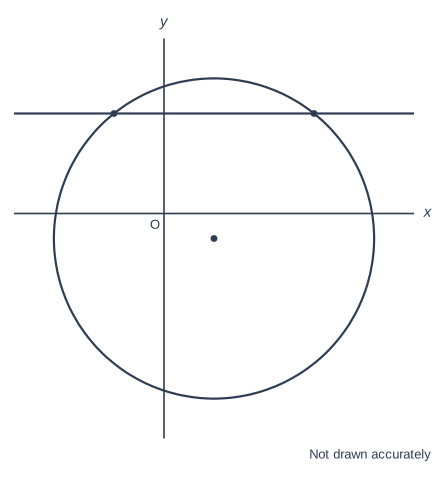
The diagram shows a circle with centre C \((2, -1)\) and the line \(y = 4\)
The line meets the circle at P and Q.
The length of PQ is 8

The equation of a circle with centre \((a, b)\) and radius \(r\) is \((x - a)^2 + (y - b)^2 = r^2\)

Work out the equation of the circle.
Type powers with \(\text{\textasciicircum}\), for example \(\text{x\textasciicircum 2}\).

A sketch on a pair of axes (x across, y up) with no scale marked, the axes crossing at the origin O. It is marked "Not drawn accurately". The circle is a circle centred at (2, −1); its radius cannot be read off, as the sketch has no scale. The line labelled "y = 4" is a horizontal straight line; its position cannot be read off, as the sketch has no scale. The circle and the line labelled "y = 4" cross at 2 points, which cannot be read off, as the sketch has no scale. Point C is marked with a dot at (2, −1). Point P is marked with a dot; its coordinates cannot be read off, as the sketch has no scale. Point Q is marked with a dot; its coordinates cannot be read off, as the sketch has no scale.

Model answer

The line \(y = 4\) is horizontal, so the perpendicular from C to PQ is vertical and meets PQ at M \((2, 4)\)
CM \(= 4 - (-1) = 5\)
The perpendicular from the centre to a chord bisects the chord, so PM \(= 8 \div 2 = 4\)
Angle CMP \(= 90^\circ\), so \(r^2 = CP^2 = 5^2 + 4^2 = 41\)
\((x - 2)^2 + (y + 1)^2 = 41\)

Explanation

The perpendicular from the centre to a chord bisects the chord, so the right-angled triangle CMP has sides CM = 5 (from y = −1 up to y = 4) and PM = 4 (half of PQ), and Pythagoras gives r² = 41 directly. Equivalently, P is (−2, 4) and Q is (6, 4), symmetric about x = 2. A common error is to use the whole chord length, 8, instead of half of it.

Mark scheme
  1. 1 mark

    M1 for the distance from C to the line \(= 4 - (-1)\) or 5, or P \((-2, 4)\) or Q \((6, 4)\)

    oe eg the midpoint of PQ is \((2, 4)\). The perpendicular from the centre to the chord PQ bisects it, so it meets PQ at \((2, 4)\), 4 units from P and from Q.

  2. 1 mark

    M1dep for \(r^2 = 5^2 + 4^2\) oe

    oe eg \(r^2 = (6 - 2)^2 + (4 - (-1))^2\) or \(r^2 = 41\) or \(r = \sqrt{41}\) or \(r = 6.40...\). \(r^2 = 5^2 + 8^2 = 89\) (using the whole chord) is M1M0A0.

  3. 1 mark

    A1 for \((x - 2)^2 + (y + 1)^2 = 41\)

    oe eg the correct expansion \(x^2 + y^2 - 4x + 2y - 36 = 0\). \((x - 2)^2 + (y + 1)^2 = 6.4^2\) is A0. Accept powers typed with \(\text{\textasciicircum}\) or written as ². A fully correct answer with no working scores full marks.

Question 3

4 marks

A circle has equation \(x^2 + y^2 + 8x - 2y + c = 0\), where \(c\) is a constant.
The area of the circle is 100

The equation of a circle with centre \((a, b)\) and radius \(r\) is \((x - a)^2 + (y - b)^2 = r^2\)

Work out the value of \(c\).
Give your answer to 3 significant figures.

Model answer

\(x^2 + 8x + y^2 - 2y + c = 0\)
\((x + 4)^2 - 16 + (y - 1)^2 - 1 + c = 0\)
\((x + 4)^2 + (y - 1)^2 = 17 - c\), so \(r^2 = 17 - c\)
Area \(= \pi r^2 = 100\), so \(r^2 = \dfrac{100}{\pi} = 31.830...\)
\(17 - c = 31.830...\)
\(c = -14.830...\)
\(c = -14.8\) (3 sf)

Explanation

Complete the square in x and in y to write the equation in centre-radius form; the right-hand side, 17 − c, is r². The area πr² = 100 then gives r² = 100/π, so c = 17 − 100/π. Common errors are a sign slip when moving the constants across (r² = c − 17) and taking r² as −c without completing the square.

Mark scheme
  1. 1 mark

    M1 for \((x + 4)^2 - 16\) or \((y - 1)^2 - 1\)

    oe completing the square for either variable

  2. 1 mark

    A1 for \((x + 4)^2 + (y - 1)^2 = 17 - c\) oe

    oe eg \(r^2 = 17 - c\) or \(r^2 = 16 + 1 - c\)

  3. 1 mark

    M1 for \(\pi(17 - c) = 100\) or \(r^2 = \dfrac{100}{\pi}\) oe

    ft their \(r^2\) in terms of \(c\). oe eg \(r^2 = [31.8, 31.84]\) or \(r = [5.64, 5.65]\)

  4. 1 mark

    A1 for \(-14.8\) [\(-14.85\), \(-14.75\)]

    accept a more accurate value in the range, eg −14.83; premature rounding giving a value outside the range is A0. \(c = 17 - \dfrac{100}{\pi}\) not evaluated is M1A1M1A0. 48.8 (from \(r^2 = c - 17\)) or \(-31.8\) (from \(r^2 = -c\)) is A0. A fully correct answer with no working scores full marks.

Question 4

5 marks

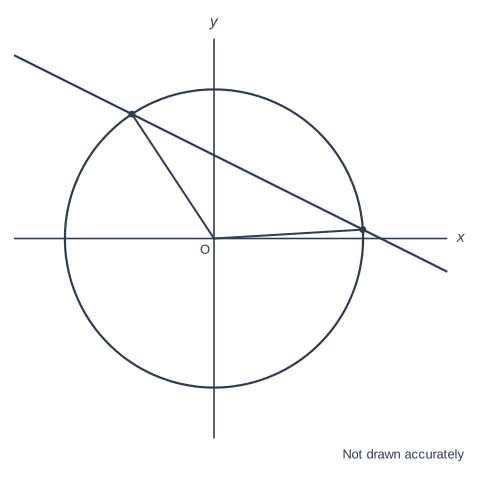
The diagram shows the circle \(x^2 + y^2 = 20\) with centre O and the line \(x + 2y = 5\)
The line meets the circle at P and Q.

The solutions of \(ax^2 + bx + c = 0\), where \(a ≠ 0\), are \(x = \dfrac{-b \pm \sqrt{b^2 - 4ac}}{2a}\)

Work out the area of triangle OPQ.
Give your answer to 3 significant figures.

A sketch on a pair of axes (x across, y up) with no scale marked, the axes crossing at the origin O. It is marked "Not drawn accurately". The circle labelled "x² + y² = 20" is a circle centred at (0, 0); its radius cannot be read off, as the sketch has no scale. The line labelled "x + 2y = 5" is a straight line sloping downwards from left to right passing through (−3, 4) and (3, 1). The circle labelled "x² + y² = 20" and the line labelled "x + 2y = 5" cross at 2 points, which cannot be read off, as the sketch has no scale. Point P is marked with a dot; its coordinates cannot be read off, as the sketch has no scale. Point Q is marked with a dot; its coordinates cannot be read off, as the sketch has no scale. A straight line segment joins (0, 0) to P. A straight line segment joins (0, 0) to Q.

Model answer

From the line, \(x = 5 - 2y\)
Substitute: \((5 - 2y)^2 + y^2 = 20\)
\(25 - 20y + 4y^2 + y^2 = 20\)
\(5y^2 - 20y + 5 = 0\), so \(y^2 - 4y + 1 = 0\)
\(y = \dfrac{4 \pm \sqrt{16 - 4}}{2} = 2 \pm \sqrt{3}\)
P is \((-2.464..., 3.732...)\) and Q is \((4.464..., 0.267...)\), using \(x = 5 - 2y\)
Area of OPQ \(= \dfrac{1}{2}\left|x_P y_Q - x_Q y_P\right| = \dfrac{1}{2}\left|(-2.464...)(0.267...) - (4.464...)(3.732...)\right|\)
\(= \dfrac{1}{2} \times 17.32... = 8.660...\)
Area \(= 8.66\) (3 sf)

Explanation

Substitute the line into the circle and solve the quadratic to find P and Q, then work out the area of the triangle with one vertex at the origin, keeping the unrounded values. A shorter way uses circle facts: the perpendicular from O to the chord PQ meets it at its midpoint M (1, 2), so OM = √5 is the height and PM = √(20 − 5) = √15 is half the base, giving area √5 × √15 = √75. A common error is to round the coordinates of P and Q before working out the area.

Mark scheme
  1. 1 mark

    M1 for \((5 - 2y)^2 + y^2 = 20\) oe

    oe eg \(x^2 + \left(\dfrac{5 - x}{2}\right)^2 = 20\). Alternative method (perpendicular from O): M1 the line through O perpendicular to \(x + 2y = 5\) is \(y = 2x\) and meets it at M \((1, 2)\); M1dep OM \(= \sqrt{5}\); M1 PM \(= \sqrt{20 - 5} = \sqrt{15}\) (OM bisects the chord PQ); M1 area \(= \dfrac{1}{2} \times 2\sqrt{15} \times \sqrt{5}\); A1 8.66.

  2. 1 mark

    M1dep for \(5y^2 - 20y + 5 = 0\) oe

    oe 3-term quadratic eg \(y^2 - 4y + 1 = 0\) or \(5x^2 - 10x - 55 = 0\) or \(x^2 - 2x - 11 = 0\)

  3. 1 mark

    M1 for P and Q, eg \((-2.46..., 3.73...)\) and \((4.46..., 0.267...)\), from a correct method for their 3-term quadratic

    oe eg \(y = \dfrac{4 \pm \sqrt{16 - 4}}{2} = 2 \pm \sqrt{3}\) with \(x = 5 - 2y\), or \(x = 1 \pm 2\sqrt{3}\), or \(PQ = \sqrt{60}\) or [7.74, 7.75]

  4. 1 mark

    M1 for a correct method for the area of triangle OPQ with their P and Q

    eg \(\dfrac{1}{2}\left|x_P y_Q - x_Q y_P\right|\), or \(\dfrac{1}{2} \times PQ \times\) the perpendicular distance \(\sqrt{5}\) from O to the line, or \(\dfrac{1}{2} \times 20 \times \sin POQ\), or the area of a surrounding rectangle minus right-angled triangles

  5. 1 mark

    A1 for 8.66 [8.655, 8.665]

    accept a more accurate value in the range, eg 8.660, or exact \(5\sqrt{3}\) or \(\sqrt{75}\); premature rounding giving a value outside the range is A0 (eg coordinates rounded to 2 decimal places give 8.65, A0). A fully correct answer with no working scores full marks.

Ready to try the rest? Every answer you write is marked against the mark scheme, so you can see exactly where the marks are.

Study Helper Hints first, answers after you try

Stuck on this one? Ask for a hint and I’ll point you in the right direction, without giving the answer away. Once you’ve checked your answer, I’ll show you how the marks are awarded.