Practise 17 exam-style questions on Geometric proof for AQA Level 2 Further Maths (Calculator). Write your answer as you would in the exam and get it marked in seconds against the mark scheme, point by point, with the Study Helper on hand if you get stuck.
17 questions
1–6 marks each
Instant marking
No sign-up needed
17 questions, marked as you go
Sample questions with model answers
Here are 4 of the questions in this topic, each with a model answer, an explanation of why it earns the marks and the mark scheme an examiner would use.
Question 1
2 marks
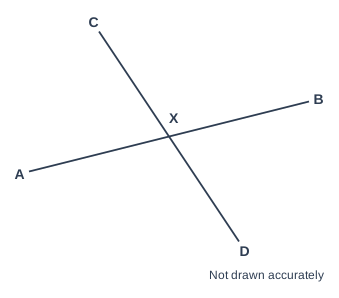
The diagram shows two straight lines, AB and CD. The lines cross at the point X.
Prove that angle AXC = angle BXD.
Model answer
AXB is a straight line, so angle AXC + angle CXB = 180° (angles on a straight line) CXD is a straight line, so angle CXB + angle BXD = 180° (angles on a straight line) So angle AXC = 180° − angle CXB = angle BXD
Explanation
Angles AXC and BXD each make a straight angle with the same angle CXB, once along the line AB and once along the line CD. Two angles that add up to 180° with the same angle must be equal. The proof cannot quote 'vertically opposite angles are equal', because that is what is being proved.
Mark scheme
1 mark
M1 for angle AXC + angle CXB = 180° or angle CXB + angle BXD = 180° (angles on a straight line)
One correct statement with its reason. Other pairs work too, eg angle AXC + angle AXD = 180° and angle AXD + angle BXD = 180°.
1 mark
A1 for both statements with the reason and the conclusion angle AXC = 180° − angle CXB = angle BXD
Quoting 'vertically opposite angles are equal' is the result to be proved and scores 0. An answer that only restates the result scores 0; every step must be shown.
Question 2
3 marks
A, B and C are three consecutive vertices of a regular polygon with \(n\) sides.
Prove that angle BAC \(= \left(\dfrac{180}{n}\right)^\circ\)
Model answer
The exterior angles of a polygon add up to 360°, so each exterior angle of the regular polygon is \(\dfrac{360}{n}\) Angle ABC \(= 180 - \dfrac{360}{n}\) (interior and exterior angles add up to 180°) AB = BC (the polygon is regular), so triangle ABC is isosceles and angle BAC = angle BCA Angle BAC \(= \dfrac{1}{2}\left(180 - \left(180 - \dfrac{360}{n}\right)\right)\) (angles in a triangle) \(= \dfrac{1}{2} \times \dfrac{360}{n}\) \(= \dfrac{180}{n}\) degrees
Explanation
Find the interior angle ABC in terms of \(n\) from the exterior angle \(\dfrac{360}{n}\). Because the polygon is regular, AB = BC, so the other two angles of triangle ABC are equal and share \(180 - \) angle ABC, which is exactly the exterior angle. Halving gives \(\dfrac{180}{n}\). Testing a hexagon or a square shows the result is plausible but is not a proof.
Mark scheme
1 mark
M1 for angle ABC \(= 180 - \dfrac{360}{n}\) or angle ABC \(= \dfrac{(n - 2) \times 180}{n}\) oe
Exterior angles of a polygon add up to 360° (so each is \(\dfrac{360}{n}\)), or interior angles add up to \((n - 2) \times 180^\circ\)
AB = BC (the sides of a regular polygon are equal), so triangle ABC is isosceles. Brackets must be correct, eg \(\dfrac{1}{2}\left(180 - \left(180 - \dfrac{360}{n}\right)\right)\)
1 mark
A1 for angle BAC \(= \dfrac{180}{n}\) with no errors and reasons stated
Reasons: the sum of the exterior angles (or interior angles) of a polygon, AB = BC because the polygon is regular, base angles of an isosceles triangle are equal (and angles in a triangle). eg from \(\dfrac{1}{2} \times \dfrac{360}{n}\) or from \(\dfrac{1}{2}\left(180 - \dfrac{180n - 360}{n}\right) = \dfrac{1}{2} \times \dfrac{360}{n}\). An answer that only restates the result scores 0; every step must be shown; checking particular values of n scores 0.
Question 3
4 marks
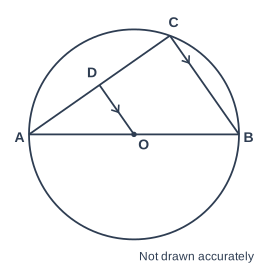
A, B and C are points on a circle, centre O. AB is a diameter of the circle. D is the point on AC such that OD is parallel to BC.
Prove that D is the midpoint of AC.
Model answer
AB is a diameter, so angle ACB = 90° (angle in a semicircle) OD is parallel to BC, so angle ADO = angle ACB = 90° (corresponding angles) So OD is perpendicular to the chord AC. The perpendicular from the centre of a circle to a chord bisects the chord, so AD = DC. D is the midpoint of AC.
Explanation
The angle in a semicircle gives a right angle at C, and the parallel lines carry that right angle to D. A line from the centre that meets a chord at 90° bisects it, so D is the midpoint. Each step needs its reason; the argument fails if the right angle at D is just assumed from the diagram.
Mark scheme
1 mark
M1 for angle ACB \(= 90^\circ\)
Angle in a semicircle. May be seen on the diagram.
1 mark
M1dep for angle ADO \(= 90^\circ\) or angle ODC \(= 90^\circ\)
Angle ADO = angle ACB (corresponding angles, OD parallel to BC), or angle ODC = 180° − angle ACB (co-interior angles). May be seen on the diagram.
1 mark
A1 for OD is perpendicular to the chord AC, so AD = DC and D is the midpoint of AC
The conclusion must be stated.
1 mark
B1 for reasons stated and used correctly: angle in a semicircle, corresponding (or co-interior) angles, the perpendicular from the centre to a chord bisects the chord
Award only for reasons attached to correct statements. Alternative method (similar triangles): M1 O is the midpoint of AB (OA = OB, radii); M1dep triangles AOD and ABC are similar (OD parallel to BC) with scale factor \(\dfrac{1}{2}\); A1 \(AD = \dfrac{1}{2}AC\), so D is the midpoint of AC; B1 for the reasons (radii equal, corresponding angles or similar triangles). An answer that only restates the result scores 0; every step must be shown; assuming the right angle at D from the diagram scores 0.
Question 4
5 marks
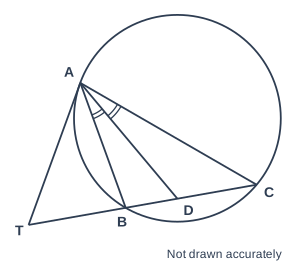
A, B and C are points on a circle. The tangent to the circle at A meets CB extended at T. The bisector of angle BAC meets BC at D.
Prove that \(TA = TD\).
Model answer
Let angle BAD = angle DAC \(= a\) (AD bisects angle BAC) and let angle ACB \(= c\) Angle TAB = angle ACB \(= c\) (alternate segment theorem) Angle TAD = angle TAB + angle BAD \(= c + a\) Angle TDA is an exterior angle of triangle ADC, so angle TDA = angle DAC + angle ACD \(= a + c\) (exterior angle of a triangle) So angle TAD = angle TDA Triangle TAD has two equal angles, so it is isosceles with \(TA = TD\) (the sides opposite the equal angles).
Explanation
To prove two sides of triangle TAD are equal, show the angles opposite them are equal. The alternate segment theorem turns the tangent angle TAB into angle ACB, and the bisector gives two equal angles \(a\) at A. Then angle TAD and angle TDA both come to \(a + c\). Students often get the angles right but forget to state why equal angles give equal sides.
Mark scheme
1 mark
B1 for angle TAB = angle ACB
Alternate segment theorem. May be seen on the diagram, eg as c.
1 mark
M1 for angle TAD = angle TAB + angle BAD = angle ACB + angle BAD oe
Letters may be used, eg angle BAD = angle DAC = a and angle ACB = c, so angle TAD = a + c
1 mark
M1 for angle TDA = angle DAC + angle ACD oe
Exterior angle of triangle ADC. oe eg angle ADC = 180 − a − c (angles in a triangle) and angle TDA = 180 − angle ADC (angles on a straight line), so angle TDA = a + c.
1 mark
A1 for angle TAD = angle TDA (both \(a + c\)), so triangle TAD is isosceles and \(TA = TD\)
dep on B1 and both M marks. Must use angle BAD = angle DAC (AD bisects angle BAC). The conclusion must be stated.
1 mark
B1 for reasons stated and used correctly: alternate segment theorem, AD bisects angle BAC, exterior angle of a triangle (or angles in a triangle and on a straight line), sides opposite equal angles are equal
Award only for reasons attached to correct statements. An answer that only restates the result scores 0; every step must be shown; no credit for using numerical angles or lengths.
Ready to try the rest? Every answer you write is marked against the mark scheme, so you can see exactly where the marks are.
Ctrl + Enter to check
Study HelperHints first, answers after you try
Stuck on this one? Ask for a hint and I’ll point you in the right direction, without giving the answer away. Once you’ve checked your answer, I’ll show you how the marks are awarded.