
Level:
Correct: 0
Incorrect: 0
Marks: 0/0
Exam Practice
Course:
Topics:
Edexcel GCSE Geography B (Paper 1) Smart practice A mixed round aimed at your weak spots
Avg
score:
–
Topics
done:
0/23

Urban growth, migration and urban economies

Practise 27 exam-style questions on Urban growth, migration and urban economies for Edexcel GCSE Geography B (Paper 1). Write your answer as you would in the exam and get it marked in seconds against the mark scheme, point by point, with the Study Helper on hand if you get stuck.

  • 27 questions
  • 1–8 marks each
  • Instant marking
  • No sign-up needed
20 questions, marked as you go

Sample questions with model answers

Here are 4 of the questions in this topic, each with a model answer, an explanation of why it earns the marks and the mark scheme an examiner would use.

Question 1

1 mark

Identify which one of the following jobs is in the quaternary sector.

Choose your answer.

  • A A bus driver
  • B A car assembly worker
  • C A research scientist developing new medicines
  • D A fisher

Model answer

C

Explanation

The quaternary sector is knowledge-based work such as research and development, information technology and consultancy. It is concentrated in cities in developed countries, close to universities and highly skilled workers. A common error is to put all service jobs, such as driving a bus, in the quaternary sector; most services are tertiary.

Mark scheme
  1. 1 mark

    C (A research scientist developing new medicines)

    Accept the letter or the option written out; do not credit more than one answer. A is incorrect: a bus driver provides a service, so the job is in the tertiary sector. B is incorrect: assembling cars is manufacturing, the secondary sector. D is incorrect: fishing extracts a natural resource, the primary sector.
Question 2

2 marks

Explain one way in which the informal economy of a city in a developing country can benefit other people living in the city.

Model answer

Informal minibuses and motorbike taxis provide cheap transport, including to areas that formal buses do not reach. This means people on low incomes can afford to travel to work, school and markets.

Explanation

One mark is for the benefit and one for explaining how it helps other residents. The question is not about the informal workers themselves, so focus on what the informal economy provides for the rest of the city, such as cheap food, transport, repairs or recycling.

Mark scheme
  1. 1 mark

    Identifies a valid benefit, e.g. it provides cheap goods and services / cheap food from street sellers / cheap transport (e.g. motorbike taxis, minibuses) / informal recycling and waste collection / cheap repairs / supplies formal businesses with cheap goods and labour

    Examples: Street sellers provide cheap food and goods (1) which poorer residents can afford, so their low incomes go further (1). Informal minibuses and motorbike taxis provide cheap transport (1) to areas that formal public transport does not reach, so people can get to work (1). Informal waste pickers collect and sell recyclable materials (1) which reduces the amount of waste left in streets and on dumps (1). Informal workshops repair phones, shoes and vehicles cheaply (1) so people can keep using them instead of buying new ones (1). Accept any other appropriate response.

  2. 1 mark

    Develops the benefit, explaining how it helps other people in the city

    The development must explain the benefit given in the first point. The question is about other people in the city, so do not credit benefits for the informal workers themselves (e.g. 'they can earn money without qualifications') unless they are linked to other residents. Do not credit 'it is cheap' with no explanation.

Question 3

2 marks

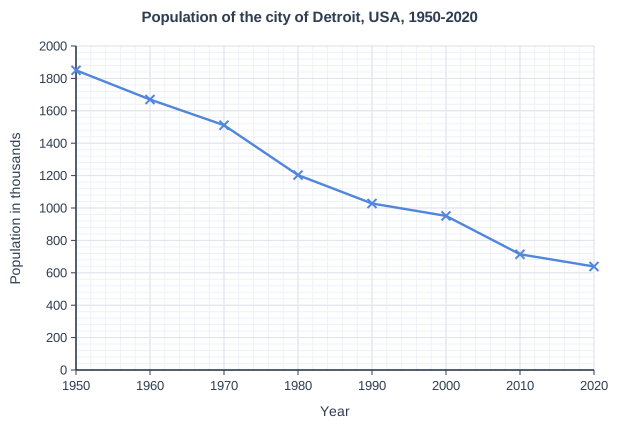
Study Figure 1, which shows the population of the city of Detroit, USA, between 1950 and 2020 (US Census data).

In 1950 Detroit's population was 1,850 thousand. In 2020 it was 639 thousand.

Calculate the percentage change in Detroit's population between 1950 and 2020.

Answer to one decimal place.

Show your working.

Population of the city of Detroit, USA, 1950-2020. Line graph of population in thousands (y-axis, 0 to 2000) against year (x-axis, 1950 to 2020). The line joins the points (1950, 1850), (1960, 1670), (1970, 1511), (1980, 1203), (1990, 1028), (2000, 951), (2010, 714), (2020, 639).

Model answer

Change = 639 - 1850 = -1211 thousand
Percentage change = -1211 ÷ 1850 × 100 = -65.5%
Detroit's population fell by 65.5%.

Explanation

Percentage change = (new value - original value) ÷ original value × 100, using the 1950 value as the original. The answer is negative because the population fell; say clearly that it is a decrease. Giving 34.5% shows what proportion is left, not the change.

Mark scheme
  1. 1 mark

    Correct method, e.g. (639 - 1850) ÷ 1850 × 100 / 1211 ÷ 1850 × 100 (correct answer -65.5%, a decrease of 65.5%)

    Correct answer: -65.5% (a decrease of 65.5%). Correct answer with no working scores full marks (2). Award this method mark for a correct method using 1850 and 639, including working with an arithmetic slip or an answer not given to one decimal place (e.g. -65%).

  2. 1 mark

    -65.5 (%) / a decrease of 65.5%

    Accept -65.5, -65.5%, 65.5% decrease or 'fell by 65.5%'. Must be given to one decimal place: do not credit -65 or -65.46 for this mark. Do not accept 65.5% described as an increase, 34.5% (639 ÷ 1850 × 100, the percentage remaining) or 189.5% (dividing by the 2020 value).

Question 4

4 marks

Explain two ways in which urban economies in developed countries are different from urban economies in developing countries.

Model answer

One difference is that most jobs in cities in developed countries are formal, because firms are registered and employment laws are enforced, whereas in developing countries most urban workers are in the informal sector, for example as street traders, because there are not enough formal jobs for the growing population.

A second difference is that cities in developed countries have many quaternary jobs in research, finance and information technology. This is because they have universities and a highly educated workforce, while most service jobs in cities in developing countries are low-skilled, such as selling goods or running small transport businesses.

Explanation

Each difference earns 1 mark and its explanation another; the two differences must be about different aspects of the economy, such as formal and informal work, the importance of each economic sector, or working conditions. Comparing both types of city in each point, using words such as 'whereas', makes the difference clear.

Mark scheme
  1. 1 mark

    Identifies a first valid difference, e.g. most jobs are formal in developed-country cities but informal in developing-country cities / developed-country cities have more quaternary and high-skill service jobs / working conditions are regulated in developed-country cities / developing-country cities have more low-skilled service and manufacturing work

    Examples: In cities in developed countries most jobs are formal (1) because employment laws are enforced and firms are registered, whereas in developing countries most people work informally, for example as street traders, because there are too few formal jobs (1). Cities in developed countries have many quaternary jobs in research, finance and IT (1) because they have universities and a highly educated workforce, whereas most service jobs in developing-country cities are low-skilled, such as selling goods or transport (1). Working conditions in developed-country cities are protected by law (1) with minimum wages, sick pay and safety inspections, whereas many workers in developing-country cities have no contract, no sick pay and unsafe conditions (1). Accept any other appropriate response.

  2. 1 mark

    Develops the first difference, e.g. explaining why it exists or what it means for workers

    The development must explain the difference given in the first point.

  3. 1 mark

    Identifies a second, different valid difference

    The two differences must be different (e.g. formal/informal employment and the importance of economic sectors). Do not credit 'people earn more in developed countries' without an explanation linked to the urban economy.

  4. 1 mark

    Develops the second difference

    The development must explain the difference given in the third point.

Ready to try the rest? Every answer you write is marked against the mark scheme, so you can see exactly where the marks are.

Study Helper Hints first, answers after you try

Stuck on this one? Ask for a hint and I’ll point you in the right direction, without giving the answer away. Once you’ve checked your answer, I’ll show you how the marks are awarded.