Practise 29 exam-style questions on An emerging country: impacts of rapid growth for Edexcel GCSE Geography B (Paper 1). Write your answer as you would in the exam and get it marked in seconds against the mark scheme, point by point, with the Study Helper on hand if you get stuck.
29 questions
1–12 marks each
Instant marking
No sign-up needed
20 questions, marked as you go
Sample questions with model answers
Here are 4 of the questions in this topic, each with a model answer, an explanation of why it earns the marks and the mark scheme an examiner would use.
Question 1
1 mark
Identify which one of the following is a way in which rapid economic growth causes rural-urban migration in an emerging country.
Choose your answer.
A Most new factory jobs are created in rural villages.
B Machines replace farm workers as farming becomes more commercial.
C Wages in cities fall below wages in rural areas.
D Death rates in rural areas rise as incomes increase.
Model answer
B
Explanation
As farming becomes more commercial, landowners buy machinery and need fewer workers, so landless labourers are pushed to the cities to look for work. Option A is the reverse of what happens: new jobs are concentrated in urban areas, which is a pull factor.
Mark scheme
1 mark
B (Machines replace farm workers as farming becomes more commercial)
Accept the letter or the option written out; do not credit more than one answer. A is incorrect: new factory and service jobs are concentrated in cities, which is why they pull migrants to urban areas. C is incorrect: wages are usually higher in cities, which attracts migrants. D is incorrect: death rates fall, not rise, as incomes increase, and this is not a cause of migration. All other answers are incorrect.
Question 2
2 marks
Explain one way in which rapid economic growth has caused fertility rates to fall in emerging countries.
Model answer
As the economy grows, more girls stay in school for longer. Educated women tend to marry later and have more opportunities for paid work, so they choose to have fewer children.
Explanation
One mark is for a way linked to economic growth (education, women's employment, falling infant mortality, urban living costs, family planning) and one for explaining why it leads to fewer births. Answers that simply say people want smaller families, without saying why, gain only the first mark at most.
Mark scheme
1 mark
Identifies a valid way, e.g. more girls stay in education / more women take paid jobs / infant mortality falls / children are more expensive to raise in cities / more money is spent on family planning
Examples: More girls stay in school for longer (1) so they marry later and have fewer children (1). More women take paid jobs in factories and offices (1) so having many children would mean losing income, and families choose to be smaller (1). Better healthcare reduces infant mortality (1) so parents no longer need many children to make sure some survive (1). Families move to cities where children are expensive to house and educate (1) and are not needed to work on farms (1). Higher incomes and taxes pay for family planning clinics (1) so more couples can use contraception (1). Accept any other appropriate response.
1 mark
Explains how the way identified leads to lower fertility, e.g. women marry later / parents choose to have fewer children
The development must explain why families have fewer children. Do not credit 'people want fewer children' or 'it is expensive' with no reason linked to economic growth. Only one way can be credited.
Question 3
3 marks
Explain one reason why death rates fall as the economy of an emerging country grows.
Model answer
As the economy grows, the government collects more tax, which it can spend on healthcare such as clinics and vaccination programmes. Vaccinations protect children from infectious diseases such as measles, so fewer people die young and the death rate falls.
Explanation
Structure a 3-mark 'explain one' answer as point, explain, expand: the reason (spending on healthcare), how it works (vaccinations prevent disease) and the effect on deaths. Listing several reasons without developing one of them scores only 1 mark.
Mark scheme
1 mark
Identifies a valid reason, e.g. higher incomes allow better diets / more spending on healthcare and vaccinations / investment in clean water and sanitation / better housing
Examples: Higher incomes mean families can afford better diets (1) so fewer people suffer from malnutrition (1) and they are better able to fight infections, so fewer people, especially children, die young (1). Tax revenue from economic growth is spent on clinics and vaccination programmes (1) which protect people from infectious diseases such as measles (1) so deaths from these diseases fall (1). Investment in clean piped water and sewers (1) reduces waterborne diseases such as cholera and diarrhoea (1) which used to be a major cause of death (1). Accept any other appropriate response.
2 marks
Up to two further marks for linked development of the same reason (1 + 1), e.g. how it reduces disease or malnutrition and so lowers deaths
The development must explain the same reason. A second, different reason earns no further marks. Do not credit 'more money' in isolation: the answer must say what the money is spent on.
Question 4
4 marks
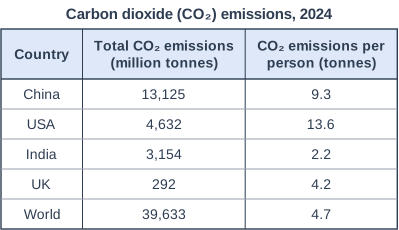
Study Figure 1, which shows carbon dioxide emissions for four countries and the world in 2024 (World Bank data).
Using Figure 1, suggest two reasons why India's total carbon dioxide emissions are high but its emissions per person are low.
Model answer
India has a very large population of about 1.45 billion people. Even though each person produces only 2.2 tonnes of carbon dioxide, this adds up to a total of 3,154 million tonnes, the third highest in Figure 1.
Secondly, many people in India still have low incomes and live in rural areas. They own few cars or electrical appliances and use little electricity, so emissions per person are less than half the world average of 4.7 tonnes.
Explanation
Two different reasons are needed, each developed: the size of the population explains the high total, while low incomes and energy use explain the low figure per person. Using figures from the table, such as 2.2 tonnes compared with 13.6 for the USA, is needed for full marks.
Mark scheme
1 mark
Suggests a first reason, e.g. India has a very large population / many people are poor and use little energy / many people live in rural areas without cars or electrical goods / incomes and consumption are still low
Max 3 if no data or evidence from Figure 1 is used. Evidence may be numeric, e.g. India's 3,154 million tonnes is the third highest total in the table, but its 2.2 tonnes per person is about half the world average (4.7) and about one-sixth of the USA's (13.6). Examples: India has a very large population, about 1.45 billion people (1) so even small emissions per person add up to a large total of 3,154 million tonnes (1). Many Indians still have low incomes (1) so they own few cars and electrical appliances and use little electricity, keeping emissions per person at 2.2 tonnes (1). Much of India's growing electricity supply comes from burning coal (1) so the total is high and rising as industry grows, even though many households use little energy (1). Accept any other appropriate response.
1 mark
Develops the first reason
1 mark
Suggests a second, different reason
The two reasons must be different; do not credit 'many people are poor' and 'people have low incomes' as two reasons.
1 mark
Develops the second reason
Ready to try the rest? Every answer you write is marked against the mark scheme, so you can see exactly where the marks are.
Ctrl + Enter to check
Study HelperHints first, answers after you try
Stuck on this one? Ask for a hint and I’ll point you in the right direction, without giving the answer away. Once you’ve checked your answer, I’ll show you how the marks are awarded.