Practise 28 exam-style questions on Top-down and bottom-up approaches to development for Edexcel GCSE Geography B (Paper 1). Write your answer as you would in the exam and get it marked in seconds against the mark scheme, point by point, with the Study Helper on hand if you get stuck.
28 questions
1–12 marks each
Instant marking
No sign-up needed
20 questions, marked as you go
Sample questions with model answers
Here are 4 of the questions in this topic, each with a model answer, an explanation of why it earns the marks and the mark scheme an examiner would use.
Question 1
1 mark
Globalisation is driven by processes and by players.
Identify which one of the following is a process that has contributed to globalisation.
Choose your answer.
A Transnational corporations (TNCs)
B National governments
C The World Trade Organization (WTO)
D Increasing flows of trade, money and information between countries
Model answer
D
Explanation
Processes are the flows and changes that link countries more closely, such as trade, investment, migration and the spread of information. Players are the organisations that drive these processes, such as TNCs, governments and inter-governmental organisations like the WTO. A common error is to choose a powerful organisation because it is closely linked with globalisation.
Mark scheme
1 mark
D (Increasing flows of trade, money and information between countries)
Accept the letter or the option written out; do not credit more than one answer. A is incorrect: TNCs are players (organisations that drive globalisation), not a process. B is incorrect: national governments are players that encourage or limit globalisation, e.g. through their trade policies. C is incorrect: the WTO is an inter-governmental organisation, a player that sets rules for world trade.
Question 2
2 marks
Explain one reason why projects led by non-governmental organisations (NGOs) can be difficult to keep going in the long term.
Model answer
NGOs depend on donations from the public, and these can fall, for example during an economic downturn. If the money runs out, the NGO may have to stop supporting the project, so equipment may not be maintained and the project may stop working.
Explanation
One mark is for a reason and one for explaining why it makes the project hard to sustain. A common weak answer is 'they are small', which needs to be linked to why that makes them hard to keep going.
Mark scheme
1 mark
Identifies a valid reason, e.g. NGOs depend on donations / the NGO may leave the area / spare parts or skills may be lacking / small projects are not linked to government services
Examples: NGOs rely on donations from the public (1), which can fall, for example during an economic downturn, so funding for the project may stop (1). The NGO may move on to work in another area (1), and if villagers lack the skills or spare parts, equipment that breaks down may not be repaired (1). Small projects are often not part of government plans (1), so there may be no money to expand or maintain them later (1). Accept any other appropriate response.
1 mark
Develops the reason
The development must explain why the project may stop working or not continue.
Question 3
3 marks
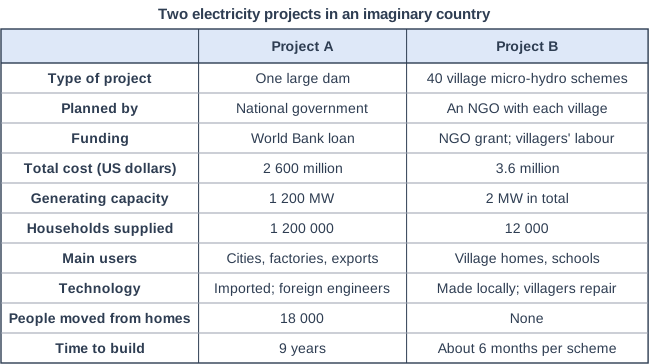
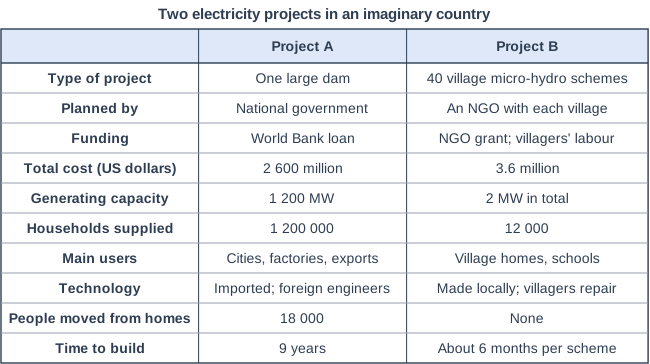
Study Figure 1, which compares two electricity projects in an imaginary country. The data were written for this course.
Compare Project A and Project B.
Model answer
Project A is much larger in scale than Project B: it generates 1 200 MW compared with only 2 MW. Project A is funded by a loan from the World Bank, whereas Project B is funded by an NGO grant and villagers' labour. Project A also moved 18 000 people from their homes, whereas Project B did not move anyone.
Explanation
Each mark needs a comparison that refers to both projects, for example their scale, funding, technology or effects on people. Describing one project and then the other, or explaining which is better, does not earn marks.
Mark scheme
1 mark
A valid comparative point, e.g. Project A is much larger in scale than Project B (1 200 MW compared with 2 MW)
Award one mark for each comparative point, up to 3 marks (points 1-3). Credit: Project A is much larger in scale (1 200 MW and 1.2 million households compared with 2 MW and 12 000 households) (1); Project A is funded by a World Bank loan whereas Project B is funded by an NGO grant and villagers' labour (1); Project A costs far more (2 600 million compared with 3.6 million US dollars, about 720 times as much) (1); Project A uses imported technology and foreign engineers whereas Project B uses locally made turbines that villagers repair (1); Project A moved 18 000 people from their homes whereas Project B moved nobody (1); Project A took 9 years to build whereas each scheme in Project B took about 6 months (1); Project A was planned by the national government (top-down) whereas Project B was planned with each village (bottom-up) (1); Project A's electricity is mainly for cities, factories and exports whereas Project B's is for village homes and schools (1).
1 mark
A second, different comparative point
Award marks for comparative statements that refer to both projects, not separate descriptions. Do not credit data lifts directly from the figure without a comparison.
1 mark
A third, different comparative point
Do not credit explanation or judgements about which project is better.
Question 4
4 marks
Study Figure 1, which compares two electricity projects in an imaginary country. The data were written for this course.
Using Figure 1, explain one advantage and one disadvantage of Project A for the people of this country.
Model answer
An advantage is that Project A can generate 1 200 MW of electricity and supplies 1.2 million households, as well as factories. This means many people get electricity for lighting and appliances, and factories can expand and create jobs. A disadvantage is that 18 000 people had to move from their homes. They may lose their farmland and their income, and their communities may be broken up.
Explanation
Each half earns 1 mark for the point and 1 for developing it. Because the question says 'Using Figure 1', answers that use no evidence from the table score at most 3 marks.
Mark scheme
1 mark
Identifies an advantage of Project A, e.g. it supplies a large amount of electricity (1 200 MW) to 1.2 million households and factories / it earns income from exports
Max 3 if no data or evidence from Figure 1 is used. Examples of advantages: Project A has a generating capacity of 1 200 MW and supplies 1.2 million households (1), so millions of people get electricity for lighting and appliances, and factories can expand and create jobs (1). Some of the electricity is exported (1), which earns money that can be used to repay the loan or pay for services (1). Accept any other appropriate response.
1 mark
Develops the advantage
The development must explain how the advantage benefits people.
1 mark
Identifies a disadvantage of Project A, e.g. 18 000 people moved from their homes / the World Bank loan must be repaid / the electricity goes mainly to cities, factories and exports / imported technology and foreign engineers
Examples of disadvantages: 18 000 people had to move from their homes (1), so they may lose their farmland and income and their communities are broken up (1). It is funded by a World Bank loan (1), which must be repaid with interest, so the government must spend money on repayments that could have gone on schools and hospitals (1). The electricity is mainly for cities, factories and exports (1), so poor rural people may not benefit (1). It uses imported technology and foreign engineers (1), so few skilled jobs are created for local people (1). Accept any other appropriate response.
1 mark
Develops the disadvantage
The advantage and the disadvantage must be different points; do not credit a disadvantage that simply reverses the advantage.
Ready to try the rest? Every answer you write is marked against the mark scheme, so you can see exactly where the marks are.
Ctrl + Enter to check
Study HelperHints first, answers after you try
Stuck on this one? Ask for a hint and I’ll point you in the right direction, without giving the answer away. Once you’ve checked your answer, I’ll show you how the marks are awarded.