An emerging country: globalisation and economic change
Practise 28 exam-style questions on An emerging country: globalisation and economic change for Edexcel GCSE Geography B (Paper 1). Write your answer as you would in the exam and get it marked in seconds against the mark scheme, point by point, with the Study Helper on hand if you get stuck.
28 questions
1–12 marks each
Instant marking
No sign-up needed
20 questions, marked as you go
Sample questions with model answers
Here are 4 of the questions in this topic, each with a model answer, an explanation of why it earns the marks and the mark scheme an examiner would use.
Question 1
1 mark
Identify which one of the following describes tied aid.
Choose your answer.
A Aid given by several countries through an organisation such as the World Bank
B Emergency help given straight after a natural disaster
C Money given by a charity to a local community project
D Aid that must be spent on goods or services from the donor country
Model answer
D
Explanation
Tied aid comes with conditions, usually that the money must be spent on goods, services or companies from the country giving the aid. Multilateral aid is given through organisations such as the World Bank, which pool money from many countries. Learn the difference between these types, because the specification names both.
Mark scheme
1 mark
D (Aid that must be spent on goods or services from the donor country)
Accept the letter or the option written out; do not credit more than one answer. A is incorrect: this is multilateral aid. B is incorrect: this is emergency (short-term) aid. C is incorrect: this is NGO-led (bottom-up) aid. All other answers are incorrect.
Question 2
2 marks
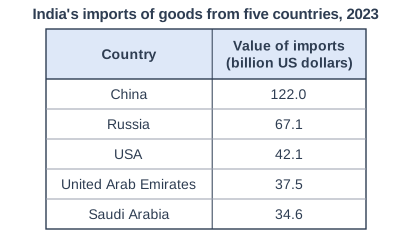
Study Figure 1, which shows the value of India's imports of goods from five countries in 2023 (source: UN Comtrade data via the World Bank).
Describe how a proportional flow-line map could be used to show the data in Figure 1.
Model answer
A world map would be drawn with an arrow from each of the five countries pointing to India, showing the direction the goods travel. The width of each arrow would be in proportion to the value of imports, using a scale such as 1 mm = 10 billion US dollars, so the arrow from China (122.0 billion) would be about three times as wide as the one from the USA (42.1 billion).
Explanation
A proportional flow-line map has two key features: lines or arrows that show the direction of a flow between places, and line widths drawn in proportion to the size of the flow using a scale. One mark is for each feature. Saying only 'draw arrows on a map' misses the proportional width, which is what makes it a proportional flow-line map.
Mark scheme
1 mark
Lines (arrows) would be drawn on a world map from each of the five countries to India, pointing towards India to show the direction of the imports (1)
Accept: an arrow from China, Russia, the USA, the UAE and Saudi Arabia to India / lines joining each country to India with arrowheads at India. Credit a description of the base map (a world map showing India and the five countries) only if it is linked to the lines. Accept any other appropriate response.
1 mark
The width of each line would be drawn in proportion to the value of imports, using a scale or key (e.g. 1 mm = 10 billion US dollars), so the line from China would be the widest (1)
The idea of width (thickness) being proportional to the value is required for this mark; a key or scale may be described. Do not credit 'bigger lines for bigger values' without the idea of width or thickness. Do not credit a description of a different technique (e.g. a bar chart).
Question 3
3 marks
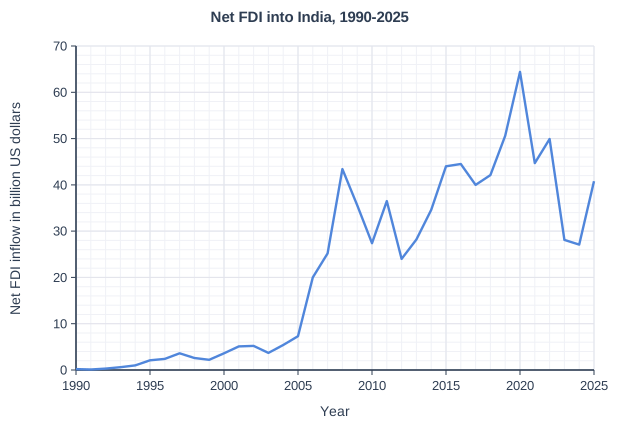
Study Figure 1, which shows the net inflow of foreign direct investment (FDI) into India between 1990 and 2025 (source: World Bank).
Describe the trend in FDI into India shown in Figure 1.
Use data in your answer.
Model answer
Overall, FDI into India increased greatly, from about 0.2 billion US dollars in 1990 to about 41 billion in 2025. It stayed very low in the 1990s, but rose rapidly after 2005 to about 43 billion in 2008. After that it fluctuated, reaching a peak of about 64 billion in 2020, then fell to about 27 billion in 2024 before rising again in 2025.
Explanation
Describe the overall trend first, then the main changes within it (rapid rise, fluctuations, peak, fall), supporting each with data and years read from the graph. Answers with no data can score only 2 marks. Do not explain why FDI changed - the command word is Describe.
Mark scheme
3 marks
One mark for each valid descriptive point, up to 3 marks, e.g. overall a large increase, from about 0.2 billion US dollars in 1990 to about 41 billion in 2025 (1); very low throughout the 1990s, below about 4 billion (1); a rapid rise after 2005, from about 7 billion to about 43 billion in 2008 (1); it fluctuated between about 24 and 51 billion from 2009 to 2019 (1); it peaked at about 64 billion in 2020 (1); it fell after 2020 to about 27-28 billion in 2023-2024, before rising again to about 41 billion in 2025 (1)
Max 2 if no data from Figure 1 is used. Award one mark for each valid descriptive point, up to 3 marks. Data may be manipulated, e.g. 'FDI rose by about 40 billion US dollars between 1990 and 2025' (1). Readings within half a gridline (plus or minus 1 billion US dollars) of the values given are acceptable, with years read to the nearest year. Isolated readings with no sense of change (e.g. 'it was 44 billion in 2015') do not describe a trend. Do not credit explanation.
Question 4
4 marks
For a named emerging country, explain two ways government policy has encouraged foreign companies to invest there.
Model answer
India: first, in 1991 the government cut import taxes, removed many of the licences needed to run a business and allowed foreign companies to own a larger share of Indian firms. This made it cheaper and less risky for TNCs to set up in India, so foreign investment rose quickly.
Second, the Make in India campaign, launched in 2014, and later production-linked incentive schemes pay subsidies to companies that manufacture goods such as smartphones in India. These payments encouraged Apple's suppliers, such as Foxconn, to build factories in India.
Explanation
Each way needs a specific government policy and an explanation of why it attracts foreign companies, such as lower costs, lower risk or subsidies. Using real policies from your case study, with dates where you know them, avoids the limit of 3 marks for generic answers. The two policies must be clearly different.
Mark scheme
1 mark
Identifies a first pro-FDI policy, e.g. opening the economy and allowing foreign ownership / special economic zones with tax breaks / subsidies or incentives for manufacturers / cutting red tape / investing in infrastructure and education
Max 3 if the answer is generic and makes no reference to a named emerging country. Examples: In 1991 India cut import taxes and many licences and allowed foreign companies to own more of Indian businesses (1) which made it easier and less risky for TNCs to set up in India, so FDI rose (1). India's Make in India campaign (from 2014) and later production-linked incentive schemes give subsidies to firms that make goods such as smartphones in India (1) which encouraged Apple's suppliers to build factories there (1). China set up special economic zones such as Shenzhen from 1980 with low taxes and few rules (1) which attracted foreign factories making goods for export (1). Joining the World Trade Organization in 2001 (1) gave China's exports easier access to world markets, so foreign firms invested to produce there (1). Credit equivalent detail for any other valid emerging country. Accept any other appropriate response.
1 mark
Develops the first way, explaining why it attracts foreign investment
The development must explain why the policy makes the country more attractive to foreign companies (lower costs, lower risk, access to markets, subsidies).
1 mark
Identifies a second, different pro-FDI policy
The two ways must be different policies.
1 mark
Develops the second way
As for the first development mark. No mark is awarded simply for naming the country.
Ready to try the rest? Every answer you write is marked against the mark scheme, so you can see exactly where the marks are.
Ctrl + Enter to check
Study HelperHints first, answers after you try
Stuck on this one? Ask for a hint and I’ll point you in the right direction, without giving the answer away. Once you’ve checked your answer, I’ll show you how the marks are awarded.