
Level:
Correct: 0
Incorrect: 0
Marks: 0/0
Exam Practice
Course:
Topics:
Edexcel GCSE Geography B (Paper 1) Smart practice A mixed round aimed at your weak spots
Avg
score:
–
Topics
done:
0/23

A megacity: opportunities, challenges and quality of life

Practise 32 exam-style questions on A megacity: opportunities, challenges and quality of life for Edexcel GCSE Geography B (Paper 1). Write your answer as you would in the exam and get it marked in seconds against the mark scheme, point by point, with the Study Helper on hand if you get stuck.

  • 32 questions
  • 1–8 marks each
  • Instant marking
  • No sign-up needed
20 questions, marked as you go

Sample questions with model answers

Here are 4 of the questions in this topic, each with a model answer, an explanation of why it earns the marks and the mark scheme an examiner would use.

Question 1

1 mark

Study Figure 1, which shows housing tenure (whether households own or rent their home legally, rent it informally, or have no legal right to the land) in four districts of an imaginary megacity. The data were written for this course.

Calculate the value of X, the percentage of households in Riverside that are informal tenants with no contract.
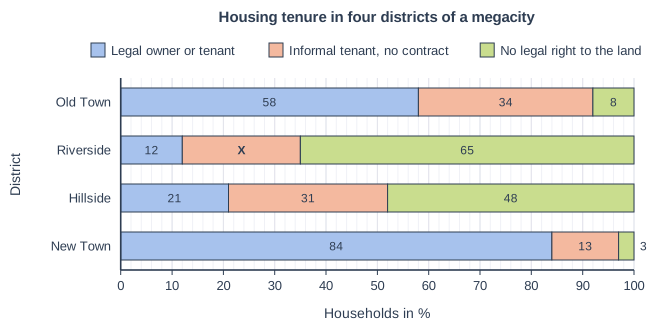
Housing tenure in four districts of a megacity. Stacked bar chart with 4 horizontal bars. The value axis (x-axis) is "Households in %", from 0 to 100 marked every 10; the bars are labelled along the y-axis, "District", from top to bottom. Each bar is split into 3 parts, shown in the key: Legal owner or tenant (left, blue), Informal tenant, no contract (middle, orange) and No legal right to the land (right, green). Values: Old Town: legal owner or tenant 58%, informal tenant, no contract 34%, no legal right to the land 8%; Riverside: legal owner or tenant 12%, informal tenant, no contract marked X, no legal right to the land 65%; Hillside: legal owner or tenant 21%, informal tenant, no contract 31%, no legal right to the land 48%; New Town: legal owner or tenant 84%, informal tenant, no contract 13%, no legal right to the land 3%. The value of each part is printed on it (just outside the bar, next to the part, where a part is too thin).

Model answer

100 - 12 - 65 = 23%

Explanation

The three parts of each bar add up to 100%, so X is 100 minus the other two parts for Riverside (12% and 65%). A common error is to give 77, the total of the other two parts, instead of subtracting it from 100.

Mark scheme
  1. 1 mark

    23 (100 - 12 - 65 = 23%)

    Accept 23 or 23%. Correct answer with no working scores full marks. Do not credit 77 (the total of the other two parts, 12 + 65).

Question 2

2 marks

Explain one reason why the building of new homes in a megacity often fails to keep up with rapid population growth.

Model answer

Land in a megacity is limited and very expensive. Developers make more profit from flats for wealthy buyers, so they build those rather than cheap homes for the low-income families who make up most of the new arrivals.

Explanation

The first mark is for a reason why housing supply falls behind, such as expensive land or the high cost of services for new homes, and the second for explaining it. Saying only that there are too many people, or that people arrive faster than homes are built, repeats the question.

Mark scheme
  1. 1 mark

    Identifies a reason, e.g. land in the city is limited and expensive / developers make more profit from homes for wealthier buyers / building affordable homes and their water, sewer and road connections is costly for the government / disputes over land ownership or slow planning approval delay new housing

    Examples: Land in the megacity is limited and very expensive (1), so developers build flats for wealthier buyers, which make more profit, rather than affordable homes for low-income families (1). City governments cannot afford to build enough housing (1) because the cost of land, roads, water pipes and sewers for so many new homes is very high (1). Much of the remaining land has unclear ownership or is already occupied by informal homes (1), so legal disputes and slow planning approval delay new housing schemes for years (1). The city may be hemmed in by the sea, hills or protected land (1), so there is little space left to build on and new homes must be built far out on the edge (1). Accept any other appropriate response.

  2. 1 mark

    Develops the reason, e.g. explains why too few homes are built, or too few that low-income families can afford

    Do not credit 'there are too many people' or 'people arrive faster than homes can be built' on its own as the reason or the development: it repeats the question.

Question 3

2 marks

Explain one political challenge of managing a megacity in a developing or emerging country.

Model answer

A megacity is often run by many different councils and government agencies. In the Mumbai Metropolitan Region there are nine municipal corporations, so it is hard for them to agree on and pay for city-wide plans such as new transport links.

Explanation

A political challenge is about how decisions are made and who makes them, such as divided responsibility, unpopular evictions or corruption. The second mark is for explaining why it makes the city harder to manage. Answers about lack of money alone are economic, not political.

Mark scheme
  1. 1 mark

    Identifies a political challenge, e.g. many different authorities share responsibility / clearing informal settlements is unpopular / corruption / pressure from powerful groups such as developers / many residents of informal settlements have little say in decisions

    Examples: The megacity is often run by several councils as well as state and national agencies (1), so it is hard to agree on and pay for city-wide plans such as transport or water supply (1). For example, the Mumbai Metropolitan Region has nine municipal corporations, and the suburban railway is run by national Indian Railways. Clearing informal settlements for roads or new flats is unpopular with the people affected (1), so politicians may delay schemes for fear of losing votes (1). Corruption (1) means money meant for services may be lost, so projects cost more and achieve less (1). Deciding who is 'eligible' for new housing in redevelopment schemes causes disputes (1), so projects such as the Dharavi redevelopment in Mumbai face protests and delays (1). Accept any other appropriate response.

  2. 1 mark

    Develops the challenge, explaining why it makes the megacity harder to manage

    Do not credit economic challenges (e.g. 'the city does not have enough money') unless they are linked to a political decision or process.

Question 4

4 marks

Explain one advantage and one disadvantage for a low-income family of living in an informal settlement close to the centre of a megacity.

Model answer

Advantage: the family can walk to work in the city centre, so they spend nothing on bus or train fares and keep more of their low income for food and school costs.

Disadvantage: the family has no legal right to the land. Land near the centre is valuable, so the settlement could be cleared for new offices or roads and the family evicted, losing their home.

Explanation

The advantage and the disadvantage each earn 1 mark when identified and 1 more when explained. The best answers link the points to the central location, such as walking to work or the high value of central land, rather than giving general points about informal settlements.

Mark scheme
  1. 1 mark

    Identifies an advantage, e.g. close to jobs / low or no rent / close to schools and hospitals / strong community support

    Award 1 mark for identifying an advantage and a further mark for explanation; award 1 mark for identifying a disadvantage and a further mark for explanation. Advantage examples: The family can walk to jobs in the city centre (1), so they spend nothing on transport and keep more of their income (1). Rent is low or there is none (1), so more money is left for food and school costs (1). Schools and hospitals in the centre are nearby (1), so children can go to school and the family can get treatment quickly (1). Neighbours who came from the same area help each other (1), for example with childcare or finding work (1). Accept any other appropriate response.

  2. 1 mark

    Explains the advantage

    The development must say how the family benefits.

  3. 1 mark

    Identifies a disadvantage, e.g. risk of eviction / poor sanitation or water supply / overcrowding / fire or flood risk / pollution

    Disadvantage examples: The family has no legal right to the land (1), so they could be evicted if the land is wanted for development, which is likely near the centre where land is valuable (1). There are few toilets and little piped water (1), so diseases such as diarrhoea spread easily (1). Homes are very crowded and built of flammable materials (1), so fires spread quickly (1). Land near the centre that is free for building is often on flood plains or beside railway lines (1), putting the family at risk of flooding or accidents (1). Do not credit a disadvantage that simply reverses the advantage.

  4. 1 mark

    Explains the disadvantage

    The development must say how the family is harmed.

Ready to try the rest? Every answer you write is marked against the mark scheme, so you can see exactly where the marks are.

Study Helper Hints first, answers after you try

Stuck on this one? Ask for a hint and I’ll point you in the right direction, without giving the answer away. Once you’ve checked your answer, I’ll show you how the marks are awarded.