
Level:
Correct: 0
Incorrect: 0
Marks: 0/0
Exam Practice
Course:
Topics:
Edexcel GCSE Geography B (Paper 1) Smart practice A mixed round aimed at your weak spots
Avg
score:
–
Topics
done:
0/23

An emerging country: changing international role

Practise 26 exam-style questions on An emerging country: changing international role for Edexcel GCSE Geography B (Paper 1). Write your answer as you would in the exam and get it marked in seconds against the mark scheme, point by point, with the Study Helper on hand if you get stuck.

  • 26 questions
  • 1–12 marks each
  • Instant marking
  • No sign-up needed
20 questions, marked as you go

Sample questions with model answers

Here are 4 of the questions in this topic, each with a model answer, an explanation of why it earns the marks and the mark scheme an examiner would use.

Question 1

1 mark

For a named emerging country you have studied, name one international organisation or group, other than the United Nations, that the country belongs to.

Model answer

India is a member of the G20.

Explanation

Any correct pairing of a named emerging country and an organisation it belongs to earns the mark. Take care: emerging countries are not members of groups of developed countries such as the G7.

Mark scheme
  1. 1 mark

    A correct organisation for the named country, e.g. India: G20 / BRICS / WTO / the Commonwealth / Shanghai Cooperation Organisation / Quad; China: G20 / BRICS / WTO / Shanghai Cooperation Organisation / APEC; Nigeria: African Union / ECOWAS / OPEC / the Commonwealth / WTO; Brazil: G20 / BRICS / Mercosur / WTO

    Credit any appropriate named emerging country with an organisation it belongs to; IMF and World Bank membership is also acceptable. The country must be named. Do not credit an organisation the named country does not belong to, e.g. India or China in the G7, NATO, the EU or the OECD; Nigeria is not itself a member of the G20 (the African Union is), and it has been a BRICS partner country since January 2025, not a full member, so do not credit BRICS for Nigeria.
Question 2

2 marks

Explain one benefit for an emerging country of signing a trade agreement with the European Union (EU).

Model answer

A trade agreement with the EU would cut the tariffs on the emerging country's exports, such as clothing and medicines. This would make its goods cheaper for EU consumers, so exports would rise and more jobs would be created in its factories.

Explanation

One mark is for a benefit (lower tariffs, investment, technology) and one for explaining how it helps the emerging country, for example by creating jobs or earning foreign currency. 'It increases trade' on its own is too vague.

Mark scheme
  1. 1 mark

    Identifies a benefit, e.g. lower tariffs on its exports to the EU / more EU investment / access to technology / a stronger political relationship

    Examples: Tariffs on its exports such as textiles and medicines are cut (1) so they become cheaper in EU shops and sell more, creating jobs in the emerging country (1). EU companies are more likely to invest (1) because they can trade goods and services more easily between the two economies (1). The agreement gives access to a market of about 450 million relatively wealthy consumers (1) so exporters can grow and earn foreign currency (1). Accept any other appropriate response, e.g. India-EU agreement (negotiations concluded in January 2026).

  2. 1 mark

    Explains how the benefit helps the emerging country

    Do not credit 'more trade' or 'more money' with no explanation of how the country benefits.

Question 3

3 marks

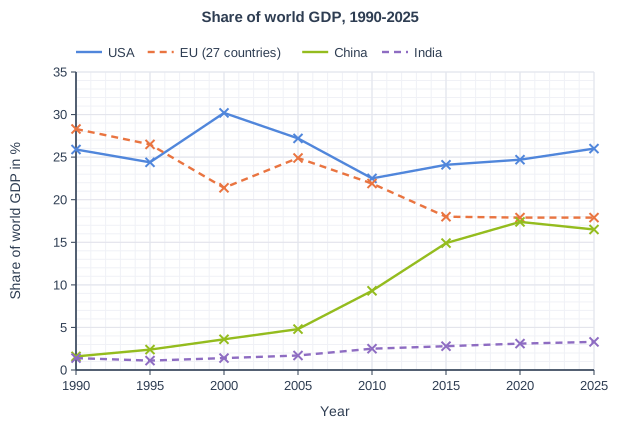
Study Figure 1, which shows the share of world GDP of China, India, the USA and the European Union between 1990 and 2025 (World Bank data).

Compare the changes in the share of world GDP of China and the European Union between 1990 and 2025.

Use data from Figure 1 in your answer.

Share of world GDP, 1990-2025. Line graph of Share of world GDP in % (y-axis, 0 to 35) against year (x-axis, 1990 to 2025). "USA" joins the points (1990, 25.9), (1995, 24.4), (2000, 30.2), (2005, 27.2), (2010, 22.5), (2015, 24.1), (2020, 24.7), (2025, 26). "EU (27 countries)" (dashed) joins the points (1990, 28.3), (1995, 26.5), (2000, 21.4), (2005, 24.9), (2010, 21.9), (2015, 18), (2020, 17.9), (2025, 17.9). "China" joins the points (1990, 1.6), (1995, 2.4), (2000, 3.6), (2005, 4.8), (2010, 9.3), (2015, 14.9), (2020, 17.4), (2025, 16.5). "India" (dashed) joins the points (1990, 1.4), (1995, 1.1), (2000, 1.4), (2005, 1.7), (2010, 2.5), (2015, 2.8), (2020, 3.1), (2025, 3.3).

Model answer

China's share of world GDP increased greatly, from 1.6% in 1990 to 16.5% in 2025, whereas the European Union's share fell from 28.3% to 17.9%. As a result, the gap between them narrowed from about 27 percentage points to only about 1.4 percentage points, and by 2020 the two shares were almost equal. China's rise was fastest between 2005 and 2015, whereas the EU's share fluctuated before levelling off at about 18% after 2015.

Explanation

Every mark needs a statement about both China and the EU together, such as 'whereas' or 'the gap narrowed', backed by readings from the graph. Explaining why China's share rose is not asked for and earns no credit.

Mark scheme
  1. 1 mark

    China's share increased whereas the EU's share decreased / China's share rose by about 15 percentage points (1.6% to 16.5%) whereas the EU's fell by about 10 percentage points (28.3% to 17.9%)

    Max 2 if no data from Figure 1 is used. Award 1 mark for each comparative statement, max 3; the statements below are alternatives. Data may be manipulated, e.g. changes or differences. Allow readings within half a gridline (plus or minus 0.5 percentage points) of the values (China 1.6, 2.4, 3.6, 4.8, 9.3, 14.9, 17.4, 16.5; EU 28.3, 26.5, 21.4, 24.9, 21.9, 18.0, 17.9, 17.9 for 1990, 1995 ... 2025). Do not credit data lifted from the figure without a comparison (e.g. 'China was 1.6% in 1990' on its own), statements about only one of the two, or explanation.

  2. 1 mark

    The gap between them narrowed greatly, from about 27 percentage points in 1990 to about 1 percentage point in 2025 / by 2020 China's share (17.4%) was almost the same as the EU's (17.9%)

  3. 1 mark

    China's share rose in every period from 1990 to 2020 (fastest between 2005 and 2015, from 4.8% to 14.9%), whereas the EU's share fluctuated, e.g. rising between 2000 and 2005 before falling again

  4. 1 mark

    The EU's share levelled off after 2015 (about 18%), whereas China's continued to rise until 2020 and then fell slightly (17.4% to 16.5%)

  5. 1 mark

    In 1990 the EU's share was about 18 times China's, but by 2025 the two shares were almost equal

    Accept any valid ratio comparison based on readings.

Question 4

4 marks

Explain two reasons why the USA and the European Union (EU) want closer trade relationships with emerging countries such as India.

Model answer

Firstly, India has a population of about 1.45 billion and a fast-growing middle class. This makes it a huge market for goods made in the USA and the EU, such as aircraft, cars and machinery, so closer trade links would increase their exports and jobs at home.

Secondly, the USA and the EU want to depend less on China for manufactured goods. Closer trade relationships with India encourage their companies to build factories and supply chains there, which spreads the risk if trade with China is disrupted.

Explanation

This question is about the reasons of the USA and the EU, so each reason should show what they gain. Two different reasons are needed, each with an explanation; avoid repeating the market idea in two forms.

Mark scheme
  1. 1 mark

    Identifies a first reason, e.g. a large and growing market for their exports / lower-cost manufacturing and services / to reduce dependence on other suppliers such as China / to gain political allies

    Examples: India has a population of about 1.45 billion and a growing middle class (1) so it is a huge market for US and EU exports such as aircraft, cars and machinery (1). Wages are lower than in the USA or the EU (1) so companies can make goods or buy services such as IT more cheaply (1). Western governments want to rely less on China for goods such as electronics (1) so they encourage companies to build supply chains in other emerging countries such as India (1). A closer relationship with a large democracy (1) helps them to balance China's growing power in Asia (1). Accept any other appropriate response.

  2. 1 mark

    Explains the first reason

  3. 1 mark

    Identifies a second, different reason

    The two reasons must be different: do not credit 'a big market' and 'many consumers' as two reasons.

  4. 1 mark

    Explains the second reason

Ready to try the rest? Every answer you write is marked against the mark scheme, so you can see exactly where the marks are.

Study Helper Hints first, answers after you try

Stuck on this one? Ask for a hint and I’ll point you in the right direction, without giving the answer away. Once you’ve checked your answer, I’ll show you how the marks are awarded.