Causes of global inequality and development theories
Practise 27 exam-style questions on Causes of global inequality and development theories for Edexcel GCSE Geography B (Paper 1). Write your answer as you would in the exam and get it marked in seconds against the mark scheme, point by point, with the Study Helper on hand if you get stuck.
27 questions
1–12 marks each
Instant marking
No sign-up needed
20 questions, marked as you go
Sample questions with model answers
Here are 4 of the questions in this topic, each with a model answer, an explanation of why it earns the marks and the mark scheme an examiner would use.
Question 1
1 mark
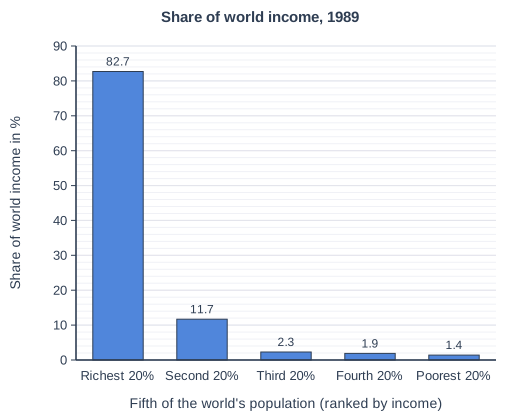
Study Figure 1, which shows the share of world income received by each fifth (20%) of the world's population in 1989 (source: UNDP Human Development Report 1992).
Calculate how many times greater the share of world income received by the richest 20% was than the share received by the poorest 20%.
Model answer
82.7 ÷ 1.4 = 59.1, so the richest 20% received about 59 times as much as the poorest 20%.
Explanation
'How many times greater' means dividing the larger share by the smaller one. A common error is to subtract the two values, which gives the difference in percentage points rather than how many times greater.
Mark scheme
1 mark
59 (82.7 ÷ 1.4 = 59.07...)
Correct answer with no working scores full marks. Accept 59, 59.1 or 59.07, 'about 59 times' or the ratio 59 : 1. Do not accept 81.3 (the difference, 82.7 - 1.4).
Question 2
2 marks
Explain one way in which relying on the export of primary products, such as crops or minerals, can increase global inequality.
Model answer
Primary products such as cocoa beans or copper ore sell for low prices compared with manufactured goods. Countries that rely on them earn less from their exports than they spend on imports, so they can fall into debt and have less money for development.
Explanation
One mark is for a problem with relying on primary products and one for explaining how it keeps the country poorer. Strong answers mention low or unstable prices, or the loss of the value added by processing.
Mark scheme
1 mark
Identifies a valid way, e.g. primary products sell for low prices / prices of primary products go up and down a lot / the value is added in other countries
Examples: Primary products sell for low prices compared with manufactured goods (1), so countries earn less from their exports than they pay for imports and can fall into debt (1). World prices for crops and minerals can rise and fall sharply (1), so export income is unpredictable and it is hard for governments to plan spending on services (1). Raw materials are processed into valuable products in other countries (1), so the jobs and profits from adding value go to richer countries (1). Accept any other appropriate response.
1 mark
Develops the way
The development must explain how this keeps the exporting country poorer than others. Do not credit 'they do not make much money' in isolation.
Question 3
2 marks
Explain one criticism of Rostow's modernisation theory.
Model answer
Rostow's theory ignores the effects of colonialism and neo-colonialism. It assumes that every country can develop by itself, so it does not explain why many former colonies are still held back by trade rules and debt that favour richer countries.
Explanation
One mark is for the criticism and one for explaining why it weakens the theory. Describing the five stages, without a criticism, does not answer the question.
Mark scheme
1 mark
Identifies a valid criticism, e.g. it is based on the history of Western countries / it ignores colonialism and the influence of richer countries / it assumes all countries follow the same path / it ignores the environment
Examples: It is based on how Western Europe and the USA developed (1), so it may not fit countries with very different histories, cultures and resources (1). It ignores colonialism and neo-colonialism (1), so it does not explain why some countries are held back by richer countries (1). It assumes all countries pass through the same stages in order (1), but some countries have stayed in the early stages for decades or skipped stages (1). It ignores environmental damage (1), as high mass consumption uses huge amounts of resources and is not sustainable for every country (1). Accept any other appropriate response.
1 mark
Develops the criticism
The development must explain why the criticism weakens the theory.
Question 4
4 marks
Explain two differences between Rostow's modernisation theory and Frank's dependency theory.
Model answer
First, Rostow believed that every country can develop by moving through five stages, from traditional society to high mass consumption, whereas Frank argued that the core keeps the periphery poor, so poorer countries cannot simply follow the same path as rich ones. Second, Rostow saw trade and investment from developed countries as helping a country to take off, whereas Frank saw this trade as unequal, because the periphery sells cheap raw materials and has to buy expensive manufactured goods, so wealth flows to the core.
Explanation
Each difference earns 1 mark and its explanation a second. A good answer says what each theory argues, using linking words such as 'whereas'; describing only one of the theories does not show a difference.
Mark scheme
1 mark
Identifies a first difference, e.g. Rostow sees development as a series of stages inside each country, whereas Frank sees underdevelopment as caused by exploitation from outside / Rostow sees trade and investment from richer countries as helpful, whereas Frank sees them as harmful / Rostow is optimistic that all countries can develop, whereas Frank argues the periphery stays poor
Examples: Rostow says every country can develop by passing through five stages (1), whereas Frank says poorer countries are kept poor by the richer core, so they cannot simply follow the same path (1). Rostow sees investment and trade with developed countries as the way to take off (1), whereas Frank sees trade with the core as unequal, because the periphery sells cheap raw materials and buys expensive goods (1). Rostow explains development by factors inside a country, such as savings and investment (1), whereas Frank explains poverty by a country's relationship with richer countries, such as colonialism and debt (1). Accept any other appropriate response.
1 mark
Develops the first difference
The development must explain the difference, for example what each theory says or why they disagree.
1 mark
Identifies a second, different difference
The two differences must be different; a description of one theory only does not identify a difference.
1 mark
Develops the second difference
As for the first difference.
Ready to try the rest? Every answer you write is marked against the mark scheme, so you can see exactly where the marks are.
Ctrl + Enter to check
Study HelperHints first, answers after you try
Stuck on this one? Ask for a hint and I’ll point you in the right direction, without giving the answer away. Once you’ve checked your answer, I’ll show you how the marks are awarded.