Practise 29 exam-style questions on Preparing for and responding to tropical cyclones for Edexcel GCSE Geography B (Paper 1). Write your answer as you would in the exam and get it marked in seconds against the mark scheme, point by point, with the Study Helper on hand if you get stuck.
29 questions
1–8 marks each
Instant marking
No sign-up needed
20 questions, marked as you go
Sample questions with model answers
Here are 4 of the questions in this topic, each with a model answer, an explanation of why it earns the marks and the mark scheme an examiner would use.
Question 1
1 mark
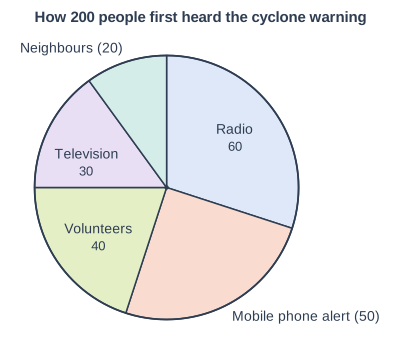
Figure 1 shows the results of a survey of 200 people in a coastal district. They were asked how they first heard a cyclone warning. The data were written for this course.
Calculate the percentage of people who first heard the warning from volunteers.
Model answer
40 ÷ 200 × 100 = 20%
Explanation
Divide the number who heard from volunteers (40) by the total surveyed (200) and multiply by 100. The volunteer sector is also one-fifth of the circle (72°), which gives the same answer. Writing 40 gives the number of people, not the percentage.
Mark scheme
1 mark
20% (40 ÷ 200 × 100)
Accept 20 or 20%. Correct answer with no working scores full marks. Do not accept 40 (the number of people, not the percentage).
Question 2
2 marks
Explain one way weather forecasting can reduce the number of deaths from tropical cyclones.
Model answer
Forecasters can predict the track of a cyclone and when it will make landfall several days ahead. This gives time to evacuate people from the areas that will be hit before the storm arrives.
Explanation
The first mark is for what the forecast predicts, and the second explains how that saves lives, usually by giving time to evacuate or prepare. Simply saying people 'are warned' needs developing into what they do with the warning.
Mark scheme
1 mark
Identifies a valid way, e.g. forecasts predict where and when the cyclone will make landfall / how strong it will be / how high the storm surge will be
Examples: Forecasts predict the track and timing of landfall several days ahead (1) so the right areas can be evacuated before the storm arrives (1). Forecasts of storm-surge height (1) show which low-lying areas must be cleared, so people are not caught by the water (1). Forecasting the strength of the storm (1) lets people secure their homes and stock up on food and water (1). Accept any other appropriate response.
1 mark
Explains how this reduces deaths, e.g. people have time to evacuate to safety
Do not credit 'people know it is coming' without saying what they can then do.
Question 3
3 marks
For a named developed country, explain one way it prepared for a tropical cyclone.
Model answer
Before Hurricane Katrina in 2005, an evacuation was ordered for New Orleans in the USA. Contraflow was used on the motorways so that all lanes carried traffic away from the city, and about 1 million people left the wider New Orleans area before the hurricane made landfall.
Explanation
One mark is for a method of preparation and two more are for developing it with detail from a named developed country. A generic answer with no named country can score at most 2 marks, and naming the country alone earns nothing.
Mark scheme
1 mark
Identifies a valid method of preparation used in a named developed country, e.g. evacuation orders, forecasting and warnings, storm-surge defences, emergency shelters
Max 2 if the answer is generic and makes no reference to a named developed country. Credit any appropriate named example. Examples for the USA: Before Hurricane Katrina in 2005 an evacuation was ordered for New Orleans (1), with contraflow on the motorways so all lanes carried traffic out of the city (1), and about 1 million people left the wider New Orleans area before landfall (1). The US National Hurricane Center uses satellites and reconnaissance aircraft to forecast a hurricane's track (1) so warnings can be issued days before landfall (1), giving time to evacuate the areas most at risk (1). After Katrina about 14.5 billion US dollars was spent on levees, floodwalls, pumping stations and a surge barrier around New Orleans (1) designed to protect against a storm surge with a 1% chance each year (1), reducing the risk of flooding in future hurricanes (1). Credit equivalent detail for any other valid example, e.g. Japan, Australia.
2 marks
Up to two further marks for linked development of the same method (1 + 1), with place-specific detail
No mark for simply naming the country. A second, separate method earns no further marks.
Question 4
4 marks
For one named developed country and one named developing or emerging country you have studied, explain two differences in how they prepared for or responded to tropical cyclones.
Model answer
First, in the USA people were expected to evacuate by car before Hurricane Katrina, with contraflow on the motorways out of New Orleans, whereas in Bangladesh most people walk to local cyclone shelters. This is because many rural families in Bangladesh do not own cars, so shelters must be close to villages. Second, the USA spent about 14.5 billion US dollars on levees, floodwalls and pumps around New Orleans after Katrina, whereas Bangladesh relies more on warnings and shelters. This is because Bangladesh cannot afford huge engineering schemes along its long, low-lying coast.
Explanation
Each difference earns 1 mark if it refers to both named countries, and a second mark for explaining why it exists. The best answers link the differences to wealth, transport or technology. Describing each country separately without comparing them limits the marks.
Mark scheme
1 mark
Identifies a first difference between the two named countries
Max 3 if the answer is generic and makes no reference to named countries. Credit any appropriate named examples. Examples (USA and Bangladesh): In the USA people were expected to evacuate by car, using contraflow on the motorways before Hurricane Katrina, whereas in Bangladesh most people walk to local cyclone shelters (1) because many rural families do not own cars and the shelters are within reach of villages (1). The USA relies on forecasts from the National Hurricane Center broadcast on television, radio and phones, whereas Bangladesh also uses volunteers with megaphones and flags (1) because many people in remote villages have no electricity or television (1). The USA spent about 14.5 billion US dollars on levees and floodwalls around New Orleans, whereas Bangladesh has spent much less and relies more on shelters and warnings (1) because it cannot afford large engineering schemes along its long, low coast (1). Examples (USA and Philippines): emergency responses in the USA were run by national agencies, whereas the Philippines relied on international help, with more than 150 foreign medical teams after Typhoon Haiyan (1) because local services were overwhelmed and had fewer resources (1). Credit equivalent detail for any other valid pair of examples.
1 mark
Explains the first difference
The explanation must give a reason for the difference (e.g. wealth, technology, transport, infrastructure).
1 mark
Identifies a second, different difference
Each difference must refer to both countries.
1 mark
Explains the second difference
Accept any other appropriate response.
Ready to try the rest? Every answer you write is marked against the mark scheme, so you can see exactly where the marks are.
Ctrl + Enter to check
Study HelperHints first, answers after you try
Stuck on this one? Ask for a hint and I’ll point you in the right direction, without giving the answer away. Once you’ve checked your answer, I’ll show you how the marks are awarded.