Practise 27 exam-style questions on Tropical cyclone hazards and vulnerability for Edexcel GCSE Geography B (Paper 1). Write your answer as you would in the exam and get it marked in seconds against the mark scheme, point by point, with the Study Helper on hand if you get stuck.
27 questions
1–8 marks each
Instant marking
No sign-up needed
20 questions, marked as you go
Sample questions with model answers
Here are 4 of the questions in this topic, each with a model answer, an explanation of why it earns the marks and the mark scheme an examiner would use.
Question 1
1 mark
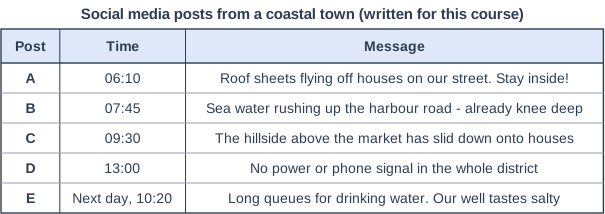
Figure 1 shows five social media posts written during a tropical cyclone. The posts were written for this course.
Identify the physical hazard described in post C.
Model answer
A landslide
Explanation
Post C describes a hillside sliding down onto houses, which is a landslide. Landslides happen when intense rainfall saturates slopes, making them heavier and weaker. Naming the rainfall gives the cause, not the hazard described.
Mark scheme
1 mark
Landslide
Accept mudslide / landslip / mudflow / mass movement. Do not accept flooding, storm surge or intense rainfall on its own (rain may have caused it, but the post describes the slope collapsing).
Question 2
2 marks
Explain one way a storm surge can damage the natural environment.
Model answer
A storm surge floods low coastal land with salt water. The salt soaks into the soil and makes it too salty for most plants to grow, so vegetation can die and the land can take years to recover.
Explanation
One mark is for a process (salt water flooding, erosion or smothering) and one for the effect on the natural environment. Answers about homes or roads describe impacts on people, not the environment.
Mark scheme
1 mark
Identifies a valid way, e.g. salt water floods land and soaks into the soil / erodes beaches and dunes / damages mangroves or coral reefs
Examples: Salt water floods coastal land (1) and makes the soil too salty for many plants to grow, sometimes for years (1). Salt water seeps into wells and freshwater aquifers (1) contaminating water that plants and animals depend on (1). The surge erodes beaches and sand dunes (1) destroying habitats for nesting birds and turtles (1). Debris and sediment are washed onto coral reefs (1) smothering the corals (1). Accept any other appropriate response.
1 mark
Explains the effect on the environment
Impacts must be on the natural environment (soil, water, plants, animals, landforms); do not credit impacts only on people or buildings.
Question 3
3 marks
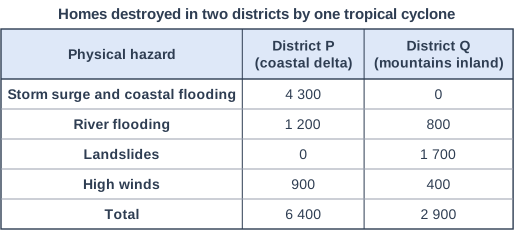
Figure 1 shows the number of homes destroyed by each physical hazard in two districts hit by the same tropical cyclone. District P is a low-lying coastal delta. District Q is a steep, mountainous area inland. The data were written for this course.
Compare the impacts of the physical hazards in District P and District Q.
Use data in your answer.
Model answer
District P had more than twice as many homes destroyed as District Q (6400 compared with 2900). In District P the main hazard was the storm surge and coastal flooding, which destroyed 4300 homes (about two-thirds), whereas District Q had no surge damage and its main hazard was landslides, which destroyed 1700 homes (over half). High winds also destroyed more than twice as many homes in District P as in District Q (900 compared with 400).
Explanation
Each comparative statement that refers to both districts earns a mark, and data (or simple manipulation such as 'twice as many') are needed for full marks. Copying the figures for one district and then the other is description, not comparison. Reasons for the differences, such as the low coast or the steep slopes, are not asked for.
Mark scheme
1 mark
Comparative point, e.g. District P had more than twice as many homes destroyed as District Q (6400 compared with 2900)
Max 2 if no data from Figure 1 is used. Award one mark for each comparative statement, up to 3. Examples: District P had more than twice as many homes destroyed in total as District Q (6400 compared with 2900) (1). The storm surge was the main hazard in District P (4300 homes, about two-thirds), whereas landslides were the main hazard in District Q (1700 homes, over half) (1). District Q had no homes destroyed by the storm surge, whereas District P had none destroyed by landslides (1). River flooding destroyed more homes in District P than in District Q (1200 compared with 800) (1). High winds destroyed more than twice as many homes in District P as in District Q (900 compared with 400) (1). Data manipulation counts as data. Do not credit data for one district without a comparison. Do not credit explanation.
1 mark
Second comparative point, e.g. the main hazard was the storm surge in District P (4300 homes) but landslides in District Q (1700 homes)
Each statement must refer to both districts (e.g. 'whereas', 'more than', 'twice as many').
1 mark
Third comparative point, e.g. high winds destroyed more than twice as many homes in District P as in District Q (900 compared with 400)
Accept any other valid comparison drawn from Figure 1.
Question 4
4 marks
Explain two ways a tropical cyclone can continue to affect people after the storm has passed.
Model answer
First, flood water often contaminates wells and drinking water. In the weeks after the storm, water-borne diseases such as cholera can spread, as happened after Cyclone Idai in Mozambique. Second, salt water from the storm surge soaks into farmland, so crops fail for several seasons. Farmers lose their income and food becomes scarce and more expensive.
Explanation
Each way earns 1 mark and its explanation another; the impacts should clearly continue after the storm, such as disease, food shortages or loss of income. Describing damage that happens during the storm, such as roofs blowing off, does not answer the question.
Mark scheme
1 mark
Identifies a first way, e.g. disease spreads from contaminated water / food shortages / loss of jobs and income / homelessness
Examples: Flood water contaminates drinking water (1) so water-borne diseases such as cholera spread in the weeks afterwards, as after Cyclone Idai in Mozambique in 2019 (1). Salt water from the storm surge ruins farmland (1) so crops fail for several seasons and food becomes scarce and expensive (1). Factories, shops and fishing boats are destroyed (1) so people lose their jobs and income for months (1). Homes are destroyed (1) so families may live in temporary shelters for a long time, with poor sanitation and little privacy (1). Accept any other appropriate response.
1 mark
Explains the first way
The explanation must show how the effect continues after the cyclone.
1 mark
Identifies a second, different way
The two ways must be different.
1 mark
Explains the second way
Accept any other appropriate response.
Ready to try the rest? Every answer you write is marked against the mark scheme, so you can see exactly where the marks are.
Ctrl + Enter to check
Study HelperHints first, answers after you try
Stuck on this one? Ask for a hint and I’ll point you in the right direction, without giving the answer away. Once you’ve checked your answer, I’ll show you how the marks are awarded.