Tropical rainforest: structure, adaptations and nutrients
Practise 26 exam-style questions on Tropical rainforest: structure, adaptations and nutrients for Edexcel GCSE Geography B (Paper 3). Write your answer as you would in the exam and get it marked in seconds against the mark scheme, point by point, with the Study Helper on hand if you get stuck.
26 questions
1–8 marks each
Instant marking
No sign-up needed
20 questions, marked as you go
Sample questions with model answers
Here are 4 of the questions in this topic, each with a model answer, an explanation of why it earns the marks and the mark scheme an examiner would use.
Question 1
1 mark
Using your own knowledge, identify the main reason why dead leaves decompose quickly on the floor of a tropical rainforest.
Choose your answer.
A It is hot and wet all year, so decomposers are active all the time
B The leaves fall from a great height and break up when they land
C Strong winds blow the leaves away before they can build up
D The leaves are thin needles that break down easily
Model answer
A
Explanation
The constant heat and moisture allow decomposers such as fungi, bacteria and termites to work all year, so leaf litter can break down within weeks to months. Option D describes taiga trees, a common mix-up between the two forest biomes.
Mark scheme
1 mark
A (It is hot and wet all year, so decomposers are active all the time)
Accept the letter or the option written out; do not credit more than one answer. B is incorrect: falling does not break leaves down; decomposition is carried out by fungi, bacteria and insects such as termites. C is incorrect: the forest floor is sheltered by the canopy and is very still, and litter is removed by decomposition, not wind. D is incorrect: rainforest trees have broad leaves; needles belong to the taiga, where they decompose slowly.
Question 2
1 mark
Using your own knowledge, state one way in which animals in a tropical rainforest help plants to reproduce.
Model answer
Animals such as toucans eat fruit and drop the seeds in other parts of the forest, which spreads the seeds.
Explanation
Pollination and seed dispersal are the two main ways animals help plants reproduce, and they show how plants and animals depend on each other. 'Animals eat plants' is the opposite link and does not answer the question.
Mark scheme
1 mark
Animals pollinate flowers (e.g. bees, bats, hummingbirds carry pollen) / animals spread (disperse) seeds, e.g. by eating fruit and dropping the seeds elsewhere / by burying nuts (e.g. agoutis bury Brazil nuts)
Any one valid way. Do not credit 'animals eat plants' or 'animals provide nutrients' on their own (not about reproduction). Accept any other appropriate response.
Question 3
2 marks
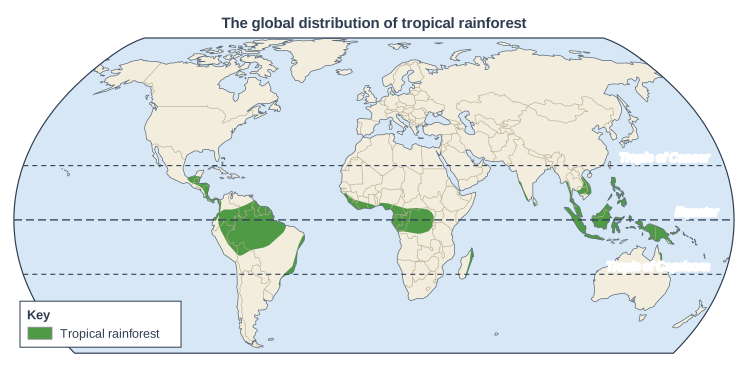
Study Figure 1, which shows the global distribution of tropical rainforest.
Using Figure 1 and your own knowledge, explain one reason why the tropical rainforests of South America, Africa and South-East Asia have a similar structure.
Model answer
Figure 1 shows that all three areas of rainforest lie close to the Equator. This means they share the same hot, wet climate all year, so trees grow tall and compete for light in the same way, creating the same layers of emergents, canopy, under-canopy and shrub layer.
Explanation
The first mark comes from the map (all near the Equator or between the Tropics) and the second from own knowledge, linking the shared equatorial climate to the layered structure. The species are different on each continent, but the climate produces a similar structure.
Mark scheme
1 mark
A reason based on Figure 1, e.g. they are all found close to the Equator / between the Tropics of Cancer and Capricorn / at similar (low) latitudes
Examples: All three areas lie close to the Equator (1) so they share the same hot, wet climate all year, which allows tall, dense forest with the same layers to grow (1). They are all between the Tropics (1) where the sun is high in the sky all year, so temperatures are high and convectional rain falls every day, giving a year-round growing season (1). Accept any other appropriate response.
1 mark
Develops the reason using own knowledge, e.g. they have the same hot and wet (equatorial) climate / year-round growing season / the same competition for light produces the same layers (emergents, canopy, under-canopy, shrub layer)
The development must link the shared location or climate to the structure of the forest. Do not credit 'they are all in hot countries' as the development. Do not credit naming the continents.
Question 4
4 marks
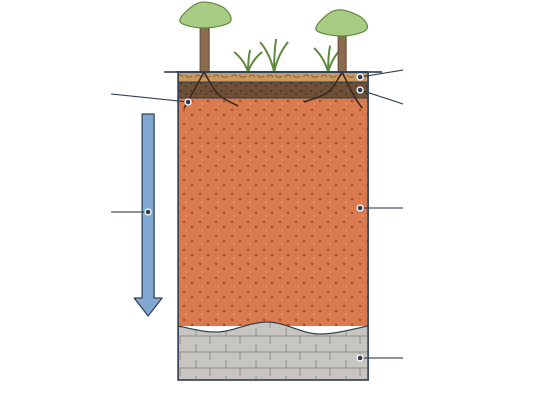
Study Figure 1, which shows a soil profile under a tropical rainforest.
Using Figure 1 and your own knowledge, explain one way in which the vegetation affects the soil and one way in which the soil affects the vegetation.
Model answer
The vegetation affects the soil because leaf litter falls from the trees all year and decomposes quickly. This forms the thin humus layer shown in Figure 1, which holds most of the soil's nutrients.
The soil affects the vegetation because, below the humus, the deep red layer is heavily leached by the rain and has few nutrients. So trees have shallow roots that spread through the top of the soil, where they can take up nutrients from the humus as soon as they are released.
Explanation
The question needs both directions of the link: one way the plants change the soil and one way the soil shapes the plants, each identified (1) and explained (1). Two ways in the same direction can only score 2 marks. Figure 1's thin humus and deep leached red layer are good evidence to use.
Mark scheme
1 mark
Vegetation affects the soil: identifies a way, e.g. leaf litter falls all year and forms the humus layer / roots bind the soil / the canopy intercepts heavy rain
Award 1 mark for identifying a way and 1 mark for explanation, for each direction, up to 4 marks. Vegetation affecting soil, examples: Leaf litter falls from the trees all year (1) and decomposes quickly to form the thin humus layer shown in Figure 1, which is where most of the soil's nutrients are (1). The roots and the canopy protect the soil (1) by binding it together and intercepting heavy rain, reducing erosion (1). Plants take up nutrients quickly (1) so few nutrients build up in the deep red layer (1). Accept any other appropriate response.
1 mark
Explains the way, e.g. adds nutrients / organic matter / reduces erosion
The development must explain the point credited immediately before it; see point 1 for examples.
1 mark
Soil affects the vegetation: identifies a way, e.g. the soil is leached and low in nutrients below a thin humus layer / the soil is shallow for roots
Soil affecting vegetation, examples: Below the thin humus layer the soil is heavily leached and poor in nutrients (1) so trees have shallow roots that spread through the top of the soil to catch nutrients as soon as they are released (1). The nutrients are only near the surface (1) so the tall trees have shallow roots and need buttress roots to support them (1). Accept any other appropriate response.
1 mark
Explains the way, e.g. shallow roots / buttress roots / plants rely on rapid recycling
The development must explain the point credited immediately before it; see point 1 for examples.
Ready to try the rest? Every answer you write is marked against the mark scheme, so you can see exactly where the marks are.
Ctrl + Enter to check
Study HelperHints first, answers after you try
Stuck on this one? Ask for a hint and I’ll point you in the right direction, without giving the answer away. Once you’ve checked your answer, I’ll show you how the marks are awarded.