Level:
Correct: 0
Incorrect: 0
Marks: 0/0
Exam Practice
Course:
Topics:
Avg
score:
–
Topics
done:
0/20

Protecting the taiga wilderness

Practise 26 exam-style questions on Protecting the taiga wilderness for Edexcel GCSE Geography B (Paper 3). Write your answer as you would in the exam and get it marked in seconds against the mark scheme, point by point, with the Study Helper on hand if you get stuck.

  • 26 questions
  • 1–8 marks each
  • Instant marking
  • No sign-up needed
20 questions, marked as you go

Sample questions with model answers

Here are 4 of the questions in this topic, each with a model answer, an explanation of why it earns the marks and the mark scheme an examiner would use.

Question 1

1 mark

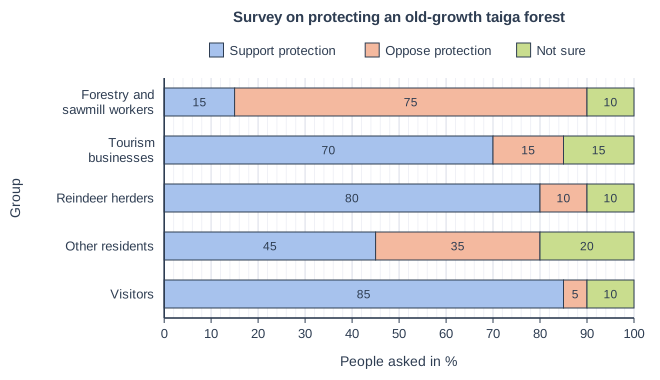
Study Figure 1, which shows the results of a survey in an imaginary town in northern Europe (data written for this course). A timber company wants to clear-fell an area of old-growth taiga forest near the town. Reindeer herders graze their herds in this forest in winter, when the reindeer feed on lichens that grow in old forest. People were asked whether the forest should be protected from logging.

Identify the group in which the largest percentage of people opposed protecting the forest.

Choose your answer.

  • A Forestry and sawmill workers
  • B Other residents
  • C Tourism businesses
  • D Reindeer herders
Survey on protecting an old-growth taiga forest. Stacked bar chart with 5 horizontal bars. The value axis (x-axis) is "People asked in %", from 0 to 100 marked every 10; the bars are labelled along the y-axis, "Group", from top to bottom. Each bar is split into 3 parts, shown in the key: Support protection (left, blue), Oppose protection (middle, orange) and Not sure (right, green). Values: Forestry and sawmill workers: support protection 15%, oppose protection 75%, not sure 10%; Tourism businesses: support protection 70%, oppose protection 15%, not sure 15%; Reindeer herders: support protection 80%, oppose protection 10%, not sure 10%; Other residents: support protection 45%, oppose protection 35%, not sure 20%; Visitors: support protection 85%, oppose protection 5%, not sure 10%. The value of each part is printed on it.

Model answer

A

Explanation

Compare the 'Oppose protection' part of each bar: it is largest for forestry and sawmill workers (75%). A common error is to read the 'Support protection' part, which would point to visitors (85%).

Mark scheme
  1. 1 mark

    A (Forestry and sawmill workers)

    Accept the letter or the option written out; do not credit more than one answer. All other answers are incorrect. 75% of forestry and sawmill workers opposed protection. B is incorrect: 35% of other residents opposed it. C is incorrect: 15% of tourism businesses opposed it. D is incorrect: 10% of reindeer herders opposed it.
Question 2

2 marks

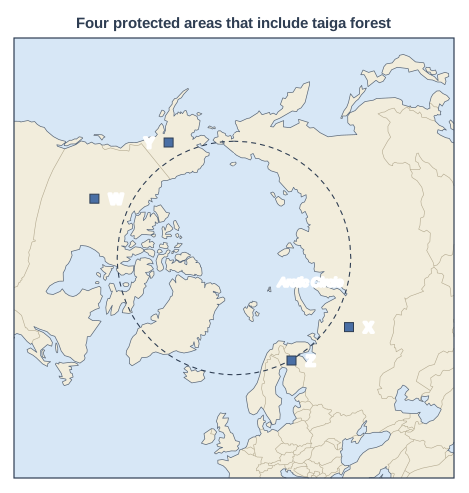
Study Figure 1, which shows the approximate locations of four protected areas that include taiga forest. The map is centred on the North Pole.

Using Figure 1 and your own knowledge, suggest one reason why very large protected areas can be created in the taiga.

Map of the Arctic (everything north of 45°N), seen from above the North Pole with 0° longitude at the bottom, titled "Four protected areas that include taiga forest". Lines of latitude: the Arctic Circle (66.5°N), drawn dashed and labelled "Arctic Circle". Points: a blue square labelled W towards the left of the map (about 20% of the way across from the left and 35% of the way down); a blue square labelled X towards the right of the map (about 75% of the way across from the left and 65% of the way down); a blue square labelled Y towards the top of the map (about 35% of the way across from the left and 25% of the way down); a blue square labelled Z towards the bottom of the map (about 65% of the way across from the left and 75% of the way down).

Model answer

The protected areas in Figure 1 are far north, where long, cold winters mean very few people live. With so few homes, farms or businesses, there are fewer people who would object to protection, so governments can set aside very large areas.

Explanation

A mark is for a reason (few people, remoteness, state ownership or little farming) and a second for explaining why it makes large protected areas possible. Saying only that the taiga is large or that it needs protecting does not explain why large protected areas can be created there.

Mark scheme
  1. 1 mark

    Suggests a reason, e.g. very few people live there / the areas are remote, far from cities and roads / much of the land is owned by the state / the cold climate and poor soils mean there is little farming

    Award 1 mark for a basic idea and 1 mark for its development. Examples: Very few people live in the taiga because of the long, cold winters (1) so few homes, farms or businesses would be affected and there are fewer objections to protection (1). The areas shown are far north and remote (1) so the land has been little used and is still wild enough to be worth protecting as a whole (1). Much of the taiga is owned by governments (1) so they can create protected areas without having to buy land from private owners (1). The cold climate and poor, acidic soils make farming very difficult (1) so there is little competition from agriculture for the land (1). Accept any other appropriate response.

  2. 1 mark

    Develops the reason, explaining why it makes large protected areas possible

    Do not credit 'because the taiga is big' with no explanation. Only one reason can be credited.

Question 3

2 marks

The Virgin Komi Forests in Russia became a UNESCO World Heritage Site in 1995. They cover about 3.3 million hectares and are the largest area of virgin forest in Europe. There has been pressure to allow gold mining inside the site.

Using your own knowledge, explain one reason why a government might allow mining in a protected area of taiga.

Model answer

A gold mine would pay taxes and royalties to the government. This money could be spent on schools, hospitals and roads, especially in poor, remote regions, so the government might decide the income is worth more than strict protection.

Explanation

One mark is for a reason (income, jobs, valuable exports, company pressure) and one for explaining how it benefits the government or the country. Simply saying 'money' without saying how it would be used or who gains it earns only 1 mark.

Mark scheme
  1. 1 mark

    Identifies a reason, e.g. income from taxes, royalties or exports / jobs in remote areas with few other employers / demand for valuable minerals / pressure from powerful companies / national development or debt

    Award 1 mark for a reason and 1 mark for further explanation. Examples: Mining companies pay taxes and royalties (1) which the government can spend on schools, hospitals or roads (1). Mines create jobs in remote northern regions where there are few other employers (1) so fewer young people move away and local poverty falls (1). Minerals such as gold are very valuable exports (1) so mining can earn foreign currency and help the national economy grow (1). Accept any other appropriate response.

  2. 1 mark

    Develops the reason

    Only one reason can be credited. Do not credit 'to make money' with no development.

Question 4

4 marks

Using your own knowledge, explain two ways in which logging companies can reduce the impact of logging on wildlife in the taiga.

Model answer

One way is to leave patches of old trees and dead wood standing when an area is logged. These provide nesting holes and food for species such as woodpeckers, owls and insects, so some wildlife can survive while the rest of the forest regrows.

A second way is to avoid logging the areas that caribou use in winter. Caribou depend on lichens that grow in old forest and take decades to recover, so leaving these areas uncut protects their food supply.

Explanation

Each way needs a point and an explanation of how it helps wildlife. Strong answers name specific methods, such as leaving old trees, river buffer strips or avoiding caribou habitat, rather than just saying 'log less'. Two different ways are needed for full marks.

Mark scheme
  1. 1 mark

    Identifies a first way, e.g. selective or continuous-cover logging instead of clear-felling / leaving patches of old trees and dead wood / leaving strips of forest beside rivers and lakes / avoiding important habitats such as caribou or reindeer winter grazing areas / longer rotations / replanting with a mix of native species / closing logging roads after use / avoiding logging in the breeding season

    In each case, award 1 mark for a way and 1 mark for further explanation. Examples: Cutting only some trees instead of clear-felling (1) keeps forest cover, so birds and mammals still have shelter and food (1). Leaving patches of old trees and dead wood (1) provides nesting holes and food for woodpeckers, owls and insects (1). Leaving strips of forest along rivers and lakes (1) stops soil washing into the water and protects fish and the animals that feed on them (1). Avoiding areas used by caribou or reindeer in winter (1) protects the lichens they feed on, which take decades to regrow (1). Closing logging roads after use (1) stops hunters and other vehicles reaching remote areas and disturbing wildlife (1). Accept any other appropriate response.

  2. 1 mark

    Develops the first way

  3. 1 mark

    Identifies a second, different way

    The two ways must be different.

  4. 1 mark

    Develops the second way

Ready to try the rest? Every answer you write is marked against the mark scheme, so you can see exactly where the marks are.

Study Helper Hints first, answers after you try

Stuck on this one? Ask for a hint and I’ll point you in the right direction, without giving the answer away. Once you’ve checked your answer, I’ll show you how the marks are awarded.