
Level:
Correct: 0
Incorrect: 0
Marks: 0/0
Exam Practice
Course:
Topics:
Avg
score:
–
Topics
done:
0/20

The taiga: climate, adaptations and productivity

Practise 26 exam-style questions on The taiga: climate, adaptations and productivity for Edexcel GCSE Geography B (Paper 3). Write your answer as you would in the exam and get it marked in seconds against the mark scheme, point by point, with the Study Helper on hand if you get stuck.

  • 26 questions
  • 1–8 marks each
  • Instant marking
  • No sign-up needed
20 questions, marked as you go

Sample questions with model answers

Here are 4 of the questions in this topic, each with a model answer, an explanation of why it earns the marks and the mark scheme an examiner would use.

Question 1

1 mark

Using your own knowledge, identify the statement that best describes the structure of the taiga forest.

Choose your answer.

  • A Several layers of trees, with emergents standing above a continuous canopy
  • B A canopy of conifers with few layers beneath it, and mosses and lichens on the ground
  • C Tall grasses with scattered trees that lose their leaves in the dry season
  • D Low shrubs, mosses and lichens with no trees at all

Model answer

B

Explanation

The taiga has a simple structure: a canopy of a few conifer species, little undergrowth, and mosses and lichens on the floor, because few plants can survive the long, cold winters and the shade of the evergreen canopy. The other options describe other biomes.

Mark scheme
  1. 1 mark

    B (A canopy of conifers with few layers beneath it, and mosses and lichens on the ground)

    Accept the letter or the option written out; do not credit more than one answer. A is incorrect: this describes the tropical rainforest. C is incorrect: this describes tropical grassland (savanna). D is incorrect: this describes the tundra, north of the tree line.
Question 2

1 mark

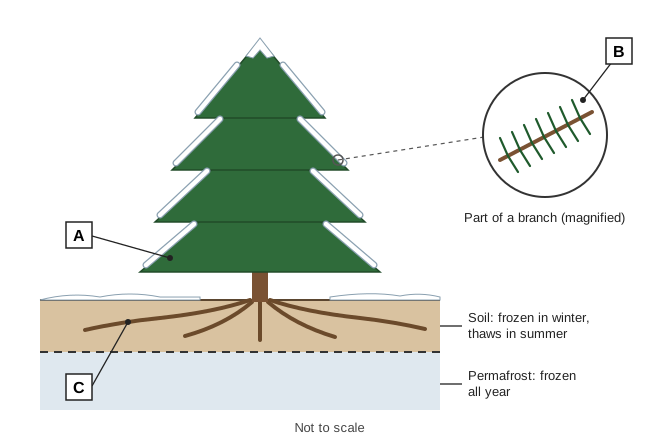
Study Figure 1, which shows a coniferous tree in the taiga in winter.

State one way in which the branch labelled A helps the tree to survive heavy snowfall.

A drawing of a coniferous tree in the taiga in winter. Snow lies on the ground and on the tree. The tree stands on a layer of soil labelled 'Soil: frozen in winter, thaws in summer', above a dashed line; below the line is a layer labelled 'Permafrost: frozen all year'. A magnified circle shows part of a branch. Three features are marked with letters: A points to the end of one of the tree's lower branches, B points to the leaves on the magnified branch and C points to the tree's roots. The drawing is not to scale.

Model answer

The branch slopes downwards and bends, so heavy snow slides off instead of building up and breaking it.

Explanation

Downward-sloping, flexible branches and the cone shape of the whole tree let snow slide off, so its weight does not snap the branches. Answers that only say the branch is strong do not explain how the shape helps.

Mark scheme
  1. 1 mark

    It slopes downwards / is flexible (bends) so snow slides off / so snow does not build up and break the branch

    The idea of snow sliding off, or of the branch not breaking under the weight of snow, is needed. Accept 'the tree is cone-shaped so snow falls off'. Do not credit 'it is strong' on its own or answers about the needles. Accept any other appropriate response.

Question 3

2 marks

Using your own knowledge, explain one way in which the lives of Indigenous peoples in the taiga are influenced by its seasonal climate.

Model answer

Some reindeer herders, such as the Evenki in Siberia, move their herds with the seasons. This is because the reindeer need to graze on lichens in the forest during the long winter and move to summer pastures when the snow melts.

Explanation

One mark is for a way of life and one for linking it to the seasonal climate (long, frozen winters and short summers). This shows that people are part of the interdependence of the taiga ecosystem.

Mark scheme
  1. 1 mark

    Identifies a way, e.g. reindeer herders move their herds between seasonal pastures / people hunt migrating caribou in spring and autumn / food is dried, smoked or stored in summer and autumn / wood is gathered for fuel for the long winter / travel by snowmobile, sledge or over frozen rivers in winter

    Examples: Some reindeer herders (e.g. the Evenki in Siberia or the Sami in Scandinavia) move their herds with the seasons (1) because the reindeer need winter grazing on lichens in the forest and summer pastures elsewhere (1). Many communities (e.g. Cree hunters in Canada) hunt caribou when the herds migrate through in spring and autumn (1) because the animals are only nearby at certain times of year (1). People dry or smoke fish and meat in summer and autumn (1) because little food can be gathered during the long, frozen winter (1). Credit any appropriate named or unnamed group. Accept any other appropriate response.

  2. 1 mark

    Explains how the climate causes this, e.g. long frozen winters / short summers / animals and food are only available at certain times

    The development must link the way of life to the seasonal climate. Do not credit general statements such as 'they live in the forest' without a link to the seasons.

Question 4

4 marks

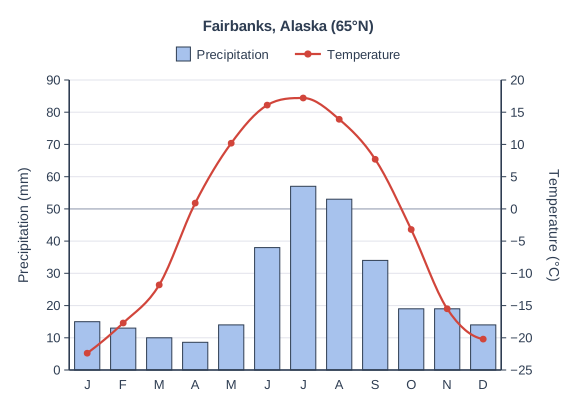
Study Figure 1, which shows the climate of Fairbanks, Alaska, in an area of taiga (boreal forest). The data are averages for 1991-2020 from the US National Oceanic and Atmospheric Administration (NOAA).

Using Figure 1 and your own knowledge, explain one way in which the winter conditions and one way in which the summer conditions shown in Figure 1 affect the soils of the taiga.

Climate graph for Fairbanks, Alaska (65°N). It has blue bars for monthly precipitation, read on the left axis (Precipitation in mm, 0 to 90, numbered every 10), and a red line with a point for each month's mean temperature, read on the right axis (Temperature in °C, −25 to 20, numbered every 5). The months J F M A M J J A S O N D (January to December) run along the bottom; a key shows Precipitation (bars) and Temperature (line). A slightly darker gridline marks 0 °C. Precipitation Jan 15, Feb 13, Mar 10, Apr 8.6, May 14, Jun 38, Jul 57, Aug 53, Sep 34, Oct 19, Nov 19, Dec 14 mm; temperature Jan −22.4, Feb −17.7, Mar −11.8, Apr 0.9, May 10.2, Jun 16.1, Jul 17.2, Aug 13.9, Sep 7.7, Oct −3.2, Nov −15.5, Dec −20.2 °C.

Model answer

In winter, Figure 1 shows that mean temperatures are below 0 °C from October to March. For about half the year the ground is frozen and decomposers are inactive, so dead needles break down very slowly and few nutrients are added to the soil, which stays thin and infertile.

In summer, Figure 1 shows that June to August are the wettest months. Snowmelt has already soaked the ground in spring, and because it is cool little water evaporates, so the rainwater moves down through the soil. This leaches nutrients downwards and forms an acidic podzol with a grey, bleached layer.

Explanation

Each half needs a condition from the graph for the right season (1) and its effect on the soil (1): slow decomposition and infertile soil or permafrost in winter; leaching, a podzol, waterlogging or thin soils linked to the summer. Two winter points, or two summer points, can only score 2 marks.

Mark scheme
  1. 1 mark

    Winter: identifies a winter condition from Figure 1, e.g. mean temperatures below 0 °C from October to March / below -15 °C from November to February / little precipitation, falling as snow

    Award 1 mark for identifying a condition shown in Figure 1 and 1 mark for explaining its effect on the soil, for winter and for summer, up to 4 marks. Winter examples: Mean temperatures are below 0 °C from October to March (1), so the ground freezes and decomposers stop working, so needles build up as a thick litter layer and few nutrients reach the soil, which stays infertile (1). The winters are so cold (below -15 °C from November to February) (1) that in many places the ground stays frozen at depth all year as permafrost, which stops water draining and roots growing deeply (1). Accept any other appropriate response. Readings within half a gridline (plus or minus 2.5 °C or 5 mm of precipitation) of the values given are acceptable.

  2. 1 mark

    Explains the effect of the winter condition on the soil, e.g. decomposition stops / thick litter / infertile soil / permafrost

    The development must explain the point credited immediately before it; see point 1 for examples.

  3. 1 mark

    Summer: identifies a summer condition from Figure 1, e.g. mean temperatures above 10 °C from May to August / June to August are the wettest months / most precipitation falls as rain in summer

    Summer examples: June to August are the wettest months (1), and the water from summer rain and spring snowmelt cannot evaporate much in the cool climate, so it moves down through the soil, leaching nutrients and forming an acidic podzol with a grey, bleached layer (1). Mean temperatures are above 10 °C from May to August (1), so the top layer of soil thaws, but where permafrost lies below, the meltwater cannot drain and the soil becomes waterlogged (1). The summer is short, with only about five months above 5 °C (1), so decomposition and weathering only happen for a few months a year and the soil stays thin (1). Accept any other appropriate response.

  4. 1 mark

    Explains the effect of the summer condition on the soil, e.g. leaching / podzol / waterlogging / thin soil

    Do not credit the same effect for both seasons (e.g. 'slow decomposition' twice).

Ready to try the rest? Every answer you write is marked against the mark scheme, so you can see exactly where the marks are.

Study Helper Hints first, answers after you try

Stuck on this one? Ask for a hint and I’ll point you in the right direction, without giving the answer away. Once you’ve checked your answer, I’ll show you how the marks are awarded.