Level:
Correct: 0
Incorrect: 0
Marks: 0/0
Exam Practice
Course:
Topics:
Avg
score:
–
Topics
done:
0/20

Decision-making: oil and peatlands in the Congo Basin

Practise 25 exam-style questions on Decision-making: oil and peatlands in the Congo Basin for Edexcel GCSE Geography B (Paper 3). Write your answer as you would in the exam and get it marked in seconds against the mark scheme, point by point, with the Study Helper on hand if you get stuck.

  • 25 questions
  • 1–16 marks each
  • Instant marking
  • No sign-up needed
20 questions, marked as you go

Sample questions with model answers

Here are 4 of the questions in this topic, each with a model answer, an explanation of why it earns the marks and the mark scheme an examiner would use.

Question 1

1 mark

This question is based on a resource booklet about oil, forests, peat and energy in the Democratic Republic of the Congo (DRC), written for this course.

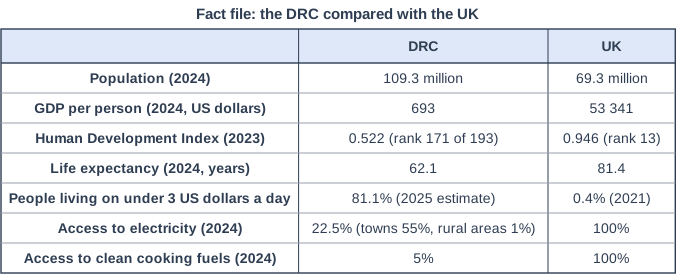
Figure 1 (Source 2 of the booklet) is a fact file comparing the DRC with the UK (World Bank and UNDP data).

Using Figure 1, calculate the ratio of GDP per person in the UK to GDP per person in the DRC in 2024. Give your answer in the form n : 1, with n to the nearest whole number.

Fact file: the DRC compared with the UK. Table with columns (row headings), "DRC", "UK". Population (2024); DRC: 109.3 million; UK: 69.3 million | GDP per person (2024, US dollars); DRC: 693; UK: 53 341 | Human Development Index (2023); DRC: 0.522 (rank 171 of 193); UK: 0.946 (rank 13) | Life expectancy (2024, years); DRC: 62.1; UK: 81.4 | People living on under 3 US dollars a day; DRC: 81.1% (2025 estimate); UK: 0.4% (2021) | Access to electricity (2024); DRC: 22.5% (towns 55%, rural areas 1%); UK: 100% | Access to clean cooking fuels (2024); DRC: 5%; UK: 100%.

Model answer

53 341 ÷ 693 = 76.97
Ratio = 77 : 1

Explanation

Divide the UK value by the DRC value to find how many times larger it is, then write the result as n : 1. A common error is to subtract the two values, or to give the ratio the wrong way round without saying which country is which.

Mark scheme
  1. 1 mark

    77 : 1 (53 341 ÷ 693 = 76.97)

    Correct answer with no working scores full marks. Accept 77 : 1, 77:1, 77 to 1 or 'the UK figure is 77 times the DRC figure'. Must be given to the nearest whole number: do not credit 76.97 : 1 or 77.0 : 1 for this mark. Accept the reversed ratio 1 : 77 only if it is labelled as DRC : UK. Do not accept 52 648 : 1 (the difference) or 0.013.

Question 2

2 marks

This question is based on a resource booklet about oil, forests, peat and energy in the Democratic Republic of the Congo (DRC), written for this course.

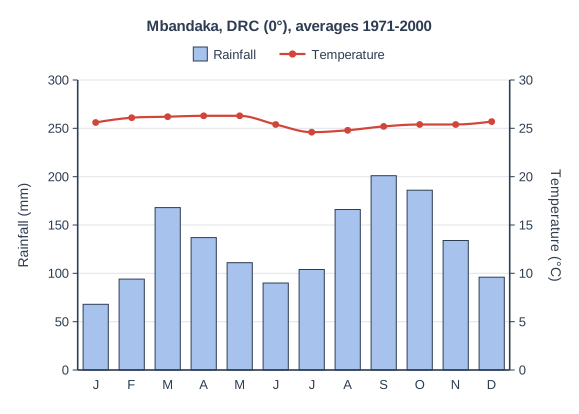
Figure 1 (Source 3 of the booklet) is a climate graph for Mbandaka, a city on the Equator in the Cuvette Centrale (averages for 1971-2000, FAO data). Peat only builds up where dead plants decay more slowly than new plant material is added.

Using Figure 1, suggest one reason why peat in the Cuvette Centrale can only build up where the ground stays waterlogged all year.

Climate graph for Mbandaka, DRC (0°), averages 1971-2000. It has blue bars for monthly rainfall, read on the left axis (Rainfall in mm, 0 to 300, numbered every 50), and a red line with a point for each month's mean temperature, read on the right axis (Temperature in °C, 0 to 30, numbered every 5). The months J F M A M J J A S O N D (January to December) run along the bottom; a key shows Rainfall (bars) and Temperature (line). Rainfall Jan 68, Feb 94, Mar 168, Apr 137, May 111, Jun 90, Jul 104, Aug 166, Sep 201, Oct 186, Nov 134, Dec 96 mm; temperature Jan 25.6, Feb 26.1, Mar 26.2, Apr 26.3, May 26.3, Jun 25.4, Jul 24.6, Aug 24.8, Sep 25.2, Oct 25.4, Nov 25.4, Dec 25.7 °C.

Model answer

Figure 1 shows that mean temperatures are about 25-26 °C in every month, so there is no cold season. In these warm conditions decomposers would normally break down dead leaves and wood quickly, so peat can only build up where waterlogging keeps oxygen out all year and slows decay.

Explanation

The first mark needs evidence from the climate graph, such as the constant high temperatures or the drier months. The second mark links this to decomposition. Answers that only say 'it rains a lot' without explaining why waterlogging must be permanent are not developed.

Mark scheme
  1. 1 mark

    A basic idea using Figure 1, e.g. temperatures are high (about 25-26 °C) all year / there is no cold season / some months are much drier (e.g. January 68 mm)

    Award 1 mark for a basic idea drawn from the climate graph and 1 mark for developing it. Readings within half a gridline (plus or minus 25 mm of rainfall and 2.5 °C) of the values given are acceptable. Examples: Mean temperatures are about 25-26 °C in every month (1), so decomposers would normally break down dead plants quickly; only the lack of oxygen in waterlogged ground slows decay enough for peat to build up (1). There is no cold season to slow decay, unlike peat in cold places such as the taiga (1), so the only thing that stops decay is permanent waterlogging (1). Rainfall falls to 68 mm in January and 90 mm in June (1), so if the ground dried out in these months air would reach the peat and it would start to decompose (1). Accept any other appropriate response.

  2. 1 mark

    Development, e.g. so decomposers would normally break down dead plants quickly, and only the lack of oxygen in waterlogged ground slows decay enough

    The development must link the climate evidence to the rate of decay.

Question 3

4 marks

This question is based on a resource booklet about oil, forests, peat and energy in the Democratic Republic of the Congo (DRC), written for this course.

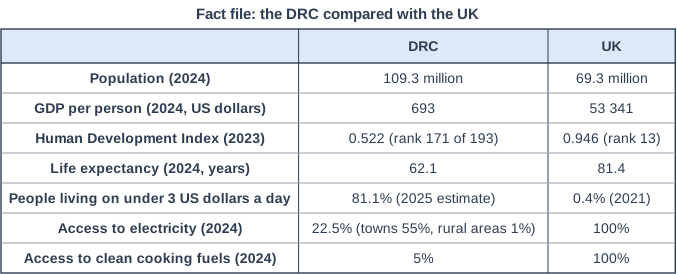
Figure 1 (Source 2 of the booklet) is a fact file comparing the DRC with the UK (World Bank and UNDP data).

Using evidence from Figure 1 and your own knowledge, explain two ways in which the lack of electricity in rural areas of the DRC could increase pressure on the forest.

Fact file: the DRC compared with the UK. Table with columns (row headings), "DRC", "UK". Population (2024); DRC: 109.3 million; UK: 69.3 million | GDP per person (2024, US dollars); DRC: 693; UK: 53 341 | Human Development Index (2023); DRC: 0.522 (rank 171 of 193); UK: 0.946 (rank 13) | Life expectancy (2024, years); DRC: 62.1; UK: 81.4 | People living on under 3 US dollars a day; DRC: 81.1% (2025 estimate); UK: 0.4% (2021) | Access to electricity (2024); DRC: 22.5% (towns 55%, rural areas 1%); UK: 100% | Access to clean cooking fuels (2024); DRC: 5%; UK: 100%.

Model answer

Figure 1 shows that only 1% of people in rural areas have electricity and only 5% of people have clean cooking fuels. This means rural families have to cook with firewood or charcoal, so trees are cut down around villages and the forest is gradually degraded and cleared.

Without electricity there are few jobs in workshops or small industries in the countryside. Making charcoal to sell in the cities, or clearing more forest to grow and sell crops, is one of the few ways for very poor people (81.1% live on less than 3 US dollars a day) to earn money, so more forest is felled.

Explanation

Each way needs a clear link from the lack of electricity to more pressure on the forest, and at least one should use data from the fact file, such as the 1% rural access figure. Answers that only state that people are poor or that forest is lost, without explaining the link, gain little credit.

Mark scheme
  1. 1 mark

    First way, using evidence from Figure 1, e.g. only 1% of rural people have electricity (and only 5% of people have clean cooking fuels), so families must cook with wood or charcoal

    Max 3 if no data or evidence from Figure 1 is used. Award 1 mark for each way and 1 mark for its development, up to 2 marks for each way. The two ways must be different. Examples: Only 1% of rural people have electricity, so they cook with firewood and charcoal (1) and trees are cut down around villages for fuel, degrading the forest (1). With no electricity there are few jobs in workshops or factories (1), so making and selling charcoal or clearing forest to farm is one of the few ways to earn money (1). Most people are very poor (81.1% live on under 3 US dollars a day) and cannot afford electric or gas cooking (1), so they depend on free wood from the forest (1). Without electricity for pumps, fridges or food processing, farmers cannot increase yields or store produce (1), so they clear new forest for shifting cultivation to grow more food (1). Accept any other appropriate response.

  2. 1 mark

    Development of the first way, e.g. so more trees are cut down for fuelwood and charcoal, degrading or clearing forest

    The development must explain how the way leads to more pressure on (loss or degradation of) the forest.

  3. 1 mark

    Second, different way, e.g. with no electricity there are few non-farm jobs, so people earn money by making charcoal or clearing land

    Must be a different way from the first. Data from Figure 1 may be used in either way.

  4. 1 mark

    Development of the second way, e.g. so forest is cleared for farming or felled for charcoal to sell in towns

    Do not credit 'it causes deforestation' without a linked reason.

Question 4

8 marks

This question is based on a resource booklet about oil, forests, peat and energy in the Democratic Republic of the Congo (DRC), written for this course.

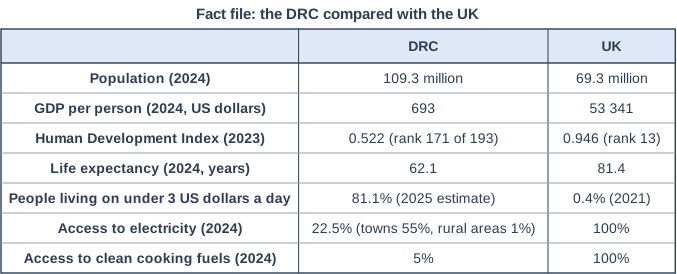
Figure 1 (Source 2 of the booklet) is a fact file comparing the DRC with the UK (World Bank and UNDP data). The booklet also states that:

- the Congo River's flow at Inga Falls is about 42 000 m³ per second and a 'Grand Inga' hydropower scheme could produce about 39 000 MW, but the existing Inga 1 and Inga 2 dams have often produced far less than their 1 775 MW capacity
- the DRC covers about 2.3 million km², and about 55% of its people live in rural areas (World Bank, 2024)
- armed conflict has affected parts of eastern DRC for many years.

Using evidence from Figure 1 and your own knowledge, assess the reasons why so few people in the DRC have access to modern energy, even though the country has very large energy resources.

Fact file: the DRC compared with the UK. Table with columns (row headings), "DRC", "UK". Population (2024); DRC: 109.3 million; UK: 69.3 million | GDP per person (2024, US dollars); DRC: 693; UK: 53 341 | Human Development Index (2023); DRC: 0.522 (rank 171 of 193); UK: 0.946 (rank 13) | Life expectancy (2024, years); DRC: 62.1; UK: 81.4 | People living on under 3 US dollars a day; DRC: 81.1% (2025 estimate); UK: 0.4% (2021) | Access to electricity (2024); DRC: 22.5% (towns 55%, rural areas 1%); UK: 100% | Access to clean cooking fuels (2024); DRC: 5%; UK: 100%.

Model answer

The DRC has huge energy resources. The Congo River's flow at Inga is about 42 000 m³ per second and a Grand Inga scheme could produce about 39 000 MW, yet Figure 1 shows that only 22.5% of people had electricity in 2024 and only 5% used clean cooking fuels. Several reasons explain this.

The most important reason is probably poverty. GDP per person is only 693 US dollars, compared with 53 341 in the UK, and 81.1% of people live on less than 3 US dollars a day. Most households cannot afford connection fees, appliances or bottled gas, and the government has little tax income to build power stations and power lines. Even the existing Inga 1 and 2 dams have often produced far less than their 1 775 MW capacity, which suggests there has not been enough money to maintain them.

A second reason is the size of the country and where people live. The DRC covers about 2.3 million km² and about 55% of its people live in rural areas, often in dense forest reached only by river or poor roads. Figure 1 shows that 55% of people in towns have electricity but only 1% in rural areas, because it is very expensive to extend the grid hundreds of kilometres to scattered villages. Inga is in the far west of the country, so its power would have to travel very long distances to reach most people.

A third reason is political. Armed conflict in parts of the east damages infrastructure and puts investors off, and plans for new stages of Inga have changed many times. When large schemes are planned, much of the power is often meant for mines and export rather than for households.

Overall, the DRC is not short of energy resources; the problem is turning them into energy that people can reach and afford. I judge poverty and lack of investment to be the most important reason, because they lie behind the poor maintenance, the lack of grid extension and the reliance on charcoal. Size and conflict make the problem harder, but small local schemes such as solar mini-grids show that some of these barriers can be overcome when money is available.

Explanation

Level 3 answers select evidence from the fact file and the stem (AO4) and weigh up several reasons, such as poverty, the size of the country, a rural population, conflict and governance, reaching a supported judgement about which matters most (AO3). Answers that list reasons without comparing them, or that ignore the evidence that physical resources are plentiful, usually stay in Level 2.

Mark scheme
  1. 8 marks

    Levels of response (8 marks).
    Level 3 (7-8 marks): Applies understanding to deconstruct information and provide logical connections between concepts throughout. A balanced, well-developed argument that synthesises relevant understanding coherently, leading to judgements that are supported by evidence throughout. (AO3) Uses geographical skills to obtain accurate information that supports all aspects of the argument. (AO4)
    Level 2 (4-6 marks): Applies understanding to deconstruct information and provide some logical connections between concepts. An imbalanced argument that synthesises mostly relevant understanding but not entirely coherently, leading to judgements that are supported by evidence occasionally. (AO3) Uses geographical skills to obtain accurate information that supports some aspects of the argument. (AO4)
    Level 1 (1-3 marks): Attempts to apply understanding to deconstruct information but understanding and connections are flawed. An unbalanced or incomplete argument that provides limited synthesis of understanding. Judgements are supported by limited evidence. (AO3) Uses some geographical skills to obtain information with limited relevance and accuracy, which supports few aspects of the argument. (AO4)
    0 marks: No acceptable response.

    AO3 (4 marks) / AO4 (4 marks). Answers should address the reasons for low access to electricity and clean cooking fuels; the assessment may offer a view on which reason matters most. Indicative content (not a checklist; credit other valid points): AO4 (use of evidence from Figure 1 and the stem): 22.5% electricity access (towns 55%, rural areas 1%) against 100% in the UK; 5% clean cooking; GDP per person 693 US dollars against 53 341; 81.1% on under 3 US dollars a day; HDI 0.522, rank 171 of 193; Inga 1 and 2 often working far below their 1 775 MW capacity; Grand Inga potential about 39 000 MW; area about 2.3 million km²; about 55% rural; conflict in the east. AO3 (judgement): poverty means households cannot afford connections, appliances or bottled gas and the government lacks money to build and maintain power stations and lines (shown by Inga 1 and 2 often working far below capacity); the size of the country and a scattered rural population in forest make grid extension very expensive, explaining the urban-rural gap; the main energy resource is in the far west at Inga, a long way from many people; conflict damages infrastructure and deters investment; weak governance and changing plans delay large schemes, and new power may go to mines and export; physical resources are not the limiting factor; a supported judgement on the most important reason, e.g. poverty and lack of investment underlie the others.

Ready to try the rest? Every answer you write is marked against the mark scheme, so you can see exactly where the marks are.

Study Helper Hints first, answers after you try

Stuck on this one? Ask for a hint and I’ll point you in the right direction, without giving the answer away. Once you’ve checked your answer, I’ll show you how the marks are awarded.