
Level:
Correct: 0
Incorrect: 0
Marks: 0/0
Exam Practice
Course:
Topics:
Avg
score:
–
Topics
done:
0/20

Global biomes: distribution, climate and local factors

Practise 28 exam-style questions on Global biomes: distribution, climate and local factors for Edexcel GCSE Geography B (Paper 3). Write your answer as you would in the exam and get it marked in seconds against the mark scheme, point by point, with the Study Helper on hand if you get stuck.

  • 28 questions
  • 1–8 marks each
  • Instant marking
  • No sign-up needed
20 questions, marked as you go

Sample questions with model answers

Here are 4 of the questions in this topic, each with a model answer, an explanation of why it earns the marks and the mark scheme an examiner would use.

Question 1

1 mark

Study Figure 1, which shows climate graphs for Singapore and Darwin, Australia. The data are averages for 1991-2020 from Singapore's National Environment Agency and the Australian Bureau of Meteorology.

Identify the number of months in which Darwin receives less than 50 mm of rainfall.
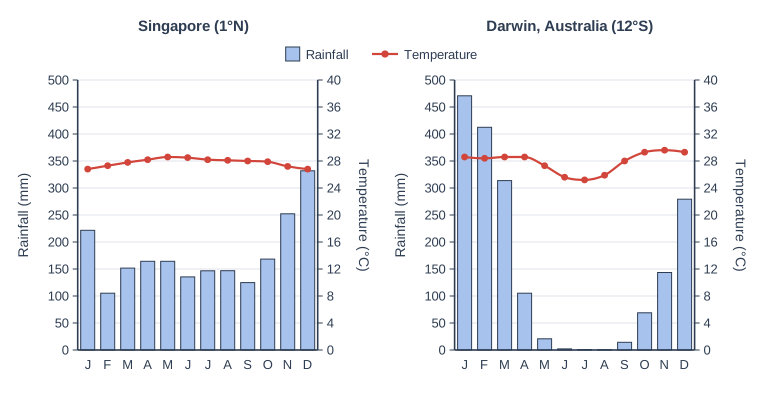
Two climate graphs side by side on the same scales: Singapore (1°N) (left) and Darwin, Australia (12°S) (right). Each has blue bars for monthly rainfall, read on the left axis (Rainfall in mm, 0 to 500, numbered every 50), and a red line with a point for each month's mean temperature, read on the right axis (Temperature in °C, 0 to 40, numbered every 4). The months J F M A M J J A S O N D (January to December) run along the bottom; a key shows Rainfall (bars) and Temperature (line). Singapore (1°N): rainfall Jan 221.6, Feb 105.1, Mar 151.7, Apr 164.3, May 164.3, Jun 135.3, Jul 146.6, Aug 146.9, Sep 124.9, Oct 168.3, Nov 252.3, Dec 331.9 mm; temperature Jan 26.8, Feb 27.3, Mar 27.8, Apr 28.2, May 28.6, Jun 28.5, Jul 28.2, Aug 28.1, Sep 28, Oct 27.9, Nov 27.2, Dec 26.8 °C. Darwin, Australia (12°S): rainfall Jan 470.7, Feb 412.4, Mar 313.7, Apr 105.1, May 20.7, Jun 2.1, Jul 0.9, Aug 0.8, Sep 14.3, Oct 68.9, Nov 143.5, Dec 279.3 mm; temperature Jan 28.6, Feb 28.4, Mar 28.6, Apr 28.6, May 27.3, Jun 25.6, Jul 25.2, Aug 25.9, Sep 28, Oct 29.3, Nov 29.6, Dec 29.3 °C.

Model answer

5

Explanation

May to September each have a rainfall bar below the 50 mm line, so Darwin has five months with less than 50 mm. A common error is to include October, whose bar (about 69 mm) is above the 50 mm line.

Mark scheme
  1. 1 mark

    5 (May, June, July, August and September)

    Accept 5 or five. The months do not need to be named. Do not accept 4 or 6 (October has about 69 mm and April about 105 mm).
Question 2

1 mark

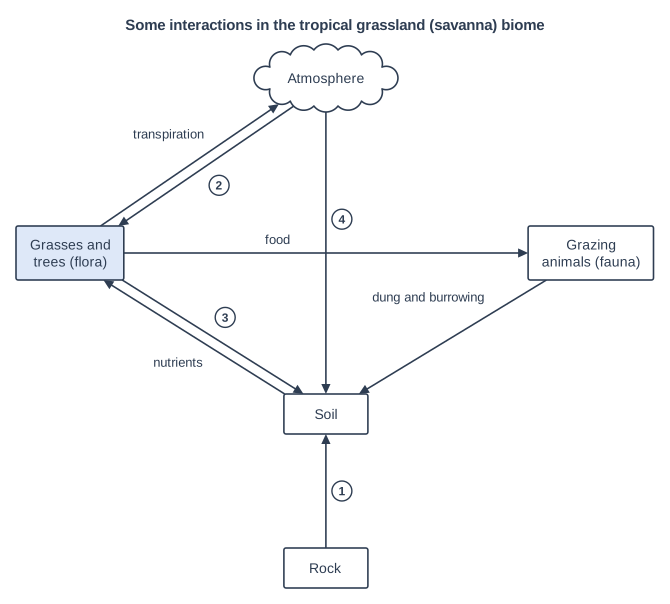
Study Figure 1, which shows some interactions between the biotic and abiotic components of the tropical grassland (savanna) biome.

Identify the numbered arrow that shows a biotic component changing an abiotic component.

Choose your answer.

  • A Arrow 1
  • B Arrow 2
  • C Arrow 3
  • D Arrow 4
Some interactions in the tropical grassland (savanna) biome. Block diagram with five parts in seven rows. Top row: a cloud "Atmosphere". Third row, left to right: a box "Grasses and trees (flora)" (shaded) and a box "Grazing animals (fauna)". Fifth row: a box "Soil". Bottom row: a box "Rock". Connections (in step order): arrow 1: an arrow from "Rock" to "Soil"; arrow 2: an arrow from "Atmosphere" to "Grasses and trees (flora)" (drawn side by side with the other line between them); arrow 3: an arrow from "Grasses and trees (flora)" to "Soil" (drawn side by side with the other line between them); arrow 4: an arrow from "Atmosphere" to "Soil"; an arrow from "Grasses and trees (flora)" to "Atmosphere", labelled "transpiration" (drawn side by side with the other line between them); an arrow from "Grasses and trees (flora)" to "Grazing animals (fauna)", labelled "food"; an arrow from "Grazing animals (fauna)" to "Soil", labelled "dung and burrowing"; an arrow from "Soil" to "Grasses and trees (flora)", labelled "nutrients" (drawn side by side with the other line between them).

Model answer

C

Explanation

Biotic components are living (flora and fauna); abiotic components are non-living (soil, rock, water, atmosphere). Only arrow 3 starts at a living component and ends at a non-living one: dead plant material decomposes into humus in the soil. Check the direction of each arrow, not just which boxes it joins.

Mark scheme
  1. 1 mark

    C (Arrow 3)

    Accept the letter or the option written out; do not credit more than one answer. Arrow 3 goes from the grasses and trees (biotic) to the soil (abiotic): dead leaves and grass decompose and add humus. A is incorrect: arrow 1 goes from rock to soil (weathering), both abiotic. B is incorrect: arrow 2 goes from the atmosphere to the grasses and trees (carbon dioxide taken in for photosynthesis), so an abiotic component is affecting a biotic one. D is incorrect: arrow 4 goes from the atmosphere to the soil (rainfall), both abiotic.

Question 3

2 marks

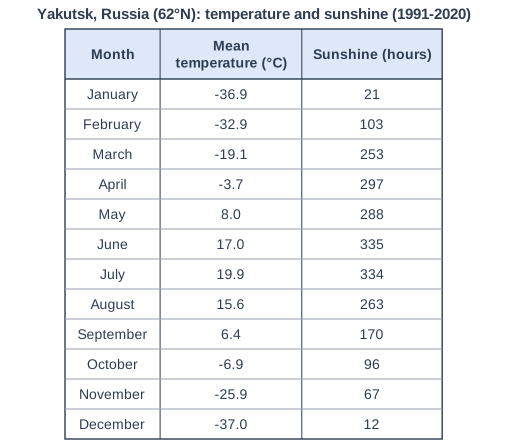
Study Figure 1, which shows the mean monthly temperature and hours of sunshine at Yakutsk, Russia, in the boreal forest. The data are averages for 1991-2020 (sources: Pogoda i Klimat and NOAA); the sunshine values are rounded to the nearest hour.

Using evidence from Figure 1, explain one way in which the pattern of sunshine helps trees to grow at Yakutsk despite its very cold climate.

Yakutsk, Russia (62°N): temperature and sunshine (1991-2020). Table with columns "Month", "Mean temperature (°C)", "Sunshine (hours)". Month: January; Mean temperature (°C): -36.9; Sunshine (hours): 21 | Month: February; Mean temperature (°C): -32.9; Sunshine (hours): 103 | Month: March; Mean temperature (°C): -19.1; Sunshine (hours): 253 | Month: April; Mean temperature (°C): -3.7; Sunshine (hours): 297 | Month: May; Mean temperature (°C): 8.0; Sunshine (hours): 288 | Month: June; Mean temperature (°C): 17.0; Sunshine (hours): 335 | Month: July; Mean temperature (°C): 19.9; Sunshine (hours): 334 | Month: August; Mean temperature (°C): 15.6; Sunshine (hours): 263 | Month: September; Mean temperature (°C): 6.4; Sunshine (hours): 170 | Month: October; Mean temperature (°C): -6.9; Sunshine (hours): 96 | Month: November; Mean temperature (°C): -25.9; Sunshine (hours): 67 | Month: December; Mean temperature (°C): -37.0; Sunshine (hours): 12.

Model answer

June and July are the sunniest months, each with about 335 hours of sunshine, and they are also the warmest, at about 17-20 °C. Because the summer days are so long, the trees can photosynthesise for many hours each day, so they make enough food to grow during the short summer even though winters are extremely cold.

Explanation

The evidence mark needs real figures or months from the table; the second mark explains that long summer days give plenty of light for photosynthesis in a short growing season. Answers that talk only about the cold winter miss the role of sunshine.

Mark scheme
  1. 1 mark

    Uses evidence from Figure 1, e.g. the sunniest months, June and July (about 335 hours each), are also the warmest (about 17-20 °C) / May to August each have more than 260 hours of sunshine while temperatures are above 0 °C

    Award 1 mark for evidence from Figure 1 and 1 mark for explaining how it helps tree growth. Examples: June and July have about 335 hours of sunshine, the most of the year, when temperatures are about 17-20 °C (1), so trees receive plenty of light energy for photosynthesis during the short growing season and can grow quickly (1). May to August all have over 260 hours of sunshine (1) because summer days are very long at 62°N, so trees can photosynthesise for many hours each day and make up for the short summer (1). Strong sunshine in April and May (about 290-300 hours) (1) warms the ground and melts the snow, so the soil thaws and roots can take up water early in the season (1). Accept any other appropriate response.

  2. 1 mark

    Explains how this helps the trees to grow, e.g. long hours of light allow a lot of photosynthesis in a short summer

    Do not credit evidence about temperature alone with no reference to sunshine. Do not credit 'the sun keeps the trees warm in winter' (December has about 12 hours of sunshine and is about -37 °C).

Question 4

4 marks

Using your own knowledge, explain one way in which rock type and one way in which poor drainage can alter the natural vegetation within a biome.

Model answer

Rock type: chalk and limestone weather to thin, alkaline soils that drain quickly, so shallow-rooted grasses and lime-tolerant plants grow well and trees are fewer than on deeper soils nearby.

Poor drainage: where the ground is waterlogged the soil is short of oxygen, so the roots of most trees die. Instead, plants such as sphagnum moss, sedges and reeds grow, and because dead plants decay slowly, peat builds up to form a bog.

Explanation

Each half needs a way the factor changes conditions (1) and the resulting change in vegetation (1). The best answers explain the process - for example, that waterlogging removes oxygen from the soil - rather than just naming a vegetation type.

Mark scheme
  1. 1 mark

    Rock type: identifies a way, e.g. chalk or limestone weathers to thin, alkaline, freely drained soils / granite or sandstone weathers to acidic, sandy, nutrient-poor soils / clay gives heavy, poorly drained soils

    Award 1 mark for identifying the way and 1 mark for explaining its effect on the vegetation, for rock type and for poor drainage. Examples (rock type): Chalk and limestone weather to thin, alkaline soils (1) so only shallow-rooted grasses and plants that tolerate lime grow well, and woodland is thinner than on deeper soils (1). Granite and sandstone weather to sandy, acidic, nutrient-poor soils (1) so plants that tolerate acid conditions, such as heather or conifers, replace broadleaved trees (1). Accept any other appropriate response.

  2. 1 mark

    Rock type: explains the effect on the vegetation

    The effect must be on the type, size or density of the vegetation.

  3. 1 mark

    Poor drainage: identifies a way, e.g. the soil becomes waterlogged and short of oxygen / dead plants do not decay and form peat

    Examples (poor drainage): Waterlogged soils are short of oxygen (1) so the roots of most trees cannot survive, and bog or marsh plants such as mosses, sedges and reeds grow instead (1). In waterlogged ground dead plants decompose very slowly (1) so peat builds up, forming a bog with acidic, nutrient-poor conditions (1). Accept any other appropriate response.

  4. 1 mark

    Poor drainage: explains the effect on the vegetation

    Do not credit an answer about poor drainage under the rock-type heading (or the reverse) twice: the two ways must be different.

Ready to try the rest? Every answer you write is marked against the mark scheme, so you can see exactly where the marks are.

Study Helper Hints first, answers after you try

Stuck on this one? Ask for a hint and I’ll point you in the right direction, without giving the answer away. Once you’ve checked your answer, I’ll show you how the marks are awarded.