Level:
Correct: 0
Incorrect: 0
Marks: 0/0
Exam Practice
Course:
Topics:
Avg
score:
–
Topics
done:
0/20

Decision-making: a hydro-electric dam on an Amazon river

Practise 25 exam-style questions on Decision-making: a hydro-electric dam on an Amazon river for Edexcel GCSE Geography B (Paper 3). Write your answer as you would in the exam and get it marked in seconds against the mark scheme, point by point, with the Study Helper on hand if you get stuck.

  • 25 questions
  • 1–16 marks each
  • Instant marking
  • No sign-up needed
20 questions, marked as you go

Sample questions with model answers

Here are 4 of the questions in this topic, each with a model answer, an explanation of why it earns the marks and the mark scheme an examiner would use.

Question 1

1 mark

Supporters of hydro-electric dams in Brazil say that dams help to keep the country's electricity low-carbon.

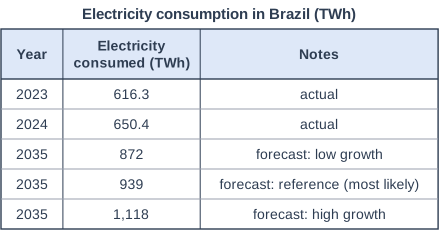
Study Figure 1, which shows the mass of carbon dioxide emitted for each megawatt-hour (MWh) of electricity generated in four countries or regions in 2022 (IEA data, published by EPE, Brazil's Energy Research Office, 2025).

Identify the statement that is supported by Figure 1.

Choose your answer.

  • A Brazil's electricity emitted about one-tenth of the carbon dioxide per MWh of China's
  • B The USA's electricity emitted more carbon dioxide per MWh than China's
  • C OECD Europe's electricity emitted less carbon dioxide per MWh than Brazil's
  • D Brazil's electricity emitted about half of the carbon dioxide per MWh of the USA's
Carbon dioxide emitted per MWh of electricity, 2022. Bar chart of Carbon dioxide in kg per MWh for each country or region: China 678.4, USA 358.1, OECD Europe 270.2, Brazil 61.

Model answer

A

Explanation

Brazil's 61 kg of carbon dioxide per MWh is about 9% of China's 678 kg, which is about one-tenth. Check each statement against the values: a common error is to judge the bars by eye and accept 'about half' for the USA, when Brazil's value is about one-sixth of the USA's. Brazil's figure is low mainly because over half of its electricity comes from hydro-electric power.

Mark scheme
  1. 1 mark

    A (Brazil's electricity emitted about one-tenth of the carbon dioxide per MWh of China's)

    Accept the letter or the option written out; do not credit more than one answer. Rationale: 61.0 / 678.4 = 0.09, about one-tenth; readings within half a gridline of the plotted values (51 to 71 kg for Brazil, 668 to 688 kg for China) give 0.07 to 0.11, still about one-tenth. B is incorrect: the USA emitted 358.1 kg per MWh, much less than China's 678.4 kg. C is incorrect: OECD Europe emitted 270.2 kg per MWh, more than Brazil's 61.0 kg. D is incorrect: 61.0 is about one-sixth of the USA's 358.1, not half.

Question 2

2 marks

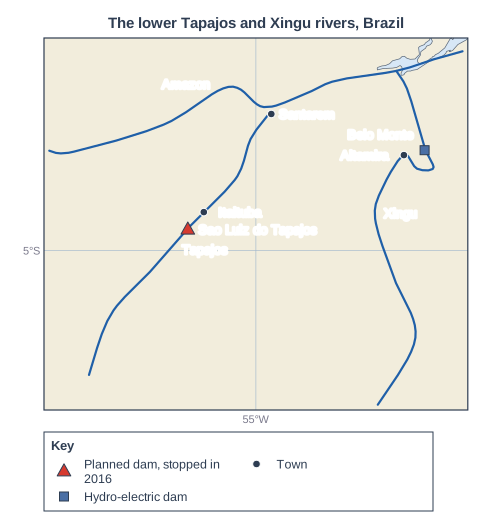
Study Figure 1, which shows Brazil's electricity consumption in 2023 and 2024 and three forecasts for 2035 (data from EPE, Brazil's Energy Research Office: its ten-year energy plan, PDE 2035, published in 2025).

Calculate the mean increase in electricity consumption each year needed between 2024 and 2035 to reach the reference forecast.

Answer to one decimal place.

Electricity consumption in Brazil (TWh). Table with columns "Year", "Electricity consumed (TWh)", "Notes". Year: 2023; Electricity consumed (TWh): 616.3; Notes: actual | Year: 2024; Electricity consumed (TWh): 650.4; Notes: actual | Year: 2035; Electricity consumed (TWh): 872; Notes: forecast: low growth | Year: 2035; Electricity consumed (TWh): 939; Notes: forecast: reference (most likely) | Year: 2035; Electricity consumed (TWh): 1,118; Notes: forecast: high growth.

Model answer

939 - 650.4 = 288.6 TWh
2035 - 2024 = 11 years
288.6 / 11 = 26.2 TWh per year

Explanation

Find the total increase (939 - 650.4 = 288.6 TWh) and divide it by the number of years between 2024 and 2035 (11), giving 26.2 TWh a year. Common errors are to divide by 10, to start from the 2023 value, or to use one of the other forecasts. The answer shows how much new electricity Brazil must find every year, which is why the government is considering new dams.

Mark scheme
  1. 1 mark

    Method: (939 - 650.4) / 11 (= 288.6 / 11)

    Correct answer 26.2 TWh per year. Correct answer with no working scores full marks (2). Award 1 mark for correct working with a wrong answer or an answer not given to one decimal place. Do not award the method mark for dividing by 10 instead of 11 (28.9), for starting from 2023 (616.3), or for using the low or high forecast.

  2. 1 mark

    Answer: 26.2 (TWh per year)

    Accept 26.2, with or without units. Must be given to one decimal place: do not credit 26 or 26.24 for this mark.

Question 3

4 marks

Brazil's electricity consumption is forecast to grow by over 40% between 2024 and 2035 (EPE reference forecast, 2025).

Using your own knowledge, explain one advantage and one disadvantage of using hydro-electric power rather than solar power to meet this growing demand.

Model answer

Advantage: hydro-electric power can be generated day and night, and water can be held back in the reservoir and released when demand is highest, such as in the evening, when solar panels produce nothing.

Disadvantage: a hydro-electric reservoir floods a large area of land, such as rainforest, destroying habitats and forcing people who live by the river to move, whereas solar panels can be put on roofs or on land that is already cleared.

Explanation

One mark is for identifying an advantage and one for developing it; the same applies to the disadvantage. Because the question says 'rather than solar power', the best answers compare the two sources. A common error is to give the same idea twice, once as an advantage of HEP and once as a disadvantage of solar.

Mark scheme
  1. 1 mark

    Identifies an advantage of HEP compared with solar, e.g. it generates at night as well as in the day / water can be stored and released when demand is high / dams last for many decades / very high output from one site

    Award 1 mark for an advantage and 1 for its development, and 1 mark for a disadvantage and 1 for its development. Advantage examples: HEP generates electricity day and night (1) whereas solar panels produce nothing after dark, so HEP can meet the evening peak in demand (1). Water can be held back in a reservoir (1) and released when demand is high, or when there is little sun or wind (1). A dam can operate for many decades (1) so its electricity becomes cheap once the building cost has been paid (1).

  2. 1 mark

    Develops the advantage

    The development must explain why the advantage matters for meeting demand.

  3. 1 mark

    Identifies a disadvantage of HEP compared with solar, e.g. the reservoir floods large areas of forest or farmland / people have to be moved / output falls in droughts / dams take many years to build and cost a lot / fish migration is blocked

    Disadvantage examples: The reservoir floods a large area of rainforest (1) destroying habitats and releasing greenhouse gases from rotting vegetation (1). People living by the river may have to move (1) losing their homes, land and fishing grounds (1). Output falls in droughts (1), as in Brazil in 2021, when more electricity had to come from fossil fuels (1). A large dam takes many years to build, e.g. Belo Monte took about eight years (1), whereas a solar farm can be built in a year or two, so solar can meet rising demand more quickly (1).

  4. 1 mark

    Develops the disadvantage

    Do not credit an advantage and a disadvantage that mirror each other (e.g. 'HEP is reliable' and 'solar is unreliable'). Accept any other appropriate response.

Question 4

8 marks

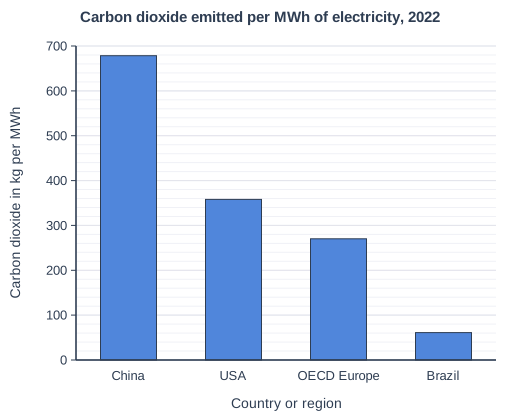
Study Figure 1, a map of the lower Tapajos and Xingu rivers in Brazil, which shows the site of the planned Sao Luiz do Tapajos dam, whose licensing was stopped in 2016.

Figure 2 (facts from ISA (2020), Mongabay (2017), Fiocruz (2020) and Brazil's Ministry of Justice (2024); the views were written for this course)
- There are about 18,000 Munduruku, and most live along the Tapajos and its tributaries. Fish is their main source of animal protein.
- The Munduruku say that the Sete Quedas rapids on the Teles Pires, a headwater of the Tapajos, were a sacred place. The rapids were blasted with explosives when dams were built on the river.
- In 2017 about 200 Munduruku occupied the construction site of the Sao Manoel dam on the Teles Pires.
- In September 2024 Brazil's Ministry of Justice declared Sawre Muybu (about 178,000 hectares) to be Munduruku land; ratification by the President is still to come.
- In a 2019 study, about 6 in 10 people tested in three Munduruku villages had more mercury in their bodies than the safe limit, because gold mining pollutes the fish.
- A Munduruku community leader: 'The river feeds us and holds the places where our ancestors live. Money cannot replace a sacred place.'
- A fisher from a riverside village: 'My family fishes, grows cassava and collects Brazil nuts. In the wet season the river spreads into the forest and the fish follow it to feed and breed. Our catch depends on that flood.'

Using evidence from Figures 1 and 2 and your own knowledge, assess the importance of the Tapajos river and its forests to the Munduruku and other riverside people.

Map of the area from 59°W to 51°W and from 8°S to 1°S, titled "The lower Tapajos and Xingu rivers, Brazil". Lines of latitude and longitude are drawn every 5°, with their values (°N/°S and °E/°W) printed round the edge. Points: a dot labelled "Santarem" in Brazil; a dot labelled "Itaituba" in Brazil; a dot labelled "Altamira" in Brazil; a red triangle labelled "Sao Luiz do Tapajos" in Brazil; a blue square labelled "Belo Monte" in Brazil. Lines drawn: a line labelled "Amazon" from Brazil to Brazil, heading generally east; a line labelled "Tapajos" from Brazil to Brazil, heading generally north-east; a line labelled "Xingu" from Brazil to Brazil, heading generally north. The key (below the map) shows: "Planned dam, stopped in 2016", "Hydro-electric dam" and "Town".

Model answer

The Tapajos river and its forests are extremely important to the Munduruku and other riverside people, and the most important reason is food. Figure 2 shows that fish is the Munduruku's main source of animal protein, so the river directly feeds most of the 18,000 or so Munduruku. The fisher explains that catches depend on the wet-season flood, when the river spreads into the forest and fish follow it to feed and breed. This means the river and the forest work together as one food system, so a dam that changed the flood would affect people's diets as well as wildlife.

The river is also important for culture and identity. The community leader says the river holds sacred places that money cannot replace, and the Munduruku say the Sete Quedas rapids were destroyed when dams were built on the Teles Pires. This kind of importance is different from food: a sacred place cannot be rebuilt or compensated for, so its loss is permanent.

The forest also provides other goods, such as Brazil nuts, building materials, medicines and fuel wood, and the fisher's family grows cassava on land beside the river. These matter for their livelihoods, but some of them could be replaced by bought goods if people had incomes, so they are less important than fish and sacred places.

People's actions show how much they value the river. In 2017 about 200 Munduruku occupied a dam construction site, and after years of campaigning their Sawre Muybu land, about 178,000 hectares along the Tapajos, was declared Munduruku land by the Ministry of Justice in 2024, although the President has still to ratify it. Figure 1 shows that the planned Sao Luiz do Tapajos dam lay on the river they depend on.

The river's value is already under threat. About 6 in 10 people tested in three villages had unsafe mercury levels because gold mining pollutes the fish. This shows how dependent people are, because when the river is polluted their main food becomes a health risk and they have few alternatives.

Overall, the river and forests are of the greatest importance, because they provide the main food supply and the sacred places at the centre of Munduruku culture. Food is most important for survival, but culture is the least replaceable, which is why many Munduruku oppose new dams so strongly.

Explanation

Level 3 answers use the facts and views in Figure 2 accurately (AO4) and weigh up the different kinds of importance, for example deciding which is most important and which cannot be replaced (AO3). A common weakness is to list the goods the river provides without any judgement. The best answers also link the river and the forest through the seasonal flood.

Mark scheme
  1. 8 marks

    Levels of response (8 marks).
    Level 3 (7-8 marks): Applies understanding to deconstruct information and provide logical connections between concepts throughout. A balanced, well-developed argument that synthesises relevant understanding coherently, leading to judgements that are supported by evidence throughout. (AO3) Uses geographical skills to obtain accurate information that supports all aspects of the argument. (AO4)
    Level 2 (4-6 marks): Applies understanding to deconstruct information and provide some logical connections between concepts. An imbalanced argument that synthesises mostly relevant understanding but not entirely coherently, leading to judgements that are supported by evidence occasionally. (AO3) Uses geographical skills to obtain accurate information that supports some aspects of the argument. (AO4)
    Level 1 (1-3 marks): Attempts to apply understanding to deconstruct information but understanding and connections are flawed. An unbalanced or incomplete argument that provides limited synthesis of understanding. Judgements are supported by limited evidence. (AO3) Uses some geographical skills to obtain information with limited relevance and accuracy, which supports few aspects of the argument. (AO4)
    0 marks: No acceptable response.

    AO3 (4 marks) / AO4 (4 marks). Answers should address the different ways in which people depend on the river and forest. The assessment may offer a view of which is most important, and why. Indicative content (not a checklist; credit other valid points): AO4 (skilled use of information from Figures 1 and 2): about 18,000 Munduruku, most along the Tapajos and its tributaries; fish is their main source of animal protein; the fisher's family also grows cassava and collects Brazil nuts; the leader's view that the river holds sacred places that money cannot replace; the Sete Quedas rapids destroyed during dam building; the 2017 occupation of a dam site; the Ministry of Justice's 2024 declaration of Sawre Muybu (about 178,000 hectares) as Munduruku land, with presidential ratification still to come; the fisher's view that catches depend on the wet-season flood into the forest; mercury above the safe limit in about 6 in 10 people tested; the location of the planned dam on the river near Itaituba (Figure 1). AO3: judgement that food from fish is the most important for survival and health, and that the river and forest work together as one food system through the flood pulse; judgement that sacred places and culture are the least replaceable, so they cannot be compensated with money; judgement that other goods (building materials, medicine, fuel wood, fruit and nuts, transport) matter but some could be replaced by bought goods; judgement that people's actions (occupation, campaign for land rights) show how important the river is to them; judgement that existing threats (mercury from gold mining) show how dependent people are, because pollution turns their main food into a health risk; overall judgement of the river's importance compared with other sources of livelihood.

Ready to try the rest? Every answer you write is marked against the mark scheme, so you can see exactly where the marks are.

Study Helper Hints first, answers after you try

Stuck on this one? Ask for a hint and I’ll point you in the right direction, without giving the answer away. Once you’ve checked your answer, I’ll show you how the marks are awarded.