
Level:
Correct: 0
Incorrect: 0
Marks: 0/0
Exam Practice
Course:
Topics:
Avg
score:
–
Topics
done:
0/20

Changing attitudes to energy futures

Practise 26 exam-style questions on Changing attitudes to energy futures for Edexcel GCSE Geography B (Paper 3). Write your answer as you would in the exam and get it marked in seconds against the mark scheme, point by point, with the Study Helper on hand if you get stuck.

  • 26 questions
  • 1–8 marks each
  • Instant marking
  • No sign-up needed
20 questions, marked as you go

Sample questions with model answers

Here are 4 of the questions in this topic, each with a model answer, an explanation of why it earns the marks and the mark scheme an examiner would use.

Question 1

1 mark

Study Figure 1, which shows carbon dioxide (CO₂) emissions per person in four countries between 1990 and 2024 (source: Global Carbon Project, Global Carbon Budget 2025, via Our World in Data).

Identify which one of the following statements is supported by Figure 1.

Choose your answer.

  • A In 2024 China's emissions per person were higher than Germany's
  • B US emissions per person fell in every five-year period after 1990
  • C UK emissions per person halved between 1990 and 2005
  • D Germany's emissions per person rose after 2010
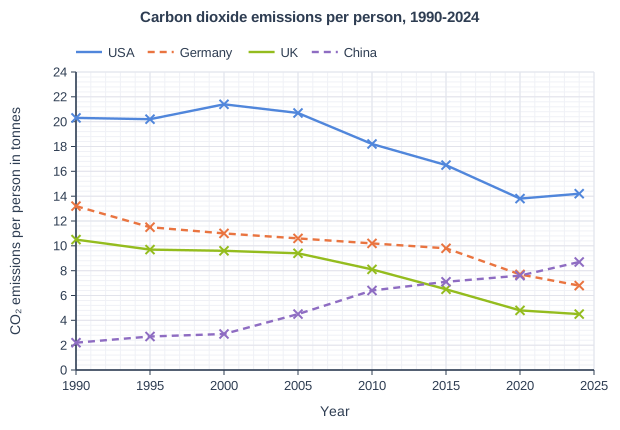
Carbon dioxide emissions per person, 1990-2024. Line graph of CO₂ emissions per person in tonnes (y-axis, 0 to 24) against year (x-axis, 1990 to 2025). "USA" joins the points (1990, 20.3), (1995, 20.2), (2000, 21.4), (2005, 20.7), (2010, 18.2), (2015, 16.5), (2020, 13.8), (2024, 14.2). "Germany" (dashed) joins the points (1990, 13.2), (1995, 11.5), (2000, 11), (2005, 10.6), (2010, 10.2), (2015, 9.8), (2020, 7.7), (2024, 6.8). "UK" joins the points (1990, 10.5), (1995, 9.7), (2000, 9.6), (2005, 9.4), (2010, 8.1), (2015, 6.5), (2020, 4.8), (2024, 4.5). "China" (dashed) joins the points (1990, 2.2), (1995, 2.7), (2000, 2.9), (2005, 4.5), (2010, 6.4), (2015, 7.1), (2020, 7.6), (2024, 8.7).

Model answer

A

Explanation

China's emissions per person rose steadily as it industrialised and became more affluent, overtaking Germany's by 2024. In the three developed countries emissions per person have fallen, most quickly since about 2010.

Mark scheme
  1. 1 mark

    A (In 2024 China's emissions per person were higher than Germany's)

    Accept the letter or the option written out; do not credit more than one answer. A is correct: in 2024 China emitted about 8.7 tonnes per person and Germany about 6.8 tonnes. B is incorrect: US emissions per person rose between 1995 (20.2 tonnes) and 2000 (21.4 tonnes). C is incorrect: UK emissions per person fell only from about 10.5 to 9.4 tonnes between 1990 and 2005; the big fall came after 2010. D is incorrect: Germany's emissions per person fell after 2010, from about 10.2 to 6.8 tonnes.

Question 2

1 mark

Using your own knowledge, state one way in which environmental groups try to change decisions about energy.

Model answer

They take legal action against governments or companies, for example challenging the approval of new oil and gas fields in court.

Explanation

Environmental groups use many methods, from campaigns and protests to court cases and lobbying. Any one clear method is enough for the mark.

Mark scheme
  1. 1 mark

    Any one valid way, e.g. campaigns and petitions / protests or direct action / taking governments or companies to court / lobbying politicians / publishing research and educating the public / pressuring shareholders and banks

    Examples: UK court cases led to the approval of the Rosebank oil field being ruled unlawful in 2025; Greenpeace and Friends of the Earth run public campaigns. Accept any other appropriate response.

Question 3

2 marks

Using your own knowledge, explain one way in which education can change people's attitudes to energy consumption.

Model answer

When students learn at school how burning fossil fuels causes climate change, they understand the effect of their own energy use. This makes them more likely to walk or cycle, switch off devices and persuade their families to save energy.

Explanation

The first mark is for a way education or information reaches people, and the second for explaining how it changes what they think or do about energy. Answers that only say people 'learn about the environment' need to link this to energy use.

Mark scheme
  1. 1 mark

    Identifies a way, e.g. learning about climate change and its causes / learning how much energy and money appliances, cars or homes use / campaigns and school projects about saving energy

    Examples: Learning in school about how burning fossil fuels causes climate change (1) makes young people more likely to save energy and to choose low-carbon options such as walking, cycling or green tariffs (1). Energy labels and smart meters show how much energy appliances use (1), so people see the cost and switch things off or buy efficient models (1). Children learn about saving energy at school (1) and persuade their families to change their habits at home (1). Accept any other appropriate response.

  2. 1 mark

    Develops the way, e.g. so people choose to use less energy or choose low-carbon options

Question 4

4 marks

Using your own knowledge, explain one reason why a government may support a 'business as usual' energy future and one reason why it may support a sustainable energy future.

Model answer

A government may support business as usual because its own oil and gas fields give a secure supply of energy. When supplies from abroad are cut, as in the 2026 Strait of Hormuz crisis, the country is less affected, and the industry also provides jobs and taxes.

A government may support a sustainable future because it has signed the Paris Agreement, which aims to keep warming well below 2 °C. In the UK the Climate Change Act sets a legal target of net zero by 2050, so the government must cut the use of fossil fuels.

Explanation

Each half needs an identified reason (1) and an explanation (1). Governments face conflicting pressures, so strong answers show that energy security and jobs can pull one way while climate targets and new green industries pull the other.

Mark scheme
  1. 1 mark

    Business as usual: identifies a reason, e.g. energy security from domestic oil and gas / jobs and tax revenue from the oil and gas industry / keeping energy cheap for voters and industry

    Award 1 mark for identifying each reason and 1 mark for its explanation. Examples (business as usual): Domestic oil and gas fields give a secure supply (1), so the country is less affected when imports are cut, as in the 2026 Strait of Hormuz crisis (1). The oil and gas industry provides jobs and tax revenue (1), which pay for public services and support regions such as north-east Scotland (1). Fossil fuels can keep energy bills low in the short term (1), which is popular with voters during a cost-of-living crisis (1). Accept any other appropriate response.

  2. 1 mark

    Business as usual: explains the reason

  3. 1 mark

    Sustainable: identifies a reason, e.g. international agreements such as the Paris Agreement / legal targets such as net zero by 2050 / evidence from climate scientists / new green jobs / renewables reduce reliance on imports / public pressure

    Examples (sustainable): The government has signed the Paris Agreement (1), which commits countries to keep warming well below 2 °C, so emissions must be cut (1). In the UK the Climate Change Act sets a legal target of net zero by 2050 (1), so the government must reduce fossil fuel use (1). Wind and solar power are produced at home (1), so they also improve energy security and protect consumers from oil and gas price shocks (1). Renewable industries create new jobs (1), for example building and maintaining offshore wind farms (1).

  4. 1 mark

    Sustainable: explains the reason

Ready to try the rest? Every answer you write is marked against the mark scheme, so you can see exactly where the marks are.

Study Helper Hints first, answers after you try

Stuck on this one? Ask for a hint and I’ll point you in the right direction, without giving the answer away. Once you’ve checked your answer, I’ll show you how the marks are awarded.