
Level:
Correct: 0
Incorrect: 0
Marks: 0/0
Exam Practice
Course:
Topics:
Avg
score:
–
Topics
done:
0/20

The biosphere's goods and services for people

Practise 26 exam-style questions on The biosphere's goods and services for people for Edexcel GCSE Geography B (Paper 3). Write your answer as you would in the exam and get it marked in seconds against the mark scheme, point by point, with the Study Helper on hand if you get stuck.

  • 26 questions
  • 1–8 marks each
  • Instant marking
  • No sign-up needed
20 questions, marked as you go

Sample questions with model answers

Here are 4 of the questions in this topic, each with a model answer, an explanation of why it earns the marks and the mark scheme an examiner would use.

Question 1

1 mark

Using your own knowledge, identify which one of the following is an example of the commercial exploitation of the biosphere for energy.

Choose your answer.

  • A A company builds a large dam that floods forest to supply electricity to distant cities.
  • B A family collects dead wood from the forest to cook their food.
  • C Villagers grow cassava on small garden plots cleared in the forest.
  • D A healer collects bark and leaves to treat illnesses.

Model answer

A

Explanation

Commercial exploitation means a resource is used on a large scale by companies or governments to make money or supply distant markets. A hydro-electric dam selling electricity to cities is commercial; the other options are local people meeting their own needs.

Mark scheme
  1. 1 mark

    A (A company builds a large dam that floods forest to supply electricity to distant cities.)

    Accept the letter or the option written out; do not credit more than one answer. B is incorrect: collecting fuelwood for cooking is use by local people, not commercial exploitation. C is incorrect: it is food production by local people for their own use. D is incorrect: it is a local use of medicine, not energy.
Question 2

1 mark

Using your own knowledge, state one reason why water flowing from forested catchments is usually cleaner than water flowing from cleared land.

Model answer

Tree roots and leaf litter hold the soil in place, so less sediment is washed into the rivers.

Explanation

Forests reduce soil erosion and let water soak slowly through the soil, which filters it. This is one reason why water companies protect forested catchments. A one-sentence reason with a clear process is enough for the mark.

Mark scheme
  1. 1 mark

    Any one of: tree roots and leaf litter hold the soil, so less sediment is washed into rivers / soil and vegetation filter the water as it soaks through / there are fewer farm chemicals (fertilisers, pesticides) or animal waste / less surface runoff carrying pollutants

    Accept any other appropriate response. Do not credit 'trees clean the water' with no idea of how, or 'there is more rain'. If more than one reason is given, mark the first.

Question 3

2 marks

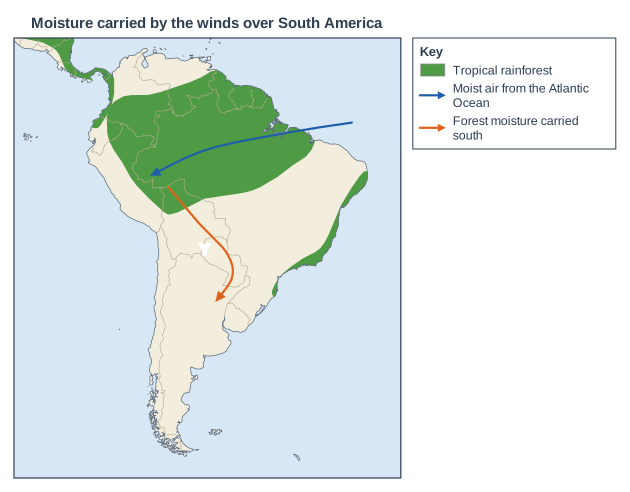
Study Figure 1, which shows how moisture is carried by the winds over South America.

Using Figure 1 and your own knowledge, explain one way in which the Amazon rainforest provides a service for people who live outside it.

Map of South America, titled "Moisture carried by the winds over South America". Shaded areas show where the biomes are found: tropical rainforest (dark green): the Amazon basin (South America), the Pacific coast of Colombia and Ecuador, the Atlantic coast of Brazil and Central America and southern Mexico. Lines drawn: a line with an arrowhead at its end from the North Atlantic Ocean to Brazil, heading generally west (key: "Moist air from the Atlantic Ocean"); a line with an arrowhead at its end labelled Y, starting near the centre of the map (about 40% of the way across from the left and 35% of the way down) and ending near the centre of the map (about 50% of the way across from the left and 60% of the way down) (key: "Forest moisture carried south"). The key (to the right of the map) shows: "Tropical rainforest", "Moist air from the Atlantic Ocean" and "Forest moisture carried south".

Model answer

The rainforest trees transpire moisture back into the air, and Figure 1 shows the winds carrying this moisture south from the Amazon. It falls as rain over southern Brazil, Paraguay and Argentina, giving water for crops, drinking water and hydro-electric power to people who live far from the forest.

Explanation

The figure shows that the forest is part of a large water cycle: it recycles rain and passes moisture to regions far away. One mark is for identifying this service and one for explaining who benefits. Avoid the inaccurate claim that the Amazon is the 'lungs of the planet'.

Mark scheme
  1. 1 mark

    Identifies a service using Figure 1, e.g. the forest returns moisture to the air that is carried south / provides rainfall for areas to the south such as southern Brazil, Paraguay and Argentina

    Award 1 mark for a service based on Figure 1 and 1 mark for further explanation. Examples: Trees transpire moisture that came from the Atlantic back into the air (1) and the winds carry it south, where it falls as rain on farms and cities in southern Brazil, Paraguay and Argentina, supplying water for crops, drinking water and HEP (1). The forest recycles rainfall many times as air moves west across it (1), so it keeps rain falling far inland, which supports farming outside the forest (1). Global services such as storing carbon (1), which slows climate change for everyone (1), may also be credited. Accept any other appropriate response.

  2. 1 mark

    Explains how this benefits people outside the forest

    The explanation must say who benefits or how (e.g. farming, water supply, HEP). Do not credit claims that the Amazon produces a fixed percentage of the world's oxygen.

Question 4

4 marks

New York City gets about 90% of its drinking water from reservoirs in the Catskill Mountains. Instead of building a filtration plant to clean this water, which the city's Commissioner of Environmental Protection estimated in 2024 could cost 20 to 40 billion US dollars, the city and its partners have protected almost 63,000 hectares of land in the catchments of these reservoirs since 1997, by buying the land or paying its owners not to build on it. (Source: New York City Department of Environmental Protection; the land figure is from its Land Acquisition Program report of July 2025.)

Using your own knowledge, explain one advantage and one disadvantage of protecting the forest in a reservoir's catchment, rather than building a large treatment works, as a way of supplying clean water to a city.

Model answer

Advantage: the forest's leaf litter and soils filter rain as it soaks through, and tree roots hold the soil in place, so the water that reaches the reservoir carries little mud or pollution. It therefore needs little treatment, which is far cheaper than building and running a huge filtration plant like the one New York City avoided.

Disadvantage: people who own land in the catchment cannot build on it or farm it as they wish, so they may lose income and jobs. The city has to buy the land or pay them compensation, and it must keep paying to protect and monitor a very large area for many years.

Explanation

Each half needs a point (1) and an explanation (1). The forest does a job, cleaning water, that would otherwise need expensive engineering, which is why the biosphere's services have a commercial value. Strong answers link the advantage to how the forest cleans the water and the disadvantage to the cost for landowners or the risk that fire, storms or disease could damage the forest.

Mark scheme
  1. 1 mark

    Advantage: identifies an advantage, e.g. the forest and its soils filter the water / roots and leaf litter hold the soil, so little sediment or pollution reaches the reservoir / much cheaper than building and running a treatment works / the forest also provides habitats and stores carbon / steadier flow into the reservoir

    Award 1 mark for identifying the advantage and 1 mark for explaining it, and the same for the disadvantage. Examples (advantage): Leaf litter and forest soils filter rainwater as it soaks through, and tree roots hold the soil in place (1), so the water reaching the reservoir carries little mud or pollution and needs little treatment (1). Protecting land costs much less than building a large treatment works, such as the plant New York City avoided (1), so money is saved for other services or water bills stay lower (1). The protected forest is also a habitat for wildlife and stores carbon (1), so the city gains other ecosystem services as well as clean water (1). Forested catchments release water slowly into the reservoir (1), giving a steadier supply and less muddy floodwater after storms (1). Accept any other appropriate response.

  2. 1 mark

    Advantage: explains the advantage, e.g. so the water needs little treatment / money is saved / the city also gains habitats and carbon storage

    The explanation must show who or what benefits. Do not credit 'it is natural' or 'it is better for the environment' with no explanation.

  3. 1 mark

    Disadvantage: identifies a disadvantage, e.g. landowners and farmers cannot build on or farm the land as they wish / the forest can be damaged by fire, storms, pests or disease / protection must be paid for and enforced over a very large area for many years / some microbes and pollutants still reach the water

    Examples (disadvantage): Farmers and landowners in the catchment cannot build on or use the protected land as they wish (1), so they may lose income and jobs unless they are paid compensation, which can cause conflict (1). The forest can be damaged by wildfire, storms, pests or disease (1), and then soil and ash would wash into the reservoir, so the water might suddenly need expensive treatment after all (1). Protection has to be paid for and monitored over a very large area for many decades (1), which is costly and hard to enforce (1). Birds and other animals in the catchment can still carry bacteria into the water (1), so the water must still be disinfected (1). Accept any other appropriate response.

  4. 1 mark

    Disadvantage: explains the disadvantage, e.g. lost income for landowners / water quality could fall suddenly / high long-term costs

    Do not credit 'it is expensive' without saying what costs money or why. Both points must be about protecting the catchment; answers about the advantages or disadvantages of building a dam are not creditable.

Ready to try the rest? Every answer you write is marked against the mark scheme, so you can see exactly where the marks are.

Study Helper Hints first, answers after you try

Stuck on this one? Ask for a hint and I’ll point you in the right direction, without giving the answer away. Once you’ve checked your answer, I’ll show you how the marks are awarded.