Level:
Correct: 0
Incorrect: 0
Marks: 0/0
Exam Practice
Course:
Topics:
Avg
score:
–
Topics
done:
0/20

Decision-making: Guyana's oil wealth and its forests

Practise 25 exam-style questions on Decision-making: Guyana's oil wealth and its forests for Edexcel GCSE Geography B (Paper 3). Write your answer as you would in the exam and get it marked in seconds against the mark scheme, point by point, with the Study Helper on hand if you get stuck.

  • 25 questions
  • 1–16 marks each
  • Instant marking
  • No sign-up needed
20 questions, marked as you go

Sample questions with model answers

Here are 4 of the questions in this topic, each with a model answer, an explanation of why it earns the marks and the mark scheme an examiner would use.

Question 1

1 mark

Tropical rainforests provide goods for local people and services for the whole planet.

Using your own knowledge, identify which one of the following is a global ecosystem service provided by Guyana's rainforest.

Choose your answer.

  • A Timber used to build houses in Amerindian villages
  • B Fish caught in forest rivers for food
  • C Gold mined from river sediments in the forest
  • D Storing carbon, which slows the rate of climate change

Model answer

D

Explanation

Global ecosystem services are benefits the biosphere gives the whole planet, such as storing carbon and regulating the climate, the water cycle and soil health. Goods such as timber, food and medicines are used directly by people. A common error is to call any resource found in the forest, such as gold, an ecosystem service.

Mark scheme
  1. 1 mark

    D (Storing carbon, which slows the rate of climate change)

    Accept the letter or the option written out; do not credit more than one answer. A is incorrect: timber is a good used by local people, not a global service. B is incorrect: fish are a good (food) for local people. C is incorrect: gold is a mineral resource, and mining it destroys forest rather than being a service the forest provides.

Question 2

2 marks

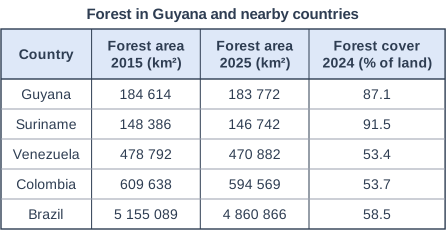
Study Figure 1, which shows the forest area of Guyana and four nearby countries. It comes from a resource booklet about Guyana written for this course, using FAO data published by the World Bank (2026).

Calculate the percentage of Brazil's 2015 forest area that was lost by 2025.

Show your working.

Answer to one decimal place.

Forest in Guyana and nearby countries. Table with columns "Country", "Forest area 2015 (km²)", "Forest area 2025 (km²)", "Forest cover 2024 (% of land)". Country: Guyana; Forest area 2015 (km²): 184 614; Forest area 2025 (km²): 183 772; Forest cover 2024 (% of land): 87.1 | Country: Suriname; Forest area 2015 (km²): 148 386; Forest area 2025 (km²): 146 742; Forest cover 2024 (% of land): 91.5 | Country: Venezuela; Forest area 2015 (km²): 478 792; Forest area 2025 (km²): 470 882; Forest cover 2024 (% of land): 53.4 | Country: Colombia; Forest area 2015 (km²): 609 638; Forest area 2025 (km²): 594 569; Forest cover 2024 (% of land): 53.7 | Country: Brazil; Forest area 2015 (km²): 5 155 089; Forest area 2025 (km²): 4 860 866; Forest cover 2024 (% of land): 58.5.

Model answer

Loss = 5 155 089 - 4 860 866 = 294 223 km²
294 223 ÷ 5 155 089 × 100 = 5.7%

Explanation

Percentage loss = (2015 area - 2025 area) ÷ 2015 area × 100. Always divide by the starting value. Brazil lost about 5.7% of its forest in ten years, more than ten times Guyana's share (about 0.5%). A common error is to divide by the 2025 area, which gives 6.1%.

Mark scheme
  1. 1 mark

    Method: (5 155 089 - 4 860 866) ÷ 5 155 089 × 100, i.e. 294 223 ÷ 5 155 089 × 100 (1)

    Correct answer: 5.7% (accept 5.7 with or without the % sign). Correct answer with no working scores full marks (2). Award this method mark for correct working (the loss divided by the 2015 area, × 100) even if the final answer is wrong or not given to one decimal place.

  2. 1 mark

    Answer: 5.7 (%)

    Must be given to one decimal place: do not credit 6 or 5.71 for this mark. Do not accept 6.1 (the loss divided by the 2025 area) or 94.3 (the 2025 area as a percentage of the 2015 area).

Question 3

4 marks

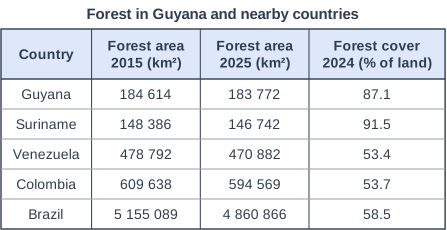
Study Figure 1, which shows the forest area of Guyana and four nearby countries. It comes from a resource booklet about Guyana written for this course, using FAO data published by the World Bank (2026). Between 2015 and 2025 Guyana lost about 0.5% of its forest area, a much smaller share than Brazil.

Using your own knowledge, explain one physical reason and one human reason why Guyana has lost such a small share of its forest.

Forest in Guyana and nearby countries. Table with columns "Country", "Forest area 2015 (km²)", "Forest area 2025 (km²)", "Forest cover 2024 (% of land)". Country: Guyana; Forest area 2015 (km²): 184 614; Forest area 2025 (km²): 183 772; Forest cover 2024 (% of land): 87.1 | Country: Suriname; Forest area 2015 (km²): 148 386; Forest area 2025 (km²): 146 742; Forest cover 2024 (% of land): 91.5 | Country: Venezuela; Forest area 2015 (km²): 478 792; Forest area 2025 (km²): 470 882; Forest cover 2024 (% of land): 53.4 | Country: Colombia; Forest area 2015 (km²): 609 638; Forest area 2025 (km²): 594 569; Forest cover 2024 (% of land): 53.7 | Country: Brazil; Forest area 2015 (km²): 5 155 089; Forest area 2025 (km²): 4 860 866; Forest cover 2024 (% of land): 58.5.

Model answer

Physical: the interior of Guyana is remote and covered by dense rainforest, and its rivers are broken by rapids and waterfalls. This makes it very hard for loggers, farmers and miners to reach most of the forest, so few roads have been built and most of the forest has not been touched.

Human: Guyana has a small population, only about 1 million people (an estimated 1 025 000 at the end of 2025), and most of them live on the coastal plain. There is therefore little demand to clear forest for farms and settlements, unlike Brazil, where cattle ranching and soya farming have cleared huge areas.

Explanation

Each part earns 1 mark for a reason and 1 for explaining how it keeps forest loss low. Do not give two physical or two human reasons. A common weakness is to describe Guyana's forest (it is large, it is green) instead of explaining why little of it has been cleared.

Mark scheme
  1. 1 mark

    Physical reason: identifies a valid physical reason, e.g. the interior is remote, with dense forest and rivers broken by rapids and waterfalls / rainforest soils are poor and leached / heavy rainfall and wet ground make access and farming difficult / mountains in the interior

    Examples (physical): The interior is remote and covered by dense forest, and its rivers are broken by rapids and waterfalls (1) so it is hard for loggers, farmers and miners to reach most of the forest (1). Rainforest soils are thin and leached (1) so cleared land soon loses its fertility, making large-scale farming or ranching unattractive (1). Heavy rainfall and waterlogged ground (1) make roads expensive to build and keep open (1). Accept any other appropriate response.

  2. 1 mark

    Develops the physical reason

    The development must explain how the physical factor reduces forest clearing.

  3. 1 mark

    Human reason: identifies a valid human reason, e.g. small population living mostly on the coast / carbon-credit payments under the LCDS reward low deforestation / few roads into the interior / Amerindian villages own and protect large areas of forest / the economy is based on the coast and oil, not cattle ranching

    Examples (human): Guyana has a small population, about 879 000 at the 2022 census and an estimated 1 025 000 at the end of 2025 (about 4-5 people per km²), most of whom live on the coast (1) so there is little demand to clear forest for farms and settlements, unlike Brazil, where cattle ranching has cleared huge areas (1). Under the Low Carbon Development Strategy Guyana earns money from carbon credits only if deforestation stays low (1) so the government has a reason to control mining and logging (1). Titled Amerindian villages own about 16% of the land (1) and use the forest sustainably for food, medicine and building materials (1). Accept any other appropriate response.

  4. 1 mark

    Develops the human reason

    The development must explain how the human factor reduces forest clearing. Credit differing interpretations of physical and human if clearly argued; do not credit the same idea twice.

Question 4

8 marks

Guyana began producing oil in December 2019. Some people think its oil wealth will help it to protect its forest; others think it will lead to more of the forest being cleared.

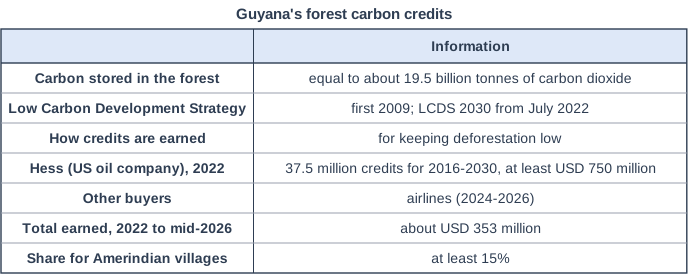
Study Figure 1, which gives information about Guyana's forest carbon credits. It comes from a resource booklet about Guyana written for this course, using information from the Government of Guyana.

Figure 2 (written for this course using information from the Government of Guyana, the Guyana Forestry Commission and the World Bank; the views were written for this course)
- In 2025 about USD 2.4 billion of oil money was paid into Guyana's Natural Resource Fund, and about USD 2.46 billion was taken out to pay for the national budget.
- Between 2015 and 2025 Guyana lost only about 0.5% of its forest area.
- In 2020 mining, mostly for gold, caused 63% of the forest cleared. Most clearing was close to roads and to rivers that boats can use, and it rose when gold prices were high.
- Ravi, a builder in Georgetown: 'Oil has brought jobs. Spend the money now on roads, houses and cheaper electricity.'
- Grace, a conservation scientist: 'The forest earns money only while it is standing. New roads bring miners and loggers.'

Using evidence from Figures 1 and 2 and your own knowledge, assess whether Guyana's oil wealth is more likely to help to protect its forest or to lead to more of it being cleared.

Guyana's forest carbon credits. Table with columns (row headings), "Information". Carbon stored in the forest; Information: equal to about 19.5 billion tonnes of carbon dioxide | Low Carbon Development Strategy; Information: first 2009; LCDS 2030 from July 2022 | How credits are earned; Information: for keeping deforestation low | Hess (US oil company), 2022; Information: 37.5 million credits for 2016-2030, at least USD 750 million | Other buyers; Information: airlines (2024-2026) | Total earned, 2022 to mid-2026; Information: about USD 353 million | Share for Amerindian villages; Information: at least 15%.

Model answer

Guyana's oil wealth could help to protect its forest in several ways. With about USD 2.4 billion of oil money paid into the Natural Resource Fund in 2025 alone, the government does not need to earn money by clearing forest for farming, logging or mining, so it can afford to keep its Low Carbon Development Strategy. Oil money could also pay for satellite monitoring and rangers to stop illegal mining, and for other jobs for villagers and miners. Oil wealth and forest protection are already linked: Hess, a US oil company, agreed to buy 37.5 million forest carbon credits for at least USD 750 million, and at least 15% of the credit money goes to Amerindian villages. So far the forest has been well protected: Guyana lost only about 0.5% of its forest area between 2015 and 2025.

However, oil wealth could also lead to more clearing. Most of the oil money is spent rather than saved: in 2025 about USD 2.46 billion was taken out of the fund for the national budget. Ravi wants it spent on roads, and Grace warns that new roads bring miners and loggers. Figure 2 shows that most clearing happens close to roads and rivers, so roads into the interior are probably the biggest risk. Carbon credits have earned only about USD 353 million since 2022, far less than the oil money paid into the fund in one year, so the government may care less about keeping the forest standing. Oil wealth also does nothing to stop gold mining, which caused most of the clearing in 2020 and rises when gold prices are high. Finally, burning oil adds to climate change, which could bring more droughts and fires to the forest.

Overall, oil wealth makes it possible to protect the forest, but it does not make it certain. In the short term the very low rate of forest loss suggests that the money is helping, but in the long term the roads and growth that oil money pays for are a serious threat. Whether oil wealth protects or harms the forest depends on how the government chooses to spend it, especially whether it builds roads into the interior and controls gold mining.

Explanation

Level 3 needs evidence from both figures used to support each side of the argument (AO4) and a weighed judgement about which outcome is more likely and what it depends on (AO3). A common weakness is to describe the carbon-credit figures without linking them to oil wealth, or to list effects without deciding which matter most.

Mark scheme
  1. 8 marks

    Levels of response (8 marks).
    Level 3 (7-8 marks): Applies understanding to deconstruct information and provide logical connections between concepts throughout. A balanced, well-developed argument that synthesises relevant understanding coherently, leading to judgements that are supported by evidence throughout. (AO3) Uses geographical skills to obtain accurate information that supports all aspects of the argument. (AO4)
    Level 2 (4-6 marks): Applies understanding to deconstruct information and provide some logical connections between concepts. An imbalanced argument that synthesises mostly relevant understanding but not entirely coherently, leading to judgements that are supported by evidence occasionally. (AO3) Uses geographical skills to obtain accurate information that supports some aspects of the argument. (AO4)
    Level 1 (1-3 marks): Attempts to apply understanding to deconstruct information but understanding and connections are flawed. An unbalanced or incomplete argument that provides limited synthesis of understanding. Judgements are supported by limited evidence. (AO3) Uses some geographical skills to obtain information with limited relevance and accuracy, which supports few aspects of the argument. (AO4)
    0 marks: No acceptable response.

    AO3 (4 marks) / AO4 (4 marks). Answers should weigh ways in which oil wealth could help to protect the forest against ways in which it could lead to more clearing; the assessment may offer a view on which is more likely and on what it depends. Indicative content (not a checklist; credit other valid points):
    AO4 (skilled use of information from Figures 1 and 2): credits are earned only for keeping deforestation low; about USD 353 million earned from 2022 to mid-2026, including from Hess, a US oil company, which agreed to buy 37.5 million credits for at least USD 750 million; at least 15% goes to Amerindian villages; the forest stores carbon equal to about 19.5 billion tonnes of carbon dioxide; about USD 2.4 billion of oil money was paid into the fund in 2025 alone, far more than credit income, and about USD 2.46 billion was taken out for the budget; Guyana lost only about 0.5% of its forest from 2015 to 2025; mining caused 63% of clearing in 2020, mostly near roads and rivers, and more when gold prices were high; Ravi wants the money spent on roads; Grace warns that new roads bring miners and loggers.
    AO3: help - with a large oil income the government does not need to earn money by clearing forest for farming, logging or mining, so it can afford to keep the LCDS; oil money can pay for monitoring, rangers and other livelihoods for villages and miners; an oil company is itself paying for forest credits, so oil wealth and forest protection are linked. Harm - oil money spent on roads into the interior gives miners, loggers and settlers access, the main reason clearing happens; a booming economy raises demand for land, timber and building materials; credit income is small compared with oil income, so the forest may become a lower priority; gold mining depends on gold prices, not oil, so oil wealth does not remove the main threat; burning oil adds to climate change, which could bring more drought and fire to the forest. Judgement, e.g. oil wealth makes protection affordable but not certain; the low rate of loss so far suggests it is helping, but roads paid for by oil money are the biggest long-term risk. Credit a supported view either way.

Ready to try the rest? Every answer you write is marked against the mark scheme, so you can see exactly where the marks are.

Study Helper Hints first, answers after you try

Stuck on this one? Ask for a hint and I’ll point you in the right direction, without giving the answer away. Once you’ve checked your answer, I’ll show you how the marks are awarded.