
Level:
Correct: 0
Incorrect: 0
Marks: 0/0
Exam Practice
Course:
Topics:
Edexcel GCSE Biology (Paper 1) Smart practice A mixed round aimed at your weak spots
Unit 1
Key concepts in biology
Unit 2
Cells and control
Unit 3
Genetics
Unit 4
Natural selection and genetic modification
Unit 5
Health, disease and the development of medicines
Avg
score:
–
Topics
done:
0/38

Three domains and selective breeding

Practise 14 exam-style questions on Three domains and selective breeding for Edexcel GCSE Biology (Paper 1). Write your answer as you would in the exam and get it marked in seconds against the mark scheme, point by point, with the Study Helper on hand if you get stuck.

  • 14 questions
  • 1–6 marks each
  • Instant marking
  • No sign-up needed
14 questions, marked as you go

Sample questions with model answers

Here are 4 of the questions in this topic, each with a model answer, an explanation of why it earns the marks and the mark scheme an examiner would use.

Question 1

1 mark

In the five-kingdom classification system, organisms were placed in five kingdoms: animals, plants, fungi, protists and prokaryotes.

When the three-domain system was introduced, the organisms in one kingdom were divided between two different domains.

Which kingdom was this?

Choose your answer.

  • A animals
  • B fungi
  • C prokaryotes
  • D protists

Model answer

C - the prokaryotes.

Explanation

All four eukaryote kingdoms went into the single domain Eukarya, but the prokaryote kingdom was split into Bacteria and Archaea once their genes were compared. This split is the main change from the five-kingdom system.

Mark scheme
  1. 1 mark

    C / prokaryotes (1)

    The only correct answer is C: genetic analysis showed that prokaryotes form two very different groups, now the domains Bacteria and Archaea. A is not correct because all animals are eukaryotes and are in the domain Eukarya. B is not correct because all fungi are eukaryotes in the domain Eukarya. D is not correct because protists are eukaryotes in the domain Eukarya. Accept the letter or the option. If more than one option is given, do not award the mark.
Question 2

2 marks

Plant breeders are selectively breeding new varieties of wheat.

Give two characteristics that the breeders might select for.

Model answer

Higher yield (more grain per plant) and resistance to disease.

Explanation

Breeders select characteristics that are useful to humans: yield, disease resistance, short strong stems, tolerance of difficult conditions and grain quality. Give two different characteristics; two kinds of the same thing (e.g. two diseases) count once.

Mark scheme
  1. 1 mark

    high yield / more or larger grains (1)

    Any two marks from the five points; max 2. Each different characteristic is a separate mark.

  2. 2 marks

    resistance to a disease / resistance to (insect) pests / tolerance of drought / tolerance of cold or frost / tolerance of salty soil (2)

    1 mark for each different characteristic in this list, max 2. Accept a named disease (e.g. a fungal disease) or a named pest (e.g. aphids); two different named diseases count as one characteristic. Accept 'can grow in poor conditions' only if a condition is named.

  3. 1 mark

    short / strong stems (so plants do not fall over in wind and rain) (1)

    Accept 'dwarf varieties'.

  4. 1 mark

    better quality grain, e.g. for bread-making / higher protein / better taste (1)

    Accept 'better flavour'.

  5. 1 mark

    faster growth / ripens earlier (1)

    Ignore 'bigger plants' (taller wheat is not usually wanted).

Question 3

3 marks

Wild cabbage grows on sea cliffs in southern England. Cabbage, kale, broccoli, cauliflower and Brussels sprouts were all produced from wild cabbage by selective breeding. They are all the same species.

Explain how selective breeding produced several very different vegetables from one wild species.

Model answer

Wild cabbage plants showed variation, for example in the size of their leaves, buds and flower heads. Different breeders chose different characteristics: some chose plants with large leaves (kale), others plants with large flower heads (broccoli and cauliflower) or large buds (Brussels sprouts). The chosen plants were cross-pollinated, the offspring with the most extreme form of the characteristic were selected, and this was repeated over many generations.

Explanation

One species can give many varieties because breeders select different characteristics from the variation that exists, and repeat the selection for many generations. The vegetables are still one species because they can interbreed. A common weakness is describing selective breeding in general without saying why the results were different.

Mark scheme
  1. 1 mark

    wild cabbage plants showed (genetic) variation, e.g. in leaf size, buds, flowers or stems (1)

    An explanation linking three from the four points; max 3.

  2. 1 mark

    different breeders selected different characteristics, e.g. large leaves for kale, large flower heads for broccoli or cauliflower, large buds for Brussels sprouts (1)

    The idea of different characteristics being chosen is needed; one example is enough.

  3. 1 mark

    plants with the chosen characteristic were bred together / cross-pollinated (1)

    Accept 'used as parents'.

  4. 1 mark

    the best offspring were selected and the process repeated over many generations (1)

    Accept 'over hundreds of years'.

Question 4

4 marks

A farmer keeps a herd of dairy cows. In each generation she chose the cows that produced the most milk and bred them with a bull whose mother had produced a lot of milk. She kept the female calves to join the herd.

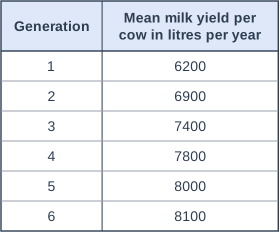
The table shows the mean milk yield of the cows in each generation.

Explain how selective breeding increased the milk yield of the herd, and suggest why the increase became smaller in later generations.

Table with columns "Generation", "Mean milk yield per cow in litres per year". Generation: 1; Mean milk yield per cow in litres per year: 6200 | Generation: 2; Mean milk yield per cow in litres per year: 6900 | Generation: 3; Mean milk yield per cow in litres per year: 7400 | Generation: 4; Mean milk yield per cow in litres per year: 7800 | Generation: 5; Mean milk yield per cow in litres per year: 8000 | Generation: 6; Mean milk yield per cow in litres per year: 8100.

Model answer

There was variation in milk yield between cows, because some cows had more alleles for high milk yield. The farmer chose the cows with the highest yield and bred them with a bull that carried alleles for high yield from his mother. The calves inherited these alleles, and by repeating this every generation the mean yield rose from 6200 to 8100 litres per year. The increase became smaller because, after several generations of selection, most cows already had the alleles for high yield, so there was less genetic variation left to select from.

Explanation

Selective breeding works by choosing parents with the wanted characteristic so that offspring inherit the alleles, and repeating this over many generations. Each round of selection reduces variation, so progress slows unless new variation is brought in. Answers should use 'alleles' or 'genes' and 'many generations', not just 'breed the best ones'.

Mark scheme
  1. 1 mark

    milk yield varies between cows / some cows had alleles for high milk yield (1)

    An answer including four from the five points; max 4. Accept 'genetic variation in the herd'.

  2. 1 mark

    cows with the highest yield were bred with a bull carrying alleles for high yield (from his mother) (1)

    Accept 'the best cows were bred with a bull from a high-yielding mother'. A point that only repeats the question without the idea of alleles or inheritance does not score.

  3. 1 mark

    the calves inherited the alleles for high milk yield (1)

    Accept genes for alleles.

  4. 1 mark

    the process was repeated over many generations, so the mean yield increased (from 6200 to 8100 litres) (1)

    Accept 'repeated each generation'.

  5. 1 mark

    (increase got smaller because) genetic variation decreased / most cows already had the alleles for high yield / the herd was reaching the maximum possible yield (1)

    Accept 'fewer new alleles for high yield to select'. Accept 'limited by other factors such as food'. Ignore 'the cows got tired'.

Ready to try the rest? Every answer you write is marked against the mark scheme, so you can see exactly where the marks are.

Study Helper Hints first, answers after you try

Stuck on this one? Ask for a hint and I’ll point you in the right direction, without giving the answer away. Once you’ve checked your answer, I’ll show you how the marks are awarded.