
Level:
Correct: 0
Incorrect: 0
Marks: 0/0
Exam Practice
Course:
Topics:
Edexcel GCSE Biology (Paper 1) Smart practice A mixed round aimed at your weak spots
Unit 1
Key concepts in biology
Unit 2
Cells and control
Unit 3
Genetics
Unit 4
Natural selection and genetic modification
Unit 5
Health, disease and the development of medicines
Avg
score:
–
Topics
done:
0/38

Core practical: microscopy and magnification

Practise 14 exam-style questions on Core practical: microscopy and magnification for Edexcel GCSE Biology (Paper 1). Write your answer as you would in the exam and get it marked in seconds against the mark scheme, point by point, with the Study Helper on hand if you get stuck.

  • 14 questions
  • 1–6 marks each
  • Instant marking
  • No sign-up needed
14 questions, marked as you go

Sample questions with model answers

Here are 4 of the questions in this topic, each with a model answer, an explanation of why it earns the marks and the mark scheme an examiner would use.

Question 1

1 mark

When preparing a microscope slide, a student uses a mounted needle to lower the cover slip onto the specimen at an angle.

What is the reason for lowering the cover slip at an angle?

Choose your answer.

  • A to avoid trapping air bubbles
  • B to spread the stain evenly
  • C to kill the cells
  • D to make the specimen thinner

Model answer

A to avoid trapping air bubbles

Explanation

Air bubbles under a cover slip look like dark-edged circles and can hide the cells. Lowering the cover slip from one side with a mounted needle lets the liquid spread out and push the air out ahead of it.

Mark scheme
  1. 1 mark

    A / to avoid trapping air bubbles (1)

    The only correct answer is A: lowering the cover slip slowly from one side pushes the air out, so no air bubbles are trapped to hide the cells. B is not correct because the stain is added before the cover slip, or drawn under it with a paper towel; C is not correct because the cover slip does not kill the cells; D is not correct because the specimen must already be thin before the cover slip is added. Accept the letter or the option. If more than one option is given, do not award the mark.
Question 2

2 marks

A student prepares a slide of banana cells. She scrapes a small amount of banana onto a glass slide, adds a drop of iodine solution to stain the starch grains and then adds a glass cover slip.

Identify one hazard in this practical and describe how the risk from this hazard can be reduced.

Model answer

Iodine solution can irritate the eyes, so the student should wear eye protection when adding it to the slide.

Explanation

A hazard is something that could cause harm; the risk is reduced by a precaution that matches that hazard. Answers that just say 'be careful' or 'follow lab rules' do not score, because they do not explain how the harm would be prevented.

Mark scheme
  1. 1 mark

    a correct hazard, e.g. iodine solution is an irritant / can irritate the eyes or skin / stains skin / glass slides or cover slips can break and cut / the microscope lamp gets hot (1)

    accept iodine can harm the eyes; ignore 'iodine is dangerous' without saying how; do not accept eating the banana as the hazard.

  2. 1 mark

    a precaution that matches the hazard, e.g. wear eye protection / wear gloves / wash off spills / handle the slides and cover slips carefully and tell the teacher about breakages / do not touch the lamp (1)

    dependent on the first marking point: the precaution must reduce the risk from the hazard given; ignore 'be careful' alone; ignore general laboratory rules not linked to the hazard.

Question 3

3 marks

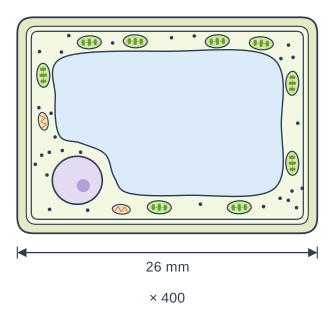
Figure 1 shows a drawing of a cell from a leaf. The magnification of the drawing is printed below it. The measuring arrow shows the width of the cell in the drawing.

Calculate the real width of the cell in micrometres (μm).

Diagram: a box-shaped cell with rounded corners and a thick outer layer, with a thin line just inside that layer. A large pale blue space fills most of the centre. In the narrow band between this space and the edge are a round structure (bottom left), nine small green oval structures with darker stacks inside, two small sausage-shaped structures with folded inner lines, and tiny dots. No parts are labelled. A double-headed measuring arrow under the drawing spans the full width of the whole cell, labelled "26 mm". Printed under the drawing: "× 400".

Model answer

Real size = size of image ÷ magnification
= 26 ÷ 400 = 0.065 mm
0.065 × 1000 = 65 μm

Explanation

Rearrange magnification = size of image ÷ size of real object to give real size = size of image ÷ magnification, then convert millimetres to micrometres by multiplying by 1000. Multiplying by the magnification instead of dividing gives an impossibly large cell, which is a useful check.

Mark scheme
  1. 1 mark

    (real size = image size ÷ magnification =) 26 ÷ 400 (1)

    An answer of 65 (μm) with no working scores 3 marks. accept 26 000 ÷ 400 (converting first) for this mark.

  2. 1 mark

    0.065 (mm) (1)

    accept 26 × 1000 = 26 000 (μm) as the unit conversion mark if the conversion is done first.

  3. 1 mark

    65 (μm) (1)

    0.065 (not converted to μm) scores 2 marks; award 2 marks for the answer with a power of ten error (e.g. 6.5 or 650) if the method is correct; 10 400 (26 × 400) scores 0.

Question 4

4 marks

A student placed a prepared slide on the stage of a light microscope. She clicked the ×40 objective lens into place. Then, while looking down the eyepiece, she turned the coarse focusing knob to move the objective lens down towards the slide.

The lens hit the slide and cracked the cover slip, and she did not find any cells.

Explain two changes she should make to her method.

Model answer

She should start with the lowest power objective lens, such as ×4, because it has the largest field of view, so the cells are easier to find, and there is more space between the lens and the slide. She should also watch from the side while she lowers the objective lens towards the slide, so that the lens does not hit the slide, and then focus by moving the lens away from the slide while looking through the eyepiece. Once the cells are in focus and in the centre of the view, she can change to the ×40 lens and use only the fine focusing knob.

Explanation

The safe method is low power first, lens lowered while watching from the side, then focusing upwards, then higher power with only the fine focus. Because the command word is 'Explain', each change needs a reason; a list of changes with no reasons scores a maximum of 2 marks.

Mark scheme
  1. 1 mark

    start with the lowest power objective lens (e.g. ×4 or ×10) (1)

    An explanation of two changes, each with a reason: any two of the four pairs; max 4. Each reason mark is dependent on its change.

  2. 1 mark

    because it has a larger field of view, so it is easier to find the cells / there is more space between the lens and the slide (1)

    dependent on the previous marking point.

  3. 1 mark

    watch from the side while lowering the objective lens (towards the slide) (1)

    accept lower the lens close to the slide first, then focus by moving the lens and slide apart while looking through the eyepiece.

  4. 1 mark

    so that the lens does not touch / hit the slide (1)

    dependent on the previous marking point.

  5. 1 mark

    use only the fine focusing knob with the high power (×40) objective lens (1)

    accept use the coarse focus only with the low power lens.

  6. 1 mark

    because it makes only small movements, so the lens will not hit the slide / gives a sharper image (1)

    dependent on the previous marking point.

  7. 1 mark

    move the slide so the cells are in the centre of the view before changing to a higher power objective (1)

    accept centre the specimen at low power first.

  8. 1 mark

    so that the cells are still in the (smaller) field of view at high power (1)

    dependent on the previous marking point.

Ready to try the rest? Every answer you write is marked against the mark scheme, so you can see exactly where the marks are.

Study Helper Hints first, answers after you try

Stuck on this one? Ask for a hint and I’ll point you in the right direction, without giving the answer away. Once you’ve checked your answer, I’ll show you how the marks are awarded.