
Level:
Correct: 0
Incorrect: 0
Marks: 0/0
Exam Practice
Course:
Topics:
Edexcel GCSE Biology (Paper 1) Smart practice A mixed round aimed at your weak spots
Unit 1
Key concepts in biology
Unit 2
Cells and control
Unit 3
Genetics
Unit 4
Natural selection and genetic modification
Unit 5
Health, disease and the development of medicines
Avg
score:
–
Topics
done:
0/38

Food tests and calorimetry

Practise 16 exam-style questions on Food tests and calorimetry for Edexcel GCSE Biology (Paper 1). Write your answer as you would in the exam and get it marked in seconds against the mark scheme, point by point, with the Study Helper on hand if you get stuck.

  • 16 questions
  • 1–6 marks each
  • Instant marking
  • No sign-up needed
16 questions, marked as you go

Sample questions with model answers

Here are 4 of the questions in this topic, each with a model answer, an explanation of why it earns the marks and the mark scheme an examiner would use.

Question 1

1 mark

Two students each burned a 1.0 g piece of the same cracker under a boiling tube of water. Student 1 used 10 cm³ of water. Student 2 used 20 cm³ of water. The water in both tubes started at the same temperature.

Assume that the same amount of energy was transferred to the water in each tube.

Which statement is correct?

Choose your answer.

  • A student 2's rise is half as big
  • B student 2's rise is twice as big
  • C the two rises are the same
  • D student 2 finds more energy per g

Model answer

A - the temperature rise for student 2 is half as big as for student 1.

Explanation

The energy needed to raise the temperature of water depends on its mass: 4.2 J raises 1 g of water by 1 °C. With the same energy, twice the mass of water rises by half as many degrees, so both students should calculate the same energy per gram. A common error is to think more water gives a bigger temperature rise.

Mark scheme
  1. 1 mark

    A / student 2's rise is half as big (1)

    The only correct answer is A: twice the mass of water heated by the same energy has half the temperature rise of student 1's water. B is not correct because twice the mass of water needs twice the energy for each degree of temperature rise, so the same energy gives a smaller rise, not a larger one; C is not correct because the temperature rise depends on the mass of water being heated; D is not correct because energy content = mass of water × temperature rise × 4.2 ÷ mass of food, so twice the mass of water with half the rise gives the same energy per g. Accept the letter or the option. If more than one option is given, do not award the mark.
Question 2

2 marks

Glucose and fructose are reducing sugars. Sucrose (table sugar) is not a reducing sugar.

A student heated a sucrose solution with Benedict's solution. The solution stayed blue.

The student then mixed some of the same sucrose solution with the enzyme sucrase and left it at 37 °C for 10 minutes. When this mixture was heated with Benedict's solution, it turned brick red.

Explain these results.

Model answer

Sucrose is not a reducing sugar, so on its own it does not change the colour of Benedict's solution. The enzyme sucrase breaks down sucrose into glucose and fructose. These are reducing sugars, so after the enzyme has acted the Benedict's test is positive and turns brick red.

Explanation

Enzymes catalyse the breakdown of large carbohydrates into smaller sugars. Sucrose does not give a positive Benedict's test, but its breakdown products, glucose and fructose, do. A common error is to say the enzyme turned the sucrose into a reducing sugar without the idea that the sucrose was broken down.

Mark scheme
  1. 1 mark

    sucrase breaks down / digests (the) sucrose (1)

    An explanation linking: accept sucrase catalyses the breakdown of sucrose / sucrase hydrolyses sucrose

  2. 1 mark

    into glucose and fructose / into reducing sugars (which give a positive Benedict's test) (1)

    accept into smaller sugars that are reducing sugars; accept into glucose (and another sugar); ignore 'sucrose is not a reducing sugar' on its own (given in the question); do not accept sucrase turns the sucrose into starch / protein

Question 3

3 marks

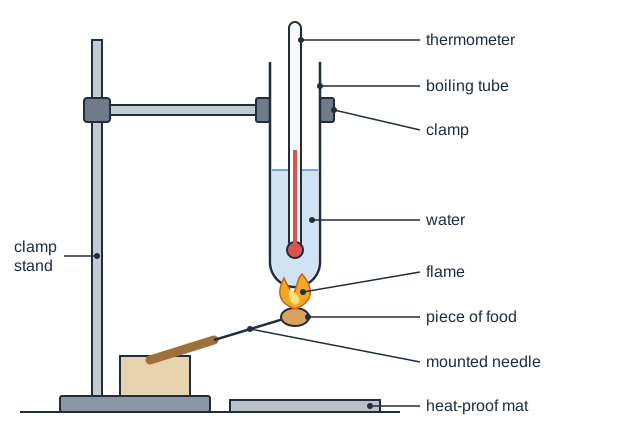
The diagram shows the apparatus a student used to estimate the energy contained in a food.

The student measured the mass of the food and the volume of water in the boiling tube. Then she set fire to the food and held it under the boiling tube until it had burned completely.

Explain how the student can use this apparatus to calculate the energy content of the food.

Diagram of apparatus. A boiling tube containing water is held by a clamp on a clamp stand, with a thermometer standing in the water. Below the boiling tube, a piece of food is burning on the end of a mounted needle whose handle rests on a block, and its flame is just under the bottom of the boiling tube. A heat-proof mat lies on the bench below the burning food. Labels: thermometer, boiling tube, clamp, water, flame, piece of food, mounted needle, heat-proof mat, clamp stand.

Model answer

When the food burns, the chemical energy stored in it is released as heat. This heat is transferred to the water in the boiling tube, so the temperature of the water rises. The student measures the temperature of the water with the thermometer before and after burning to find the temperature rise. The energy transferred is mass of water × temperature rise × 4.2, because 4.2 J raises the temperature of 1 g of water by 1 °C. Dividing this energy by the mass of food burned gives the energy content in J per g.

Explanation

Calorimetry uses the temperature rise of a known mass of water to measure the energy released by burning a known mass of food. A good answer links the burning food to the heating of the water, then explains how the temperature rise, the mass of water and the mass of food give the energy per gram. Weaker answers only say 'measure the temperature' without the start and end temperatures.

Mark scheme
  1. 1 mark

    burning releases the (chemical) energy stored in the food (as heat) (1)

    An explanation linking three from the five points; max 3. accept combustion of the food transfers energy

  2. 1 mark

    the energy (released) heats the water / is transferred to the water (1)

    accept the temperature of the water rises

  3. 1 mark

    measure the temperature of the water before and after burning (with the thermometer) to find the temperature rise (1)

    ignore 'measure the temperature' without the idea of before and after / the change

  4. 1 mark

    energy = mass of water × temperature rise × 4.2 / 4.2 J raises the temperature of 1 g of water by 1 °C (1)

    accept the mass of water is found from its volume (1 cm³ has a mass of 1 g); accept the specific heat capacity of water is 4.2 J/g °C

  5. 1 mark

    divide the energy by the mass of food (burned) to find the energy per gram (1)

    accept energy content = energy transferred ÷ mass of food

Question 4

4 marks

Ellie burned three samples of a corn snack, one at a time, under a boiling tube of water to find how much energy the snack contains.

Her three results were 9.4 kJ per g, 9.8 kJ per g and 9.6 kJ per g. Her mean result was 9.6 kJ per g.

The packet says that 100 g of the corn snack contains 2160 kJ of energy.

Calculate Ellie's mean result as a percentage of the value on the packet.

Explain why Ellie's results are precise but not accurate.

Model answer

Value on the packet = 2160 ÷ 100 = 21.6 kJ per g
Percentage = 9.6 ÷ 21.6 × 100 = 44.4 %

The results are precise because they are close together: they range from 9.4 to 9.8 kJ per g, only 0.4 kJ per g apart. They are not accurate because they are far from the true value: the mean is less than half of the value on the packet. Every result is too low because much of the heat from the burning food is lost to the air instead of heating the water.

Explanation

Convert the packet value to kJ per g before finding the percentage, and divide Ellie's value by the packet value, not the other way round. Precise results are close to each other; accurate results are close to the true value. Simple calorimetry gives results that are all too low (a systematic error), because heat escapes to the surroundings and the food may not burn completely, so repeating it makes the results precise but not accurate. A common error is to mix up the two terms.

Mark scheme
  1. 1 mark

    (2160 ÷ 100 =) 21.6 (kJ per g) (1)

    Marking points 1 and 2 are for the calculation; marking points 3 and 4 are for the explanation. accept Ellie's mean result as 960 kJ per 100 g for this mark. An answer of 44.4 % with no working scores marking points 1 and 2; an answer of 44 % with no working scores marking points 1 and 2. An inverted ratio (21.6 ÷ 9.6 × 100 = 225 %) scores marking point 1 only if 21.6 or 960 is shown.

  2. 1 mark

    (9.6 ÷ 21.6 × 100 =) 44.4 (%) (1)

    accept values that round to 44 (e.g. 44, 44.4, 44.44); accept 960 ÷ 2160 × 100

  3. 1 mark

    (precise because) the three results are close together / close to the mean / have a small range (of 0.4 kJ per g, 9.4 to 9.8) (1)

    accept the results are similar / repeatable / show little spread; do not accept 'precise because they are close to the value on the packet'; ignore 'the results are the same'

  4. 1 mark

    (not accurate because) the results are far from / much lower than the true value (the value on the packet) / the mean is less than half of the value on the packet (1)

    accept the results are all too low because heat is lost to the surroundings / the food does not burn completely (a systematic error); accept the mean is only 44 % of the packet value; do not accept 'not accurate because the results are not close together'; ignore 'human error'

Ready to try the rest? Every answer you write is marked against the mark scheme, so you can see exactly where the marks are.

Study Helper Hints first, answers after you try

Stuck on this one? Ask for a hint and I’ll point you in the right direction, without giving the answer away. Once you’ve checked your answer, I’ll show you how the marks are awarded.