
Level:
Correct: 0
Incorrect: 0
Marks: 0/0
Exam Practice
Course:
Topics:
Edexcel GCSE Biology (Paper 1) Smart practice A mixed round aimed at your weak spots
Unit 1
Key concepts in biology
Unit 2
Cells and control
Unit 3
Genetics
Unit 4
Natural selection and genetic modification
Unit 5
Health, disease and the development of medicines
Avg
score:
–
Topics
done:
0/38

Non-communicable diseases and lifestyle factors

Practise 17 exam-style questions on Non-communicable diseases and lifestyle factors for Edexcel GCSE Biology (Paper 1). Write your answer as you would in the exam and get it marked in seconds against the mark scheme, point by point, with the Study Helper on hand if you get stuck.

  • 17 questions
  • 1–6 marks each
  • Instant marking
  • No sign-up needed
17 questions, marked as you go

Sample questions with model answers

Here are 4 of the questions in this topic, each with a model answer, an explanation of why it earns the marks and the mark scheme an examiner would use.

Question 1

1 mark

A doctor wants to know whether a patient is storing excess fat around the abdomen.

Which measurement gives the doctor the most useful information?

Choose your answer.

  • A height
  • B body mass
  • C waist:hip ratio
  • D BMI

Model answer

C - waist:hip ratio.

Explanation

The waist:hip ratio compares the waist with the hips, so a high ratio shows that fat is stored around the abdomen, near vital organs, which is linked to a higher risk of cardiovascular disease. BMI only compares mass with height, so a muscular person can have a high BMI without excess fat. Students often confuse what the two measurements show.

Mark scheme
  1. 1 mark

    C / waist:hip ratio (1)

    The only correct answer is C. A is not correct because height gives no information about body fat; B is not correct because body mass includes muscle, bone and water and does not show where fat is stored; D is not correct because BMI compares mass with height but does not show where fat is stored and cannot tell muscle from fat. Accept the letter or the option. If more than one option is given, do not award the mark.
Question 2

2 marks

A person can be obese and also be malnourished.

Explain how this is possible.

Model answer

Malnutrition means not having the right balance of nutrients. A person may eat a diet that contains far more energy than they use, for example lots of fat and sugar, so the excess energy is stored as fat and they become obese. But the same diet may lack nutrients such as protein, vitamins and minerals, so the person is also malnourished.

Explanation

Malnutrition is an unbalanced diet, not only too little food: the World Health Organization includes obesity as well as undernutrition in malnutrition. Too much energy causes obesity, while too little of particular nutrients (protein, vitamins, minerals) causes malnutrition, so both can occur in one person. Saying the person 'does not eat enough' cannot explain obesity.

Mark scheme
  1. 1 mark

    the diet contains more energy than the person uses (e.g. too much fat / sugar) so the excess is stored as fat (1)

    An explanation linking both points. Accept 'eats too many calories / too much energy-dense food'. Accept 'takes in more energy than is used in exercise'.

  2. 1 mark

    but the diet lacks some nutrients / is unbalanced, e.g. too little protein / vitamins / minerals / fibre (1)

    Accept 'malnutrition means not having the right balance of nutrients'. Do not accept 'the person does not eat enough food' (this contradicts obesity).

Question 3

3 marks

Priya is 1.60 m tall. Her BMI is 31.6.

Her doctor advises her to lose mass until her BMI is 24.9, the top of the healthy range.

BMI = mass (kg) ÷ (height (m))²

Calculate the mass Priya would need to lose.

Model answer

Rearranging the equation: mass = BMI × height²
Current mass = 31.6 × 1.60² = 31.6 × 2.56 = 80.9 kg
Mass for a BMI of 24.9 = 24.9 × 2.56 = 63.7 kg
Mass to lose = 80.9 - 63.7 = 17.2 kg

Explanation

Rearrange BMI = mass ÷ height² to mass = BMI × height², then find the mass at each BMI and subtract (or multiply the change in BMI, 6.7, by 2.56). The answer is about 17.2 kg. The most common errors are forgetting to square the height and dividing by the height squared instead of multiplying.

Mark scheme
  1. 1 mark

    (current mass =) 31.6 × 1.60² = 80.9 (kg) (1)

    An answer of 17.2 (kg) with no working scores 3 marks. Accept 80.896. Alternative method: (31.6 - 24.9) × 1.60² = 6.7 × 2.56 scores the first two marks.

  2. 1 mark

    (target mass =) 24.9 × 1.60² = 63.7 (kg) (1)

    Accept 63.744.

  3. 1 mark

    (mass to lose =) 17.2 (kg) (1)

    Accept 17.15, 17.152 or answers from 17.1 to 17.2. Allow ecf from incorrect masses. Allow 1 mark only for 10.7 (height not squared).

Question 4

4 marks

Callum is 182 cm tall and has a mass of 97 kg.

BMI = mass (kg) ÷ (height (m))²

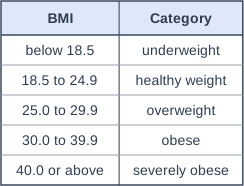
The table shows the BMI categories used by his doctor.

Calculate Callum's BMI. Give your answer to 3 significant figures.

State which category Callum is in.

Table with columns "BMI", "Category". BMI: below 18.5; Category: underweight | BMI: 18.5 to 24.9; Category: healthy weight | BMI: 25.0 to 29.9; Category: overweight | BMI: 30.0 to 39.9; Category: obese | BMI: 40.0 or above; Category: severely obese.

Model answer

Height = 182 cm = 1.82 m
BMI = 97 ÷ 1.82² = 97 ÷ 3.3124 = 29.28...
BMI = 29.3 (to 3 significant figures)
Callum is in the overweight category (25.0 to 29.9).

Explanation

The height must be converted to metres before it is squared: 182 cm = 1.82 m, and 1.82² = 3.3124. Then 97 ÷ 3.3124 = 29.28, which is 29.3 to 3 significant figures, in the overweight range. Common errors are using the height in cm (giving 0.00293), forgetting to square the height (giving 53.3) and rounding to the wrong number of figures.

Mark scheme
  1. 1 mark

    97 ÷ 1.82² / 97 ÷ 3.3124 (1)

    Award the three calculation marks for 29.3 with no working. Allow 1 mark only for 0.00293 / 0.0029 (height not converted to metres).

  2. 1 mark

    29.28 (1)

    Accept 29.284 or any value that rounds to 29.28. Accept 29.3 for this mark.

  3. 1 mark

    29.3 (1)

    This mark is for the answer given to 3 significant figures. Allow ecf: an incorrect BMI correctly rounded to 3 significant figures.

  4. 1 mark

    overweight (1)

    Allow ecf from the student's calculated BMI, using the table. Do not accept obese.

Ready to try the rest? Every answer you write is marked against the mark scheme, so you can see exactly where the marks are.

Study Helper Hints first, answers after you try

Stuck on this one? Ask for a hint and I’ll point you in the right direction, without giving the answer away. Once you’ve checked your answer, I’ll show you how the marks are awarded.