
Level:
Correct: 0
Incorrect: 0
Marks: 0/0
Exam Practice
Course:
Topics:
Edexcel GCSE Biology (Paper 1) Smart practice A mixed round aimed at your weak spots
Unit 1
Key concepts in biology
Unit 2
Cells and control
Unit 3
Genetics
Unit 4
Natural selection and genetic modification
Unit 5
Health, disease and the development of medicines
Avg
score:
–
Topics
done:
0/38

Immunisation, herd immunity and monoclonal antibodies

Practise 17 exam-style questions on Immunisation, herd immunity and monoclonal antibodies for Edexcel GCSE Biology (Paper 1). Write your answer as you would in the exam and get it marked in seconds against the mark scheme, point by point, with the Study Helper on hand if you get stuck.

  • 17 questions
  • 1–6 marks each
  • Instant marking
  • No sign-up needed
17 questions, marked as you go

Sample questions with model answers

Here are 4 of the questions in this topic, each with a model answer, an explanation of why it earns the marks and the mark scheme an examiner would use.

Question 1

1 mark

A monoclonal antibody used to find blood clots binds to a protein found only in blood clots. The antibody is injected into a patient's blood, and a camera outside the body detects where the antibody collects.

Which substance is attached to the antibody?

Choose your answer.

  • A a radioactive substance
  • B a coloured bead
  • C an antibiotic
  • D an anticancer drug

Model answer

A - a radioactive substance

Explanation

To locate a blood clot, the antibody carries a radioactive substance; the antibodies bind to the clot, and a camera detects the radiation coming from that place. Coloured beads are used in test sticks outside the body, such as pregnancy tests, and drugs are attached for treatment. Mixing up diagnosis inside the body with test sticks is a common error.

Mark scheme
  1. 1 mark

    A / a radioactive substance (1)

    The only correct answer is A. B is not correct because a coloured bead cannot be detected by a camera outside the body (coloured beads are used on test sticks, such as pregnancy tests); C is not correct because an antibiotic kills bacteria and would not show where the antibody is; D is not correct because an anticancer drug is attached to antibodies for treating cancer, not for locating blood clots. Accept the letter or the option. If more than one option is given, do not award the mark.
Question 2

2 marks

Hybridoma cells are grown in large tanks to produce monoclonal antibodies. All the cells in a tank are produced from a single hybridoma cell.

Explain why all the antibodies produced in the tank are identical.

Model answer

All the hybridoma cells were produced from one cell by mitosis, so they are a clone with identical DNA. Each cell came from a lymphocyte that made one particular antibody, so they all make the same antibody, which binds to the same antigen.

Explanation

'Monoclonal' means from one clone: the cells all come from one hybridoma cell by mitosis, so they are genetically identical and make one type of antibody. The answer must link the identical cells to the identical antibodies. Writing that the antibodies divide or are cloned is wrong - the cells divide, and the antibodies are proteins made by them.

Mark scheme
  1. 1 mark

    the hybridoma cells are a clone of one cell / are made by mitosis, so they are genetically identical (1)

    An explanation linking the two points. accept they all have the same DNA / genes.

  2. 1 mark

    so they all make the same antibody (that binds to one antigen) (1)

    accept the antibodies are all specific to the same antigen; ignore 'the antibodies are clones'.

Question 3

3 marks

To produce monoclonal antibodies, scientists fuse lymphocytes with tumour cells.

Explain why lymphocytes are fused with tumour cells, rather than the lymphocytes being grown on their own.

Model answer

Lymphocytes make the antibody that is wanted, but they do not divide, so they cannot be grown in large numbers. Tumour cells divide rapidly and keep on dividing. When the two are fused, the hybridoma cell divides many times and every cell makes the antibody, so large amounts of the antibody can be produced.

Explanation

Each parent cell brings one property: the lymphocyte the ability to make one specific antibody, the tumour cell the ability to divide again and again. The hybridoma cell has both, so it produces antibodies as it divides. Saying the tumour cell 'makes the antibodies' is a common error.

Mark scheme
  1. 1 mark

    lymphocytes make the antibody wanted but do not divide (1)

    An explanation linking the three points. accept lymphocytes cannot be grown in large numbers / do not reproduce in culture.

  2. 1 mark

    tumour cells divide rapidly / many times / without stopping (1)

    accept tumour cells divide uncontrollably.

  3. 1 mark

    the hybridoma cell divides (many times) and makes the antibody, so large amounts of the antibody are produced (1)

    accept the fused cell has the properties of both cells; ignore 'the tumour cells make antibodies'.

Question 4

4 marks

Whooping cough is a disease caused by a bacterium. It can be very serious in young babies.

In 2001, a newspaper story wrongly claimed that the whooping cough vaccine was unsafe. In 2008, the government started a campaign to explain to parents that the vaccine is safe.

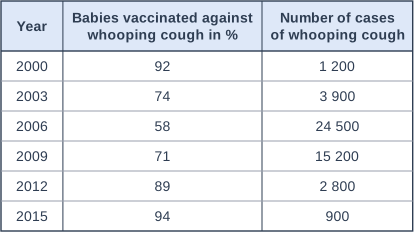
The table shows the percentage of babies vaccinated against whooping cough and the number of cases of whooping cough in one country.

Explain the changes in the number of cases of whooping cough between 2000 and 2015. Use data from the table in your answer.

Table with columns "Year", "Babies vaccinated against whooping cough in %", "Number of cases of whooping cough". Year: 2000; Babies vaccinated against whooping cough in %: 92; Number of cases of whooping cough: 1 200 | Year: 2003; Babies vaccinated against whooping cough in %: 74; Number of cases of whooping cough: 3 900 | Year: 2006; Babies vaccinated against whooping cough in %: 58; Number of cases of whooping cough: 24 500 | Year: 2009; Babies vaccinated against whooping cough in %: 71; Number of cases of whooping cough: 15 200 | Year: 2012; Babies vaccinated against whooping cough in %: 89; Number of cases of whooping cough: 2 800 | Year: 2015; Babies vaccinated against whooping cough in %: 94; Number of cases of whooping cough: 900.

Model answer

After the newspaper story in 2001, the percentage of babies vaccinated fell from 92% in 2000 to 58% in 2006, and the number of cases rose from 1 200 to 24 500. Fewer people had memory lymphocytes against the bacterium, so more people could be infected. With fewer people immune there was less herd immunity, so the bacterium spread more easily, including to young babies too young to be vaccinated.

After the campaign began in 2008, the percentage vaccinated rose to 94% by 2015 and the number of cases fell to 900. More people were immune, so herd immunity was restored and the bacterium could not spread easily. Cases were still high in 2009 because many children who had not been vaccinated in earlier years were still not immune.

Explanation

The number of cases goes up when vaccination falls and down when it rises, because the proportion of people who are immune decides how easily the pathogen spreads (herd immunity). Good answers quote figures from the table for both changes and explain them using immunity and herd immunity. Describing the changes without explaining them does not get full marks.

Mark scheme
  1. 1 mark

    after the newspaper story, the percentage of babies vaccinated fell and the number of cases rose (1)

    An explanation linking four from the six points; max 4. Max 3 if no data from the table are used. accept e.g. vaccination fell from 92% (2000) to 58% (2006) and cases rose from 1 200 to 24 500 (about 20 times as many).

  2. 1 mark

    fewer people were immune / had memory lymphocytes against the bacterium, so more people could be infected (1)

    accept more people with no antibodies / no immunity.

  3. 1 mark

    there was less herd immunity, so the bacterium could spread more easily (including to babies too young to be vaccinated) (1)

    accept the pathogen was more likely to reach people who were not immune.

  4. 1 mark

    after the campaign, the percentage vaccinated rose and the number of cases fell (1)

    accept e.g. vaccination rose to 94% in 2015 and cases fell to 900.

  5. 1 mark

    more people were immune / herd immunity was restored, so the bacterium could not spread as easily (1)

    accept fewer people could pass the bacterium on.

  6. 1 mark

    cases were still high in 2009 because children not vaccinated in earlier years were still not immune / it takes time for vaccination levels to rebuild herd immunity (1)

    accept the idea of a delay between the change in vaccination and the change in cases.

Ready to try the rest? Every answer you write is marked against the mark scheme, so you can see exactly where the marks are.

Study Helper Hints first, answers after you try

Stuck on this one? Ask for a hint and I’ll point you in the right direction, without giving the answer away. Once you’ve checked your answer, I’ll show you how the marks are awarded.