
Level:
Correct: 0
Incorrect: 0
Marks: 0/0
Exam Practice
Course:
Topics:
Edexcel GCSE Biology (Paper 1) Smart practice A mixed round aimed at your weak spots
Unit 1
Key concepts in biology
Unit 2
Cells and control
Unit 3
Genetics
Unit 4
Natural selection and genetic modification
Unit 5
Health, disease and the development of medicines
Avg
score:
–
Topics
done:
0/38

Fossils, stone tools and human evolution

Practise 14 exam-style questions on Fossils, stone tools and human evolution for Edexcel GCSE Biology (Paper 1). Write your answer as you would in the exam and get it marked in seconds against the mark scheme, point by point, with the Study Helper on hand if you get stuck.

  • 14 questions
  • 1–6 marks each
  • Instant marking
  • No sign-up needed
14 questions, marked as you go

Sample questions with model answers

Here are 4 of the questions in this topic, each with a model answer, an explanation of why it earns the marks and the mark scheme an examiner would use.

Question 1

1 mark

Three important fossils of human ancestors are Ardi, Lucy and Turkana Boy.

Which shows the fossils in order from the oldest to the most recent?

Choose your answer.

  • A Lucy, Ardi, Turkana Boy
  • B Ardi, Lucy, Turkana Boy
  • C Turkana Boy, Lucy, Ardi
  • D Ardi, Turkana Boy, Lucy

Model answer

B - Ardi (4.4 million years ago), Lucy (3.2 million years ago), Turkana Boy (1.6 million years ago).

Explanation

The larger the number of millions of years, the older the fossil, so the order from oldest is Ardi, Lucy, Turkana Boy. A common slip is to read the list the wrong way round (option C).

Mark scheme
  1. 1 mark

    B / Ardi, Lucy, Turkana Boy (1)

    The only correct answer is B: Ardi is about 4.4 million years old, Lucy about 3.2 million years old and Turkana Boy about 1.6 million years old. A is not correct because Lucy (3.2 million years) is younger than Ardi (4.4 million years). C is not correct because it gives the order from the most recent to the oldest. D is not correct because Turkana Boy (1.6 million years) is younger than Lucy (3.2 million years). Accept the letter or the option. If more than one option is given, do not award the mark.

Question 2

2 marks

Very few fossils of early human ancestors have been found, and most are incomplete.

Suggest two reasons why.

Model answer

Most bodies decayed or were eaten and scattered by scavengers before they could be fossilised, because fossils only form when remains are buried quickly in sediment. Many fossils that did form have since been destroyed by erosion or are buried too deep to be found.

Explanation

Fossilisation needs rapid burial and the right conditions, so it is rare, and fossils can later be destroyed or stay hidden. This is why the human fossil record has gaps and why nearly complete skeletons such as Lucy and Turkana Boy are so valuable. 'They are too old' is not a reason on its own.

Mark scheme
  1. 1 mark

    bodies decay / are eaten by scavengers before they can fossilise (1)

    Any two from the five points; max 2. Accept 'bones are scattered by animals'.

  2. 1 mark

    fossils only form in rare conditions, e.g. the body must be buried quickly in sediment (1)

    Accept 'need low oxygen / need to be covered by mud or volcanic ash'.

  3. 1 mark

    fossils may be destroyed by erosion / weathering / movement of rocks (1)

    Accept 'broken up by geological activity'.

  4. 1 mark

    many fossils are buried too deep or in places that have not been searched (1)

    Accept 'only found where rock layers are exposed'. Ignore 'they are too old' unqualified.

  5. 1 mark

    populations of early human ancestors were small, so there were few bodies to fossilise (1)

    Accept 'there were few early humans compared with other animals'.

Question 3

3 marks

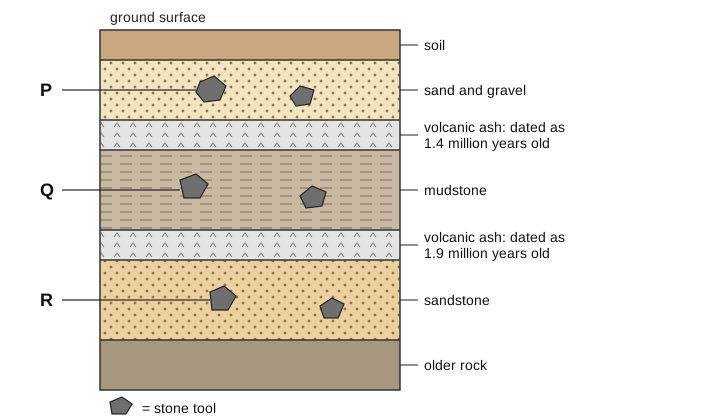
Figure 1 shows the layers of rock at a site in East Africa where three groups of stone tools, P, Q and R, were found. The layers were laid down one on top of another and have not been disturbed. The two layers of volcanic ash have been dated using radiometric dating.

Give the age range of the tools in group Q.

Explain how the rock layers allow scientists to date these tools.

Figure 1: a vertical cross-section through rock layers, with the ground surface at the top. Stone tools are shown as small grey stones in three of the layers, with groups labelled P, Q and R from the top down. The name of each layer is written on the right, and two layers of volcanic ash have their dates written beside them.

Model answer

The tools in group Q are between 1.4 and 1.9 million years old. They are in the mudstone layer, which lies below the volcanic ash dated at 1.4 million years and above the ash dated at 1.9 million years. Deeper layers were laid down earlier, so the tools must have been left after the lower ash fell and before the upper ash covered them.

Explanation

Stone tools cannot be dated directly, so scientists date the layers around them: volcanic ash can be dated by radiometric methods, and undisturbed layers get younger towards the surface. A tool between two dated layers has an age between their ages. Giving only one number misses the idea of a range.

Mark scheme
  1. 1 mark

    between 1.4 and 1.9 million years old (1)

    Age range 1 mark + explanation max 2; max 3 in total. Both ages are needed. Accept 'older than 1.4 million years and younger than 1.9 million years'. Do not accept a single value such as 1.65 million years unless the range is also given.

  2. 1 mark

    the tools are in the layer below the 1.4 million year ash and above the 1.9 million year ash (1)

    Explanation: an explanation linking two from the three points; max 2. Accept 'between the two ash layers'.

  3. 1 mark

    deeper layers were laid down earlier, so they are older / the tools were left after the lower ash was laid down and before the upper ash covered them (1)

    Accept 'the deeper the layer, the older it is', 'layers above are younger' or 'the tools must be younger than the layer beneath them and older than the layer above them'.

  4. 1 mark

    the stone tools cannot be dated directly, but the volcanic ash can be (radiometrically) dated, so the ash layers give the limits (1)

    Accept 'the ash contains material that can be dated, the stone tools / mudstone do not'. Ignore 'carbon dating'.

Question 4

4 marks

The humerus is the upper arm bone and the femur is the thigh bone. Scientists compare species using this equation.

humerofemoral index = length of humerus ÷ length of femur × 100

The table shows data for Lucy, a typical chimpanzee and a typical modern human. Chimpanzees spend much of their time climbing in trees.

Calculate value X for Lucy.

Then explain what Lucy's humerofemoral index suggests about how she moved.

Table with columns "Species", "Length of humerus in cm", "Length of femur in cm", "Humerofemoral index". Species: Chimpanzee; Length of humerus in cm: 28.0; Length of femur in cm: 28.6; Humerofemoral index: 97.9 | Species: Lucy (Australopithecus afarensis); Length of humerus in cm: 23.7; Length of femur in cm: 28.0; Humerofemoral index: X | Species: Modern human; Length of humerus in cm: 32.3; Length of femur in cm: 45.0; Humerofemoral index: 71.8.

Model answer

X = 23.7 ÷ 28.0 × 100 = 84.6

Lucy's index (84.6) is between the chimpanzee's (97.9) and the modern human's (71.8). Her arms were long compared with her legs, so she was probably still able to climb trees, but her legs were longer than a chimpanzee's relative to her arms, which suggests she walked upright on two legs on the ground.

Explanation

A higher index means longer arms relative to legs, as in tree-climbing apes; a lower index means relatively long legs for walking upright. Lucy's intermediate value fits other evidence that she walked upright but could also climb. A common calculation error is dividing the femur length by the humerus length.

Mark scheme
  1. 1 mark

    23.7 ÷ 28.0 × 100 (1)

    Calculation 2 marks + explanation max 2; max 4 in total. An answer of 84.6 or 85 with no working scores marking points 1 and 2.

  2. 1 mark

    84.6 (1)

    Accept values that round to 84.6, e.g. 84.64, or 85. Award 1 mark for 0.846 (not multiplied by 100). Do not accept 118 (femur ÷ humerus).

  3. 1 mark

    Lucy's index is between that of the chimpanzee and the modern human / her arms were long compared with her legs (but not as long as a chimpanzee's) (1)

    Explanation: an explanation linking two from the three points; max 2. ecf from their value of X. Accept 'intermediate'.

  4. 1 mark

    so she was probably still able to climb trees (using her long arms) (1)

    Accept 'spent some time in trees'.

  5. 1 mark

    and she walked upright on two legs (her legs were longer relative to her arms than a chimpanzee's) (1)

    Accept 'she was bipedal but less efficiently than modern humans'. Do not accept 'she walked on all fours'.

Ready to try the rest? Every answer you write is marked against the mark scheme, so you can see exactly where the marks are.

Study Helper Hints first, answers after you try

Stuck on this one? Ask for a hint and I’ll point you in the right direction, without giving the answer away. Once you’ve checked your answer, I’ll show you how the marks are awarded.