Level:
Correct: 0
Incorrect: 0
Marks: 0/0
Exam Practice
Course:
Topics:
Edexcel GCSE Biology (Paper 1) Smart practice A mixed round aimed at your weak spots
Unit 1
Key concepts in biology
Unit 2
Cells and control
Unit 3
Genetics
Unit 4
Natural selection and genetic modification
Unit 5
Health, disease and the development of medicines
Avg
score:
–
Topics
done:
0/38

Specialised cells

Practise 12 exam-style questions on Specialised cells for Edexcel GCSE Biology (Paper 1). Write your answer as you would in the exam and get it marked in seconds against the mark scheme, point by point, with the Study Helper on hand if you get stuck.

  • 12 questions
  • 1–6 marks each
  • Instant marking
  • No sign-up needed
12 questions, marked as you go

Sample questions with model answers

Here are 4 of the questions in this topic, each with a model answer, an explanation of why it earns the marks and the mark scheme an examiner would use.

Question 1

1 mark

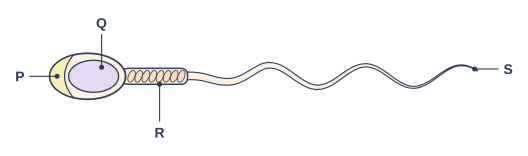
Figure 1 shows a sperm cell.

Some men produce sperm cells that cannot swim, even though the mitochondria in these sperm cells work normally.

Which labelled part of these sperm cells is most likely to be faulty?

Choose your answer.

  • A P
  • B Q
  • C R
  • D S
Diagram: a long thin cell drawn horizontally: an oval head on the left, with a thin cap over its front (left-hand) end and a large oval structure filling most of it; behind the head a short, thicker middle section packed with small oval structures; then a long thin wavy tail to the right. Label P points to the thin cap over the front (left-hand) end of the head; label Q points to the large oval structure filling most of the head; label R points to the short, thicker middle section just behind the head; label S points to the long thin wavy tail.

Model answer

D (label S, the tail)

Explanation

The tail (flagellum) beats to move the sperm cell, using energy released by aerobic respiration in the mitochondria of the midpiece. The mitochondria work normally, so energy is still being released and the fault is most likely in the tail itself. Choosing the midpiece ignores the information that the mitochondria are working.

Mark scheme
  1. 1 mark

    D / S (1)

    The only correct answer is D. Label S points to the tail (flagellum), which beats to make the sperm cell swim, so a faulty tail stops the sperm swimming even when energy is being released. A is not correct because P is the acrosome, which contains enzymes to digest the jelly coat of the egg cell and plays no part in swimming; B is not correct because Q is the haploid nucleus, which contains the genetic material; C is not correct because R is the midpiece, whose mitochondria are working normally, so energy for swimming is still being released. Accept the letter of the option, the label S, 'tail' or 'flagellum'. If more than one option is given, do not award the mark.

Question 2

2 marks

A sperm cell has very little cytoplasm compared with an egg cell.

Suggest why it is an advantage for a sperm cell to have very little cytoplasm.

Model answer

Having very little cytoplasm makes the sperm cell small and streamlined, so it can swim faster and use less energy to reach the egg cell. It does not need a lot of cytoplasm because the egg cell's cytoplasm provides the nutrients for the embryo.

Explanation

A sperm cell's job is to deliver its haploid nucleus to the egg cell, so being small and streamlined helps it to swim, and the egg cell, not the sperm, supplies nutrients to the early embryo. Answers that say only 'it is smaller' without linking this to swimming score 1 mark.

Mark scheme
  1. 1 mark

    the sperm cell is small / light / streamlined (1)

    Any two from the three points; max 2. accept less mass to move.

  2. 1 mark

    so it can swim faster / further / it needs less energy to swim (1)

    accept it can reach the egg cell more quickly.

  3. 1 mark

    it does not need to provide nutrients for the embryo / the egg cell provides the nutrients (1)

    accept the egg cell's cytoplasm contains the nutrients for the zygote / embryo.

Question 3

3 marks

Some men produce sperm cells that have round heads with no acrosome. These sperm cells can still swim, but they are not able to fertilise an egg cell naturally.

Doctors can sometimes help these men to have children by injecting a single sperm cell directly into the cytoplasm of an egg cell.

Explain why these sperm cells cannot fertilise an egg cell naturally, and why the injection method can work.

Model answer

The acrosome contains enzymes that digest the jelly coat around the egg cell, so a sperm cell without an acrosome cannot get through to the egg cell, even though it can swim to it. Injecting the sperm cell puts it directly inside the egg cell, so the jelly coat does not need to be digested. The sperm cell still has a normal haploid nucleus, which can fuse with the egg cell nucleus.

Explanation

The acrosome is a cap on the sperm head containing enzymes that break down the egg cell's outer layers; it plays no part in swimming. The injection method bypasses this step, and fertilisation can then happen because the sperm still carries a haploid nucleus. Answers that say the acrosome 'protects the sperm' or 'gives it energy' are incorrect.

Mark scheme
  1. 1 mark

    the acrosome contains enzymes (1)

    An explanation linking three from the five points; max 3. accept digestive enzymes.

  2. 1 mark

    (the enzymes) digest / break down the jelly coat / outer layer of the egg cell (1)

    accept break down the egg cell membrane; ignore 'break into the egg' unless the action of the enzymes is described.

  3. 1 mark

    so without an acrosome the sperm cannot {get into / penetrate} the egg cell (1)

    accept the sperm cannot get through the jelly coat.

  4. 1 mark

    injection puts the sperm (nucleus) inside the egg cell, so the jelly coat does not need to be digested (1)

    accept the injection does the job of the acrosome / gets the sperm past the jelly coat.

  5. 1 mark

    the sperm cell still has a (haploid) nucleus / genetic material that can fuse with the egg cell nucleus (1)

    accept the sperm still contains the father's chromosomes.

Question 4

4 marks

Sperm cells and ciliated epithelial cells are both specialised cells that are adapted for movement.

Compare the adaptations of a sperm cell with the adaptations of a ciliated epithelial cell.

Model answer

Both cells contain many mitochondria, which release energy by respiration for movement. However, a sperm cell has a single long tail, whereas a ciliated epithelial cell has many short cilia on its surface. The sperm cell uses its tail to swim to the egg cell, whereas the ciliated epithelial cell stays in place in a lining and uses its cilia to move mucus or an egg cell along its surface. A sperm cell also has an acrosome containing enzymes and a haploid nucleus, while a ciliated epithelial cell has no acrosome and a diploid nucleus.

Explanation

A 'Compare' answer must relate every point to both cells, using words such as 'both', 'whereas' or 'but'. The key similarity is the large number of mitochondria; the key difference is that a sperm moves itself with one tail, while a ciliated cell stays still and moves things past it with many cilia.

Mark scheme
  1. 1 mark

    both contain many mitochondria (to release energy for movement) (1)

    Any four from the five points; max 4. Each point must refer to both cells (a similarity or a difference); a statement about one cell only does not gain the mark unless the comparison is clear.

  2. 1 mark

    a sperm cell has one (long) tail whereas a ciliated epithelial cell has many (short) cilia (1)

    accept flagellum for tail; accept hair-like structures for cilia.

  3. 1 mark

    a sperm cell moves itself / swims (to the egg) whereas a ciliated epithelial cell stays in place and moves {mucus / fluid / an egg cell} along its surface (1)

    accept the sperm cell travels but the ciliated cell is fixed in a lining / tissue.

  4. 1 mark

    a sperm cell has an acrosome (containing enzymes) but a ciliated epithelial cell does not (1)

    accept the sperm cell has enzymes to digest the jelly coat of the egg.

  5. 1 mark

    a sperm cell has a haploid nucleus whereas a ciliated epithelial cell has a diploid nucleus (1)

    accept the sperm cell has half the number of chromosomes / one set of chromosomes; accept 23 and 46 chromosomes (in humans).

Ready to try the rest? Every answer you write is marked against the mark scheme, so you can see exactly where the marks are.

Study Helper Hints first, answers after you try

Stuck on this one? Ask for a hint and I’ll point you in the right direction, without giving the answer away. Once you’ve checked your answer, I’ll show you how the marks are awarded.