
Level:
Correct: 0
Incorrect: 0
Marks: 0/0
Exam Practice
Course:
Topics:
Edexcel GCSE Biology (Paper 1) Smart practice A mixed round aimed at your weak spots
Unit 1
Key concepts in biology
Unit 2
Cells and control
Unit 3
Genetics
Unit 4
Natural selection and genetic modification
Unit 5
Health, disease and the development of medicines
Avg
score:
–
Topics
done:
0/38

Effect of pH on enzymes, rates and catalysis

Practise 15 exam-style questions on Effect of pH on enzymes, rates and catalysis for Edexcel GCSE Biology (Paper 1). Write your answer as you would in the exam and get it marked in seconds against the mark scheme, point by point, with the Study Helper on hand if you get stuck.

  • 15 questions
  • 1–6 marks each
  • Instant marking
  • No sign-up needed
15 questions, marked as you go

Sample questions with model answers

Here are 4 of the questions in this topic, each with a model answer, an explanation of why it earns the marks and the mark scheme an examiner would use.

Question 1

1 mark

In an investigation of the effect of pH on amylase, a different buffer solution is added to the amylase and starch in each test tube.

State the purpose of the buffer solution.

Model answer

The buffer solution keeps the pH of the reaction mixture at a fixed, known value throughout the reaction.

Explanation

A buffer resists changes in pH, so each test tube stays at the pH being tested; pH is the independent variable. Without a buffer the pH could drift, so the results would not show the effect of one known pH. Do not confuse the buffer with the water bath, which controls temperature.

Mark scheme
  1. 1 mark

    to keep the pH (of the mixture) constant / at a known value (1)

    accept to set / control the pH; accept to keep the pH the same during the reaction; ignore 'to change the pH' on its own; do not accept to keep the temperature constant
Question 2

2 marks

In the core practical to investigate the effect of pH on amylase, a beaker of water is heated with a Bunsen burner on a tripod and gauze, and iodine solution is used to test for starch.

Give one hazard in this investigation and describe how the risk from this hazard can be reduced.

Model answer

Hazard: iodine solution is an irritant and can harm the eyes. Precaution: wear eye protection when using the iodine solution and wash any splashes off the skin straight away.

Explanation

A risk assessment links each hazard (what could cause harm) to a precaution that reduces the risk from that hazard. Here the hazards are the irritant iodine solution, the enzyme solution and the heating equipment. 'Be careful' is too vague to gain credit, and the precaution must match the hazard you named.

Mark scheme
  1. 1 mark

    iodine (solution) is an irritant / is harmful to the eyes / stains the skin (1)

    1 mark for a hazard (points 1, 2 or 3) and 1 mark for a precaution linked to that hazard (points 4 or 5); max 2. A precaution that does not match the hazard given does not score; two hazards with no precaution score 1.

  2. 1 mark

    the Bunsen burner flame / hot tripod / hot gauze / hot water can cause burns (1)

    accept fire risk from the Bunsen burner

  3. 1 mark

    amylase / enzymes can cause an allergic reaction (1)

    accept enzymes are irritants

  4. 1 mark

    (for iodine or amylase) wear eye protection / goggles / gloves / avoid skin contact / wash off spills straight away (1)

    ignore 'be careful' on its own; ignore lab coat on its own

  5. 1 mark

    (for heat) do not touch the tripod or gauze until cool / tie hair back / use the safety flame when not heating / stand the Bunsen burner on a heatproof mat (1)

    accept use tongs to move hot apparatus; ignore 'be careful' on its own

Question 3

3 marks

A student investigated the effect of pH on amylase. The student mixed amylase with starch solution and a buffer. Every 20 seconds, a drop of the mixture was added to a new well of iodine solution. This was done at three different pH values.

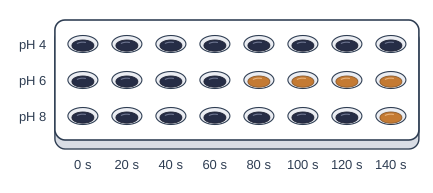
The diagram shows the spotting tile results. Blue-black shows that starch is present.

Calculate the rate of reaction at pH 6. Give your answer in s⁻¹.

Give a reason why the student could not calculate a rate of reaction at pH 4 from these results.

Diagram of a spotting tile with drops of iodine solution. A white spotting tile with 3 rows of 8 small hollows (wells), seen from slightly above. Each hollow is empty or holds a drop of iodine solution coloured orange-brown or blue-black; from left to right, row 1 (labelled "pH 4"): blue-black, blue-black, blue-black, blue-black, blue-black, blue-black, blue-black, blue-black; row 2 (labelled "pH 6"): blue-black, blue-black, blue-black, blue-black, orange-brown, orange-brown, orange-brown, orange-brown; row 3 (labelled "pH 8"): blue-black, blue-black, blue-black, blue-black, blue-black, blue-black, blue-black, orange-brown. The columns are labelled, from left to right: "0 s", "20 s", "40 s", "60 s", "80 s", "100 s", "120 s" and "140 s".

Model answer

At pH 6 the first sample that stayed orange-brown was at 80 s, so the starch took 80 s to be broken down.
Rate = 1 ÷ time = 1 ÷ 80 = 0.0125 s⁻¹
At pH 4 every sample, up to 140 s, turned the iodine blue-black, so the starch had not all been broken down and there is no end time to calculate a rate from.

Explanation

The time taken is the time of the first sample with no starch (orange-brown), and rate = 1 ÷ time gives a value in s⁻¹. At pH 4 the reaction had not finished when sampling stopped, so the time is only known to be more than 140 s. A common error is to use the time of the last blue-black sample (60 s).

Mark scheme
  1. 1 mark

    (time taken =) 80 (s) (1)

    An answer of 0.0125 or 0.013 s⁻¹ with no working scores marking points 1 and 2; accept 1 ÷ 80 seen for point 1; 0.017 / 0.0167 (1 ÷ 60, using the last sample that still contained starch) is wrong and scores 0 for points 1 and 2

  2. 1 mark

    (rate = 1 ÷ 80 =) 0.0125 (s⁻¹) (1)

    accept 0.013 / 1.25 × 10⁻² / any value that rounds to 0.013; 12.5 (1000 ÷ 80) does not score this point because the answer must be in s⁻¹

  3. 1 mark

    (at pH 4) the starch was not all broken down within 140 s / the iodine was still blue-black in the last sample, so there is no end time (1)

    accept the reaction did not finish / the student did not sample for long enough; ignore 'the amylase did not work at pH 4' unless linked to no end point being recorded

Question 4

4 marks

A scientist germinated maize grains in the dark. Every two days she dried some of the grains with their seedlings and measured their contents. Over the first 8 days, the mean values for one grain changed like this:
- the mass of starch stored in the grain fell from 200 mg to 50 mg
- the dry mass of the new root and shoot rose from 0 mg to 100 mg
- the total dry mass of the grain and seedling fell from 300 mg to 250 mg.

Explain these changes. In your answer, refer to the role of enzymes.

Model answer

Carbohydrases such as amylase break down the stored starch into sugars, so the mass of starch falls from 200 mg to 50 mg. The sugars are small, soluble molecules, so they can be transported to the growing root and shoot. There, other enzymes catalyse synthesis reactions that build large molecules from the sugars, such as cellulose for the walls of new cells, so the dry mass of the root and shoot rises to 100 mg.

Some of the sugar is used in respiration to release energy for growth. Respiration releases carbon dioxide and water, which are lost, and in the dark there is no photosynthesis to make new glucose, so the total dry mass falls by 50 mg. Without enzymes as catalysts, these breakdown and synthesis reactions would be far too slow for the seedling to grow.

Explanation

Follow the starch: enzymes break it down into sugars, which are moved to the growing parts and used either to build new molecules such as cellulose and proteins or in respiration. The total dry mass falls because the carbon dioxide released by respiration is lost and, in the dark, no photosynthesis replaces it. Saying the starch is used up without naming its breakdown into sugars, or giving the wrong products, does not earn the enzyme marks.

Mark scheme
  1. 1 mark

    amylase / carbohydrase enzymes break down the starch into sugars / glucose / maltose (1)

    An explanation linking four from the eight points; max 4. For 4 marks the answer must refer to enzymes (point 1, 3 or 8); otherwise max 3. Accept digest for break down. Do not accept starch broken down into amino acids or fatty acids.

  2. 1 mark

    the sugars are small / soluble molecules, so they can be transported to the growing root and shoot (1)

    accept the sugars move to the growing parts / to the embryo

  3. 1 mark

    enzymes join sugar / glucose molecules to make cellulose (for new cell walls) / join amino acids to make proteins (in the root and shoot) (1)

    a correct synthesis reaction is needed; accept starch or lipids made from smaller molecules

  4. 1 mark

    so new cells are made / the seedling grows, so the dry mass of the root and shoot increases (1)

    must be linked to building new molecules or new cells

  5. 1 mark

    some of the sugar is used in respiration to release energy (for growth / cell division) (1)

    do not accept respiration makes / produces energy

  6. 1 mark

    respiration releases carbon dioxide (and water), which is lost from the seedling, so the total dry mass falls (1)

    accept the mass is lost as carbon dioxide

  7. 1 mark

    in the dark there is no photosynthesis, so no new glucose / biomass is made to replace what is used (1)

    accept the seedling cannot make its own food in the dark

  8. 1 mark

    enzymes are (biological) catalysts / speed up the breakdown and synthesis reactions, which would be too slow without them (1)

    ignore enzymes help the reaction unless speeding it up is stated

Ready to try the rest? Every answer you write is marked against the mark scheme, so you can see exactly where the marks are.

Study Helper Hints first, answers after you try

Stuck on this one? Ask for a hint and I’ll point you in the right direction, without giving the answer away. Once you’ve checked your answer, I’ll show you how the marks are awarded.