
Level:
Correct: 0
Incorrect: 0
Marks: 0/0
Exam Practice
Course:
Topics:
Edexcel GCSE Biology (Paper 1) Smart practice A mixed round aimed at your weak spots
Unit 1
Key concepts in biology
Unit 2
Cells and control
Unit 3
Genetics
Unit 4
Natural selection and genetic modification
Unit 5
Health, disease and the development of medicines
Avg
score:
–
Topics
done:
0/38

Monohybrid inheritance and sex determination

Practise 19 exam-style questions on Monohybrid inheritance and sex determination for Edexcel GCSE Biology (Paper 1). Write your answer as you would in the exam and get it marked in seconds against the mark scheme, point by point, with the Study Helper on hand if you get stuck.

  • 19 questions
  • 1–6 marks each
  • Instant marking
  • No sign-up needed
19 questions, marked as you go

Sample questions with model answers

Here are 4 of the questions in this topic, each with a model answer, an explanation of why it earns the marks and the mark scheme an examiner would use.

Question 1

1 mark

In fruit flies, the allele for normal wings (V) is dominant to the allele for vestigial (short) wings (v).

A fly with the genotype Vv is crossed with a fly with the genotype vv.

What percentage of the offspring are expected to be heterozygous?

Choose your answer.

  • A 0%
  • B 25%
  • C 50%
  • D 75%

Model answer

C - 50%.

Explanation

The Vv fly makes V and v gametes and the vv fly makes only v gametes, so the offspring are Vv and vv in equal numbers: 50% heterozygous (normal wings) and 50% homozygous recessive (vestigial wings). Using the 3:1 pattern from a cross of two heterozygotes is the usual mistake.

Mark scheme
  1. 1 mark

    C / 50% (1)

    The only correct answer is C. The offspring are Vv, Vv, vv and vv, so 2 out of 4 are heterozygous. A is not correct because half of the offspring receive the V allele and so are Vv; B is not correct because 25% would be expected for one genotype from a cross of two heterozygous flies (Vv × Vv); D is not correct because 75% is the percentage with the dominant phenotype from Vv × Vv. Accept the letter or the option (accept 1/2 / 0.5 / 2 out of 4 as the option). If more than one option is given, do not award the mark.
Question 2

2 marks

Cystic fibrosis is caused by a recessive allele, f.

A woman has cystic fibrosis. Her partner is homozygous dominant (FF).

State the probability that their child will have cystic fibrosis. Explain your answer.

Model answer

The probability is 0. The woman is ff and can only pass on f, but her partner is FF, so every sperm carries F. Every child will be Ff: a carrier who does not have cystic fibrosis, because F is dominant.

Explanation

With an FF parent, every child receives at least one dominant allele, so no child can be ff. All the children will be heterozygous carriers. Students sometimes give 50% because one parent is affected, forgetting that the condition is recessive and needs an f allele from both parents.

Mark scheme
  1. 1 mark

    0 / 0% / no chance (1)

    accept 0/4 / 0 in 4 / none of their children will have cystic fibrosis; do not accept 25% / 50%

  2. 1 mark

    all the father's gametes / sperm contain F so every child is Ff (and F is dominant) (1)

    accept all the children will be carriers / heterozygous and will not have cystic fibrosis; accept a correct genetic diagram showing ff × FF gives only Ff; dependent on 0

Question 3

3 marks

In maize, the allele for purple kernels (P) is dominant to the allele for yellow kernels (p).

A student counted the kernels on a maize cob produced by crossing two plants that were both heterozygous (Pp). There were 381 purple kernels and 119 yellow kernels.

Calculate the percentage of kernels that were yellow.

Comment on how well this result agrees with the expected outcome of the cross.

Model answer

Percentage yellow = 119 ÷ 500 × 100 = 23.8%
Pp × Pp gives PP, Pp, Pp and pp, so 25% of kernels (1 in 4) are expected to be yellow (pp). 23.8% is very close to 25%, so the result agrees well with the expected 3 purple : 1 yellow ratio; the small difference is due to chance.

Explanation

Find the total number of kernels (500) first, then 119 ÷ 500 × 100 = 23.8%. A cross between two heterozygotes is expected to give 1 in 4 homozygous recessive offspring, so 23.8% is a close match to the expected 25%. A common error is to divide by the number of purple kernels instead of the total.

Mark scheme
  1. 1 mark

    119 ÷ (381 + 119) × 100 / 119 ÷ 500 × 100 (1)

    An answer of 23.8 or 24 % with no working scores marking points 1 and 2; the comment mark must be seen

  2. 1 mark

    23.8 (%) (1)

    accept 24 (%); do not award marks for 31.2 (%) (119 ÷ 381 × 100) or 76.2 (%) (the percentage of purple kernels)

  3. 1 mark

    it is close to the expected 25% (from Pp × Pp, 1 in 4 are pp) so it (largely) agrees / supports the expected 3:1 ratio (1)

    accept the expected ratio is 3:1 / 375 purple and 125 yellow and the result is close; accept a valid comparison using ecf from their percentage; do not accept 'it agrees exactly'

Question 4

5 marks

Albinism is caused by a recessive allele, a.

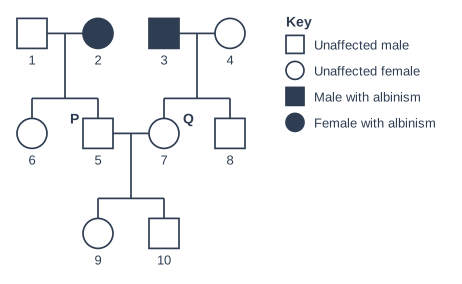
Figure 1 shows the inheritance of albinism in a family. Persons P and Q are planning to have another child.

Calculate the probability that their next child will be a girl with albinism.

Show how you work out your answer, including the genotypes of P and Q and how you know them.

Family tree with three generations. Squares are males and circles are females; horizontal lines join couples, and lines down from a couple lead to their children. The key shows: an unshaded square = Unaffected male; an unshaded circle = Unaffected female; a shaded square = Male with albinism; a shaded circle = Female with albinism. In the top row, person 1 (male, unshaded: unaffected) and person 2 (female, shaded: has albinism) are a couple; their two children in the second row, from left to right, are person 6 (female, unshaded: unaffected) and person 5 (male, unshaded: unaffected, marked with the letter P). In the top row, person 3 (male, shaded: has albinism) and person 4 (female, unshaded: unaffected) are a couple; their two children in the second row, from left to right, are person 7 (female, unshaded: unaffected, marked with the letter Q) and person 8 (male, unshaded: unaffected). Person 5 and person 7 are a couple; their two children in the third row, from left to right, are person 9 (female, unshaded: unaffected) and person 10 (male, unshaded: unaffected).

Model answer

P does not have albinism, but his mother (person 2) has albinism, so she is aa and must have passed an a allele to P. So P is Aa.
Q does not have albinism, but her father (person 3) has albinism (aa), so Q must also be Aa.
Aa × Aa gives AA, Aa, Aa, aa, so the probability of a child with albinism = 1/4.
The probability of a girl = 1/2.
Probability of a girl with albinism = 1/4 × 1/2 = 1/8 (0.125 or 12.5%)

Explanation

First use the pedigree to fix the genotypes: an unaffected person with an affected (aa) parent must be a heterozygous carrier. Then two carriers have a 1/4 chance of an aa child, and this is independent of the 1/2 chance of a girl, so the probabilities are multiplied. Their earlier unaffected children do not change the chance for the next child, and adding the probabilities is a common error.

Mark scheme
  1. 1 mark

    P is Aa because his mother (2) has albinism / is aa and P does not have albinism (1)

    the genotype and the reason are both needed; accept P must have received a from his mother

  2. 1 mark

    Q is Aa because her father (3) has albinism / is aa and Q does not have albinism (1)

    the genotype and the reason are both needed

  3. 1 mark

    (Aa × Aa so) probability of a child with albinism = 1/4 / 0.25 / 25% (1)

    accept 1 in 4; accept AA, Aa, Aa, aa shown

  4. 1 mark

    probability of a girl = 1/2 / 0.5 / 50% (1)

    accept 1 in 2; accept XX, XY shown

  5. 1 mark

    (1/4 × 1/2 =) 1/8 / 0.125 / 12.5% (1)

    accept 1 in 8; a correct answer of 1/8 with no working scores the last three marks; the first two marks need the genotypes with reasons; ecf from their probability of albinism × 1/2; do not accept 1/4 + 1/2 = 3/4; do not accept 1:8 or 1:7 (ratios, not probabilities)

Ready to try the rest? Every answer you write is marked against the mark scheme, so you can see exactly where the marks are.

Study Helper Hints first, answers after you try

Stuck on this one? Ask for a hint and I’ll point you in the right direction, without giving the answer away. Once you’ve checked your answer, I’ll show you how the marks are awarded.