
Level:
Correct: 0
Incorrect: 0
Marks: 0/0
Exam Practice
Course:
Topics:
Edexcel GCSE Biology (Paper 1) Smart practice A mixed round aimed at your weak spots
Unit 1
Key concepts in biology
Unit 2
Cells and control
Unit 3
Genetics
Unit 4
Natural selection and genetic modification
Unit 5
Health, disease and the development of medicines
Avg
score:
–
Topics
done:
0/38

Pathogens and the spread of infections

Practise 21 exam-style questions on Pathogens and the spread of infections for Edexcel GCSE Biology (Paper 1). Write your answer as you would in the exam and get it marked in seconds against the mark scheme, point by point, with the Study Helper on hand if you get stuck.

  • 21 questions
  • 1–6 marks each
  • Instant marking
  • No sign-up needed
20 questions, marked as you go

Sample questions with model answers

Here are 4 of the questions in this topic, each with a model answer, an explanation of why it earns the marks and the mark scheme an examiner would use.

Question 1

1 mark

Which method would reduce the spread of tuberculosis (TB) in a hospital ward?

Choose your answer.

  • A chlorinating the drinking water
  • B ventilating the ward
  • C using insecticide-treated nets
  • D draining standing water

Model answer

B - ventilating the ward.

Explanation

TB bacteria are airborne: they are spread in tiny droplets when an infected person coughs or sneezes. Ventilation removes and dilutes the droplets so fewer bacteria are breathed in by other people. The other options would reduce waterborne (cholera) or vector-borne (malaria) diseases.

Mark scheme
  1. 1 mark

    B / ventilating the ward (1)

    The only correct answer is B. A is not correct because TB is not spread in water (chlorinating water reduces the spread of cholera); C is not correct because TB has no insect vector (nets reduce the spread of malaria); D is not correct because draining water reduces the number of mosquitoes, which spread malaria, not TB. Accept the letter or the option. If more than one option is given, do not award the mark.
Question 2

2 marks

Tuberculosis (TB) is caused by bacteria that damage the lungs.

Explain why a person with severe TB may be short of breath, even when they are resting.

Model answer

The TB bacteria damage the lung tissue, so there are fewer alveoli and a smaller surface for gas exchange. Less oxygen is absorbed into the blood, so the person breathes faster and feels short of breath even at rest.

Explanation

Specification point 5.5 says tuberculosis causes lung damage. Link the damage to the gas exchange surface and then to less oxygen getting into the blood. Saying only that 'the lungs are damaged' repeats the question and does not gain the first mark: link the damage to the alveoli and the gas exchange surface.

Mark scheme
  1. 1 mark

    lung tissue / alveoli are damaged, so there is a smaller surface for gas exchange (1)

    An explanation linking: accept 'fewer alveoli' / 'less surface area for oxygen to diffuse into the blood'. Ignore 'the lungs are damaged' unqualified (it repeats the question). Accept 'the airways or lungs are partly filled with mucus / fluid'.

  2. 1 mark

    so less oxygen is absorbed into the blood (so the person breathes faster) (1)

    Accept 'less oxygen reaches the cells' / 'not enough oxygen for respiration'. Ignore 'cannot breathe' unqualified.

Question 3

3 marks

Tuberculosis (TB) usually affects the lungs, but it can also affect other organs, such as the kidneys.

Explain why a person with TB in the lungs is much more likely to pass TB on to other people than a person with TB only in the kidneys.

Model answer

TB is spread through the air. When a person with TB in the lungs coughs, sneezes or talks, they release tiny droplets containing TB bacteria into the air, and other people breathe these droplets in. TB bacteria in the kidneys are not breathed out into the air, so they are very unlikely to reach other people.

Explanation

This applies specification point 5.6: TB is an airborne disease, so it spreads only when the bacteria get into the air from the airways. A common error is to give general ways to stop the spread instead of explaining why the site of the infection matters.

Mark scheme
  1. 1 mark

    TB bacteria in the lungs are released into the air when the person coughs / sneezes / speaks (1)

    An explanation linking the three points. Accept 'TB is airborne / spread in droplets from the lungs'.

  2. 1 mark

    other people breathe in the droplets containing the bacteria (1)

    Accept 'inhale the bacteria'. Ignore 'catch it from the air' unqualified.

  3. 1 mark

    bacteria in the kidneys are not released into the air / are not breathed out (1)

    Accept ORA. Ignore 'kidneys are inside the body' unqualified (so are the lungs).

Question 4

4 marks

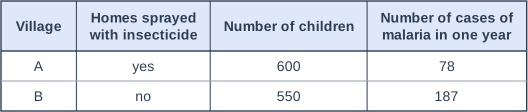
Scientists compared two villages, A and B, in a region where malaria is common. In village A, the inside walls of every home were sprayed with insecticide. In village B, the homes were not sprayed.

The table shows the number of children in each village and the number of cases of malaria in the children in one year.

Calculate the number of cases of malaria per 1000 children in each village.

Evaluate whether spraying with insecticide reduced the number of cases of malaria.

Table with columns "Village", "Homes sprayed with insecticide", "Number of children", "Number of cases of malaria in one year". Village: A; Homes sprayed with insecticide: yes; Number of children: 600; Number of cases of malaria in one year: 78 | Village: B; Homes sprayed with insecticide: no; Number of children: 550; Number of cases of malaria in one year: 187.

Model answer

Village A: 78 ÷ 600 × 1000 = 130 cases per 1000 children
Village B: 187 ÷ 550 × 1000 = 340 cases per 1000 children

The sprayed village had 210 fewer cases per 1000 children, less than half as many as the unsprayed village, so spraying appears to have reduced malaria by killing mosquitoes that rest on the walls. However, only two villages were compared for one year, and they may differ in other ways, such as the amount of standing water nearby or the use of bed nets, so we cannot be sure the spraying caused all of the difference.

Explanation

Because the villages have different numbers of children, the raw numbers of cases cannot be compared fairly; converting to cases per 1000 children (number ÷ total × 1000) gives a fair comparison. An evaluation needs a judgement supported by the data and a limitation, such as other differences between the villages. A common error is to compare 78 with 187 directly.

Mark scheme
  1. 1 mark

    village A: 78 ÷ 600 × 1000 = 130 (1)

    Answers of 130 (village A) and 340 (village B) cases per 1000 children with no working score marking points 1 and 2. Accept 0.13 × 1000. Award 1 mark max for both calculations if both answers are given as cases per child (0.13 and 0.34) or as percentages (13% and 34%).

  2. 1 mark

    village B: 187 ÷ 550 × 1000 = 340 (1)

    See marking point 1.

  3. 1 mark

    there were fewer cases per 1000 children in the sprayed village, so spraying appears to have reduced malaria (1)

    Allow ecf from their calculated values. Accept a correct comparison, e.g. 210 fewer cases per 1000 children / less than half as many / about 62% fewer. Ignore a comparison of the raw numbers of cases (78 and 187) alone, as the villages have different numbers of children.

  4. 1 mark

    but the villages may differ in other ways (e.g. amount of standing water / use of nets / number of mosquitoes), so the difference may not be caused by the spraying (1)

    Accept 'only two villages / only one year were studied, so the conclusion may not be valid / more villages are needed'. Accept 'the villages were not compared before spraying'.

Ready to try the rest? Every answer you write is marked against the mark scheme, so you can see exactly where the marks are.

Study Helper Hints first, answers after you try

Stuck on this one? Ask for a hint and I’ll point you in the right direction, without giving the answer away. Once you’ve checked your answer, I’ll show you how the marks are awarded.