
Level:
Correct: 0
Incorrect: 0
Marks: 0/0
Exam Practice
Course:
Topics:
Edexcel GCSE Biology (Paper 1) Smart practice A mixed round aimed at your weak spots
Unit 1
Key concepts in biology
Unit 2
Cells and control
Unit 3
Genetics
Unit 4
Natural selection and genetic modification
Unit 5
Health, disease and the development of medicines
Avg
score:
–
Topics
done:
0/38

Evolution by natural selection and resistance

Practise 15 exam-style questions on Evolution by natural selection and resistance for Edexcel GCSE Biology (Paper 1). Write your answer as you would in the exam and get it marked in seconds against the mark scheme, point by point, with the Study Helper on hand if you get stuck.

  • 15 questions
  • 1–6 marks each
  • Instant marking
  • No sign-up needed
15 questions, marked as you go

Sample questions with model answers

Here are 4 of the questions in this topic, each with a model answer, an explanation of why it earns the marks and the mark scheme an examiner would use.

Question 1

1 mark

Rabbits in a population vary in the thickness of their fur. Fur thickness is an inherited characteristic.

A series of very cold winters kills many of the rabbits.

Which rabbits are most likely to survive and pass on their alleles to the next generation?

Choose your answer.

  • A rabbits with the thinnest fur
  • B the fastest rabbits
  • C the youngest rabbits
  • D rabbits with the thickest fur

Model answer

D - rabbits with the thickest fur.

Explanation

In natural selection the individuals best adapted to the particular selection pressure survive and reproduce. Here the pressure is cold, so rabbits with inherited thick fur keep warm, survive and pass on the alleles for thick fur. 'Survival of the fittest' means best suited to the environment, not the strongest or fastest.

Mark scheme
  1. 1 mark

    D / rabbits with the thickest fur (1)

    The only correct answer is D. A is not correct because rabbits with thin fur lose more heat and are less likely to survive the cold. B is not correct because the selection pressure is the cold, so the characteristic that matters is fur thickness; speed does not keep a rabbit warm - 'fittest' does not mean fastest or strongest, a common misconception about natural selection. C is not correct because age is not an inherited characteristic and does not help a rabbit survive the cold. Accept the letter or the option. If more than one option is given, do not award the mark.
Question 2

2 marks

A student wrote this statement.

'Bacteria become resistant because the antibiotic changes their DNA so that they can survive it.'

Explain why the student's statement is not correct.

Model answer

The antibiotic does not change the bacteria's DNA. Resistance comes from a random mutation that was already present in a few bacteria before the antibiotic was used. The antibiotic acts as a selection pressure: it kills the non-resistant bacteria, so only the resistant bacteria survive and reproduce.

Explanation

This is the most common misconception about resistance. Mutations are random; the antibiotic only selects which bacteria survive. Natural selection acts on variation that already exists - it does not create the variation.

Mark scheme
  1. 1 mark

    resistance is caused by a (random) mutation that happens whether or not the antibiotic is present / the allele for resistance is already present in some bacteria before the antibiotic is used (1)

    An explanation linking the two points. Accept 'the antibiotic does not cause the mutation' only if linked to the idea that the mutation is random or already present. Ignore 'the bacteria adapt'.

  2. 1 mark

    the antibiotic kills the non-resistant bacteria so only the resistant bacteria survive (and reproduce) / the antibiotic acts as a selection pressure (1)

    Accept 'the antibiotic selects the resistant bacteria'. Do not accept 'the bacteria become immune'.

Question 3

3 marks

One bacterium of a strain that is resistant to an antibiotic survives in a patient's wound.

In ideal conditions, this strain of bacteria divides once every 20 minutes. Each division doubles the number of bacteria.

Calculate the shortest time it would take for this one bacterium to produce a population of more than one million (1 × 10⁶) bacteria, if all the bacteria keep dividing and none die.

Give your answer in hours and minutes.

Model answer

After n divisions there are 2ⁿ bacteria.
2¹⁹ = 524 288, which is less than 1 × 10⁶
2²⁰ = 1 048 576, which is more than 1 × 10⁶
So 20 divisions are needed.
Time = 20 × 20 = 400 minutes = 6 hours 40 minutes

Explanation

Each division doubles the number of bacteria, so one bacterium becomes 2ⁿ bacteria after n divisions. Find the smallest n for which 2ⁿ is more than 1 × 10⁶ (n = 20), multiply by the 20 minutes each division takes, then convert 400 minutes into hours and minutes. Common errors are dividing 1 000 000 by 2 instead of doubling, and writing 400 minutes as 6.4 hours. The short time shows why one surviving resistant bacterium can quickly produce a large resistant population.

Mark scheme
  1. 1 mark

    (number of divisions needed =) 20, because 2²⁰ = 1 048 576 is more than 1 × 10⁶ (and 2¹⁹ = 524 288 is not) (1)

    An answer of 6 hours 40 minutes with no working scores 3 marks. Accept 20 divisions seen, or 2²⁰ / 1 048 576 / 1.05 × 10⁶ seen. Accept repeated doubling (1, 2, 4, 8 ... 1 048 576) as the method. Do not award this mark for 1 × 10⁶ ÷ 2 = 500 000 (the number doubles at each division).

  2. 1 mark

    (time =) 20 × 20 = 400 (minutes) (1)

    ecf: their number of divisions × 20 minutes. Accept 6.67 hours / 6⅔ hours for this mark.

  3. 1 mark

    6 hours 40 minutes (1)

    This mark is for the time given in hours and minutes. Accept 6 h 40 min however written. ecf: their time in minutes correctly converted into hours and minutes. 6.67 hours scores 2 marks only. Do not accept 6.4 hours or 6 hours 4 minutes (400 minutes is 6 hours and 40 minutes).

Question 4

4 marks

Scientists studied a population of seed-eating birds on an island. They measured the beak depth of every bird. Birds with deeper beaks can crack larger, harder seeds. Beak depth is inherited.

Then there was a drought. The plants that produce small, soft seeds died, so most of the seeds left were large and hard. Most of the birds died during the drought.

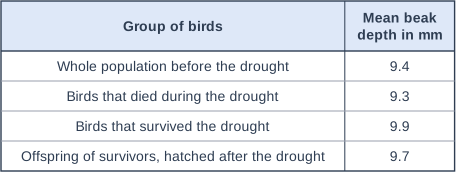
The table shows the scientists' results.

Explain how these data support the idea that natural selection took place in this population.

Table with columns "Group of birds", "Mean beak depth in mm". Group of birds: Whole population before the drought; Mean beak depth in mm: 9.4 | Group of birds: Birds that died during the drought; Mean beak depth in mm: 9.3 | Group of birds: Birds that survived the drought; Mean beak depth in mm: 9.9 | Group of birds: Offspring of survivors, hatched after the drought; Mean beak depth in mm: 9.7.

Model answer

The drought killed the plants with small, soft seeds, so there was a shortage of food the birds could eat - a selection pressure. Birds with deeper beaks could crack the large, hard seeds, so they were more likely to survive: the survivors had a mean beak depth of 9.9 mm, compared with 9.3 mm for the birds that died. The survivors reproduced and passed on the alleles for deeper beaks, so their offspring had a mean beak depth of 9.7 mm, greater than the 9.4 mm of the population before the drought.

Explanation

The data show each step of natural selection: the survivors differ from the birds that died (selection), and the next generation differs from the original population (inheritance and change in the population). The best answers quote the data to support each step. Saying the birds' beaks grew bigger to cope with the seeds gains no credit: individual birds do not change their inherited beak depth - the population changes because of who survives and breeds.

Mark scheme
  1. 1 mark

    (during the drought) there was a shortage of small soft seeds / only large hard seeds were available - a selection pressure (1)

    An explanation linking four from the five points; max 4. Accept 'competition for food'.

  2. 1 mark

    birds with deeper beaks could crack / eat the large hard seeds (1)

    Accept 'deeper beaks are an advantage'.

  3. 1 mark

    so birds with deeper beaks were more likely to survive: survivors had a mean beak depth of 9.9 mm compared with 9.3 mm for the birds that died (1)

    The comparison of survivors and the birds that died is needed for this mark; data are not required but the comparison must be correct. Ignore 'only birds with deep beaks survived'.

  4. 1 mark

    the survivors reproduced and passed on the alleles for deeper beaks (1)

    Accept 'beak depth was inherited by the offspring'.

  5. 1 mark

    the offspring had a greater mean beak depth (9.7 mm) than the population before the drought (9.4 mm) / the population changed (1)

    Accept 'the next generation had deeper beaks'. Ignore 'the birds' beaks grew deeper'.

Ready to try the rest? Every answer you write is marked against the mark scheme, so you can see exactly where the marks are.

Study Helper Hints first, answers after you try

Stuck on this one? Ask for a hint and I’ll point you in the right direction, without giving the answer away. Once you’ve checked your answer, I’ll show you how the marks are awarded.